
Kohaku
Key facts: Kohaku (紅白) is a koi variety with red (hi, 緋) markings on a white body (shiroji, 白地), considered one of the foundational nishikigoi varieties and a member of the Gosanke (御三家) group alongside Taisho Sanshoku and Showa Sanshoku.[1][2]
Colors:
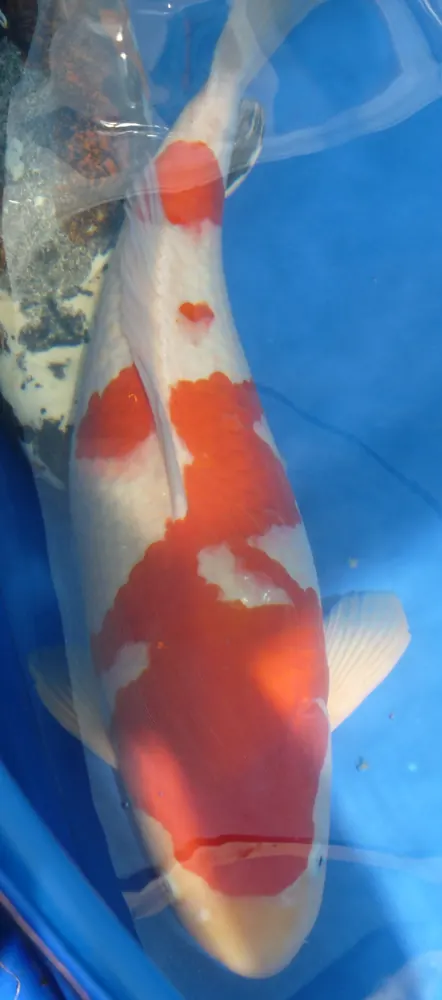
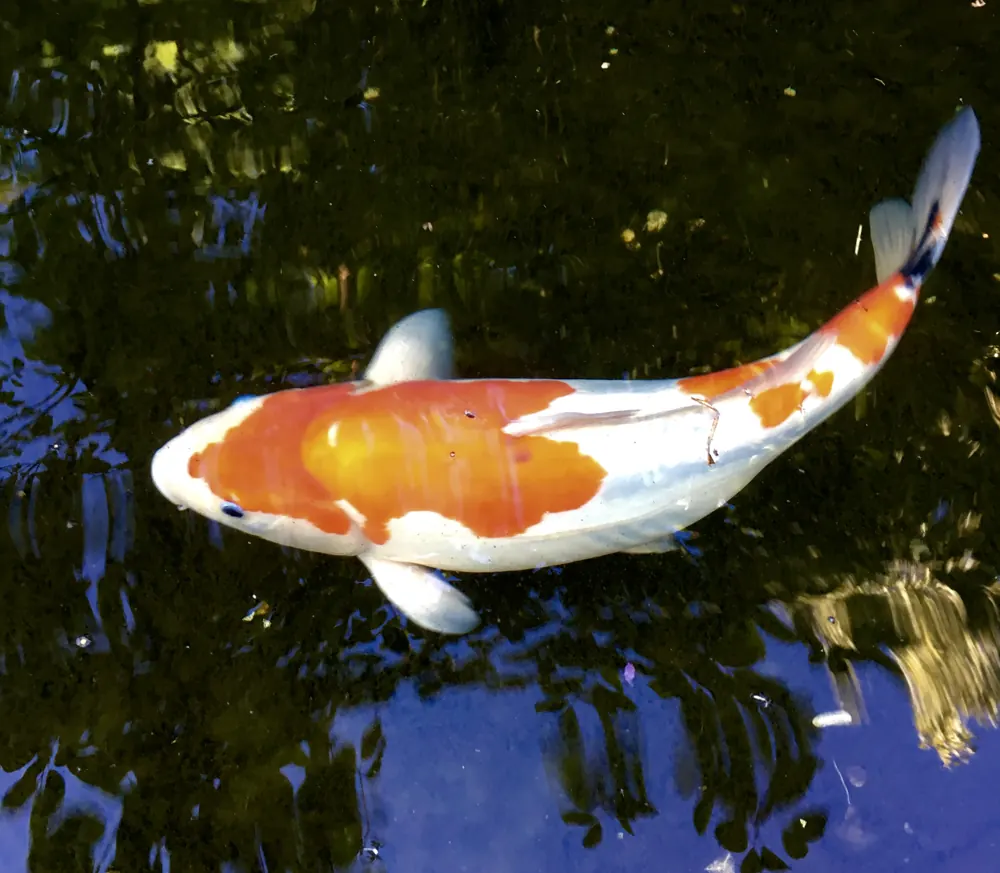
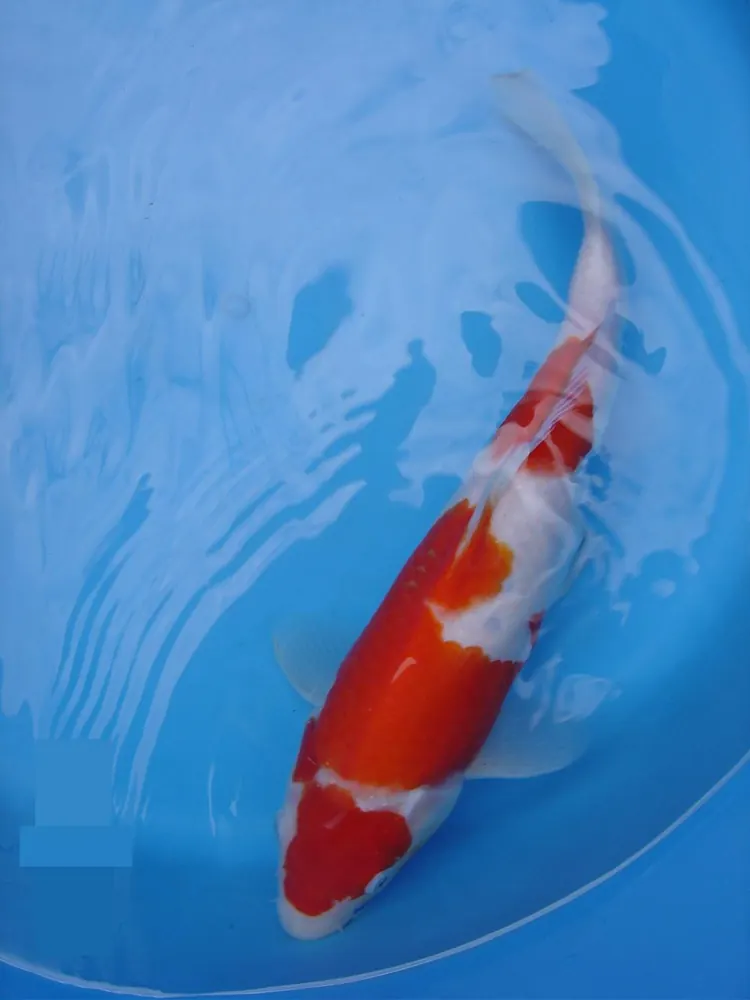
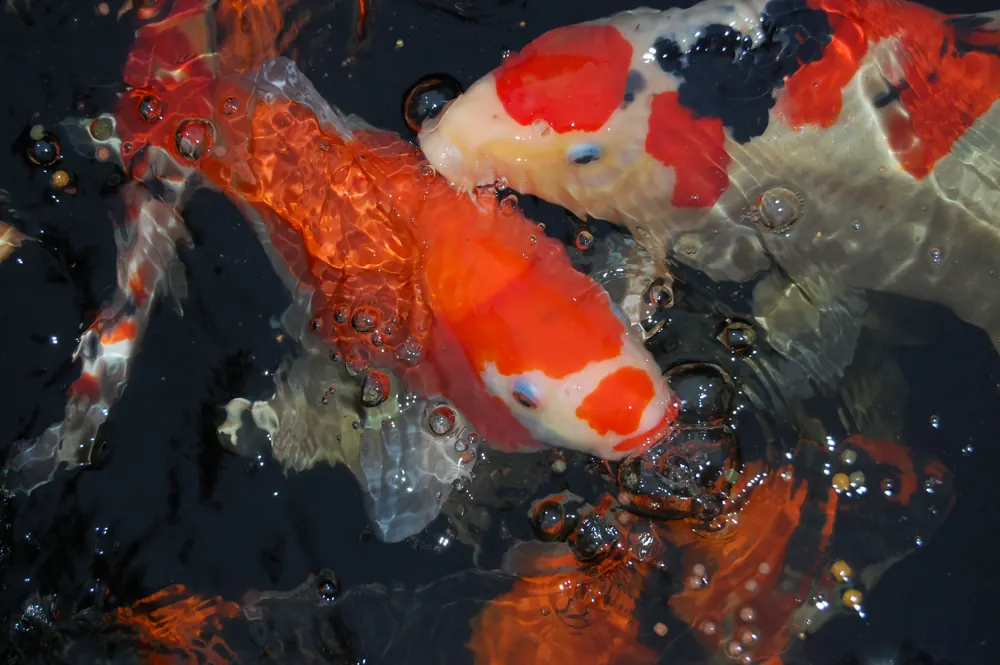
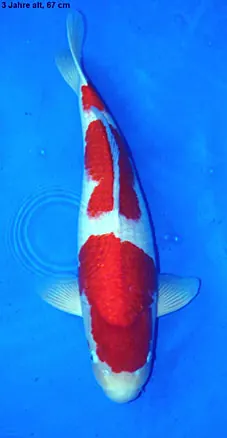
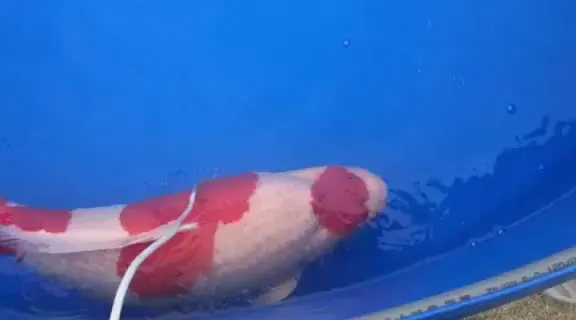
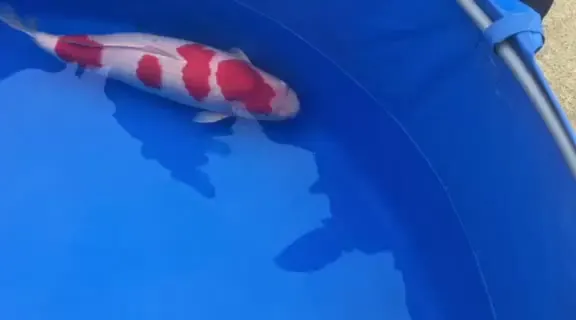
Kohaku is defined by Japanese Agricultural Standard (JAS) No. 2001 as a koi with a white skin ground (shiroji) carrying red or scarlet imprints called hiban across the body.[5][1] According to the Zen Nippon Airinkai (ZNA), Kohaku has red markings on a white skin ground and is considered representative of nishikigoi, sometimes called the “King of the Nishikigoi.”[9]The All Japan Nishikigoi Promotion Association notes that although Kohaku's color scheme of white and red is simple, the impression it creates is diverse, and it is said that “the viewing of koi begins with Kohaku and ends with Kohaku.”[1] Kohaku with a clear white background, dark and bright red imprints, and a sharp boundary between red and white (kiwa) are considered excellent.[1]- hi (red)
- shiroji (white ground)
History and origin
According to a secondary source, Wikipedia, Kohaku was one of the first ornamental koi varieties established in Japan, dating to the late 19th century.[6] A separate Wikipedia article on the Kohaku variety states that it dates to 1888, when Kunizo Hiroi bred a red-headed female koi with one of his own males whose markings resembled cherry blossoms, creating the now-extinct Gosuke bloodline from which known Kohaku bloodlines descend, including Tomoin, Sensuke, Yagozen and Manzo; today the Tomoin and Yagozen lines are described as the two remaining major bloodlines in Japan.[3] The American Koi Judges Association (AKJA) glossary lists Manzo and Sensuke as named Kohaku bloodlines.[10]According to Kodama Koi Farm, a US koi importer, red-on-white koi existed around 200 years ago but were originally called “Sarasa,” after a traditional dyed textile, with the name spontaneously shifting to “Kohaku” sometime after the Second World War, for reasons the farm states are unknown.[11] The same dealer source states Kohaku breeding was perfected by dedicated breeders in Niigata.[11] The Japanese Wikipedia history of nishikigoi states that in 1889 (Meiji 22), Kunizo Hiroi of Ranboku (present-day Ojiya) produced the “Gosuke Sarasa,” said to be the origin of the modern Kohaku.[12]Judging points
- Shiroji (white ground) should be snow-white and is considered as important as the red pattern.[11]
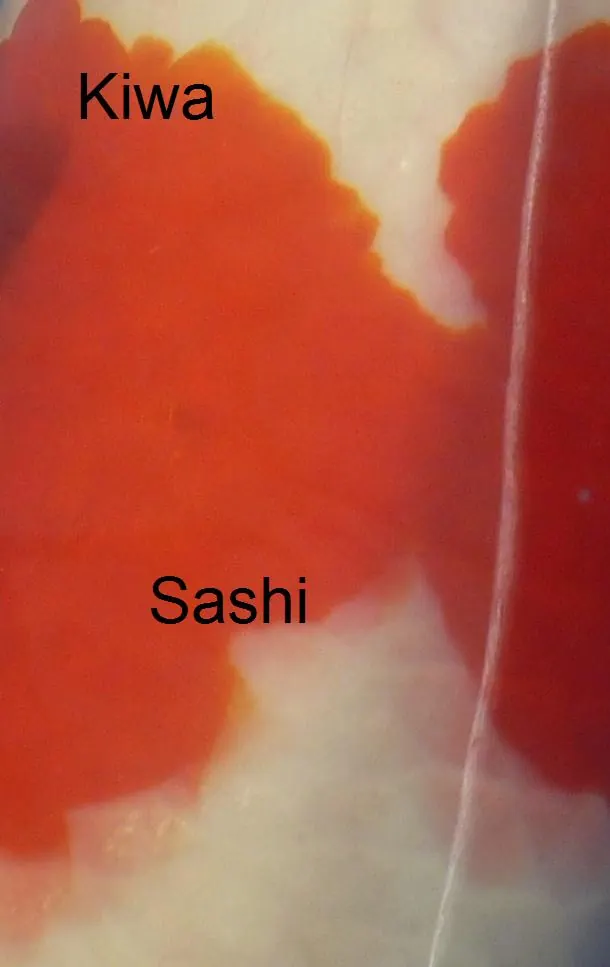
- Kiwa, the back edge of a hi marking, should be sharp where it meets the white ground.[13]
- Sashi should be about one scale wide and run parallel to the kiwa.[14]
- Balance between head red (toh hi) and tail-section red (odome hi) is considered important.[11]
- Hi should be even in color across the body, without white scales within the marking or uneven coloring (hi mura).[3][13]
- Eye coloration is also taken into account during evaluation.[11]
Appearance and standard definition
JAS No. 2001 defines Kohaku as having a white skin ground with red or scarlet imprints (hiban) distributed across the body.[5] The AKJA glossary similarly defines Kohaku simply as “white koi with red markings.”[10]According to Kodama Koi Farm, the white ground (shiroji) is considered as important as the red or black patterning on any variety, and should be snow-white; fukurin, a net-like pattern that can appear around mature scales, is said to add further beauty.[11] The red pattern (hi) should end on the tail section at a boundary called odome, and the appearance of this odome hi can strongly affect a fish's value.[11] Thicker hi is generally preferred, though extreme redness does not necessarily indicate thickness, and hi tends to thicken as a koi grows.[11] Hi coloration is said to depend on carotene pigment absorbed from food.[11] It is also considered desirable for the hi pattern to wrap below the lateral line, called maki, and for head red (toh hi) to balance the tail red (odome hi).[11]Per the Wikipedia article on the variety, hi should be bright and even in color across the body, should not contain white scales within it (considered a serious fault), and markings should be balanced though not strictly symmetrical; the edges of the hi are described as never as sharp near the head as near the tail.[3] Terms described there include odome (the white area between the last body marking and the tail, ideally around 2 cm), zubonhaki (a fault where hi wraps around the tail), makibara (hi wrapping the belly), and kuchibeni (hi covering the mouth, “lipstick,” usually a fault in Japan).[3]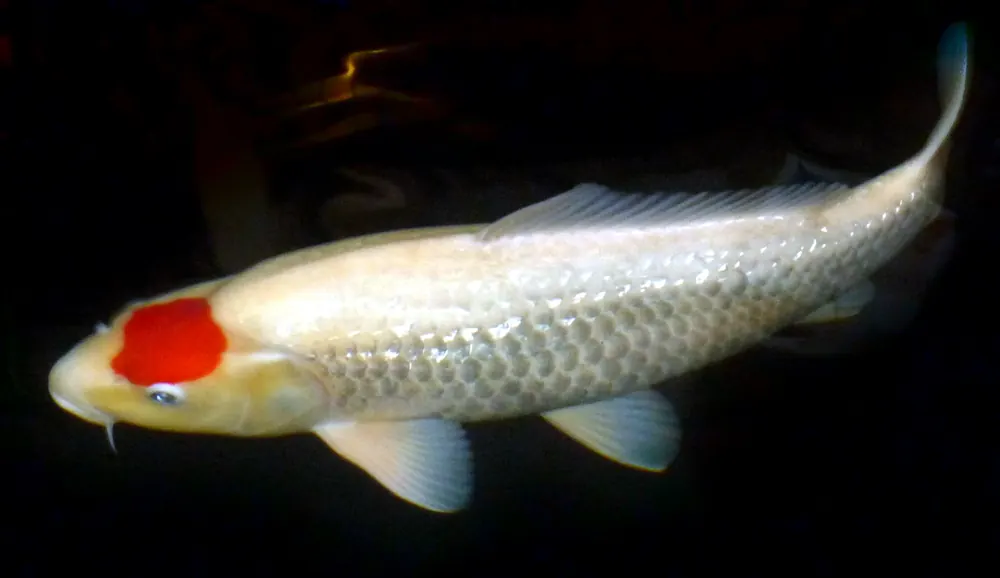

Kohaku pattern names
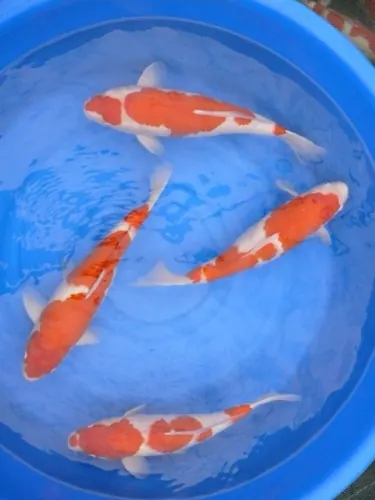
- Nidan: a Kohaku with two separate hi markings (a two-step pattern).[10][3][11]Sandan: three separate hi markings (a three-step pattern).[10][3][11]Yondan: four separate hi markings; per Wikipedia, a Kohaku with more than four markings is instead classed as komoyo and of lesser value.[3][11]Inazuma: a lightning-bolt, zigzag hi marking running the length of the body; per Wikipedia, the name originated from a 1970 All Nippon Show-winning fish with this pattern.[9][10][3]Maruten: an independent round hi marking on the head together with separate hi markings on the body; distinguished from Tancho, which has only the head spot.[9][10]Straight hi (ippon hi): a single continuous hi marking without separation; the AKJA glossary defines ippon hi as “a continuous pattern, without variation.”[9][10]Menkaburi: most of the head is covered (“blanketed”) by a hi marking, which ZNA describes as giving an ungraceful impression; the AKJA glossary calls it an early ancestor form of Kohaku meaning “hood.”[9][10]Kuchibeni: a small hi marking on the lip, described by ZNA as “lipstick”; Wikipedia notes it is usually considered a fault in Japan.[9][3]
Judging Kohaku
According to Kodama Koi Farm, Kohaku judging emphasizes the balance between toh hi (head red) and odome hi (tail-section red boundary), noting that koi with this balance can appear beautiful even to untrained viewers.[11] Eye coloration is also said to influence evaluation.[11] The same source states the white ground (shiroji) should be snow-white and is as important as the red pattern.[11]ZNA terminology distinguishes kiwa (the back edge of a hi marking at the border with white, where a sharp kiwa is preferable), sashi (faint red at the front edge of a hi marking caused by white scales overlapping red ones, where a one-scale-wide sashi is considered good but wider or uneven sashi is not), and hi mura (uneven coloring within the hi, considered poor quality).[13] Kodama Koi Farm similarly states that sashi should run parallel to kiwa and ideally extend no more than one scale width.[14]Subtypes, Tancho and related variations
ZNA lists numerous Kohaku variations by hi-marking shape, including Kuchi-beni, Maruten, Men-kaburi, Hana-tsuki (a head marking touching the nose tip), Inazuma, Ippon-hi, and dan-mono groupings (Nidan, Sandan, Yondan).[9] It also lists Tancho Kohaku, with only an independent round hi on the forehead, and notes that all-white (Shiro-muji) or all-red (Aka-muji) culls are usually removed at first culling, as they are classified under Mujimono.[9]The JNPA describes Tancho as having only one red, round pattern on the head, named after the Tancho crane, and notes that if the body also carries a pattern the fish is instead called Maruten or Komaruten rather than Tancho.[15] Kodama Koi Farm describes Tancho Kohaku, Tancho Showa and Tancho Goshiki as having a well-proportioned round hi marking confined to the head, with a sharp edge and deep red color, named for the red-crowned crane associated with good fortune in Japan.[16]Kanoko Kohaku is a variant with dappled red markings, per the AKJA glossary, and the JNPA's description of Kawarigoi lists Kanoko-kohaku as having part of its scales dyed red in a dotted pattern across a white body, which may or may not include additional scarlet imprints.[10][17] Gotenzakura Kohaku is described by the AKJA glossary as a “cherry blossom patterned Kohaku.”[10]Scale forms: Doitsu and Ginrin
The ZNA classification used for its International Koi Show lists Doitsu Kohaku as a recognized form within the Kohaku class, alongside standard-scaled Kohaku.[4] It also lists Ginrin Kohaku under a dedicated Kinginrin 1 class for Gosanke varieties.[4] JAS similarly defines A-ginrin and B-ginrin categories for koi whose scales shine gold or silver in the red or white areas respectively, among koi with the appearance characteristics of Kohaku, Taisho Sanshoku or Showa Sanshoku.[5]Classification at shows
Kohaku (including Doitsu Kohaku) forms its own class, Class 1, in the ZNA classification used for the 2026 ZNA America Koi Show, separate from Taisho Sanshoku, Showa Sanshoku and Utsurimono.[4] JAS lists Kohaku as entry No. 2001 under its variety vocabulary, defined by a white ground with red or scarlet imprints.[5] Kodama Koi Farm groups Kohaku together with Taisho Sanke and Showa as the Gosanke, the three most popular koi varieties, noting that any variety containing red patterns is evaluated with reference to Kohaku pattern quality.[11][2]How Kohaku differs from similar varieties
Taisho Sanshoku (Sanke) closely resembles Kohaku but adds small black sumi markings; Kodama Koi Farm states Sanke generally lack black on the head, distinguishing it from Showa.[6][18] Showa Sanshoku is described by Wikipedia as a black koi with red and white markings, genetically related to Utsurimono patterns but with both red and white present.[6] Tancho Kohaku, by contrast to a Maruten Kohaku, has only the single head spot and no body hi.[15][9] Goshiki, created by breeding Asagi with Kohaku according to Kodama Koi Farm, carries a Kohaku-like red pattern overlaid with a netted blue-gray reticulation.[7] Koromo varieties are described by Kodama Koi Farm as having a Kohaku-style hi pattern overlaid with indigo-blue markings on each red scale.[8]Images
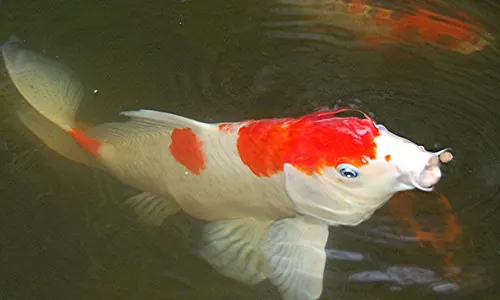

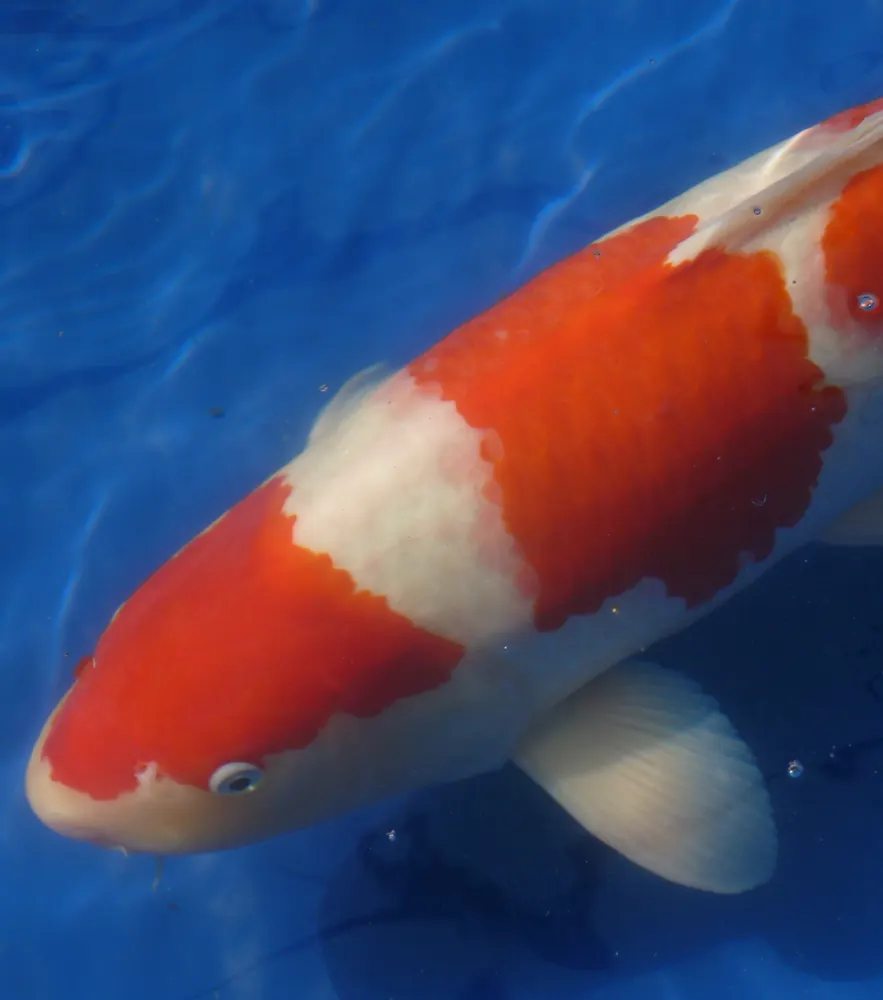

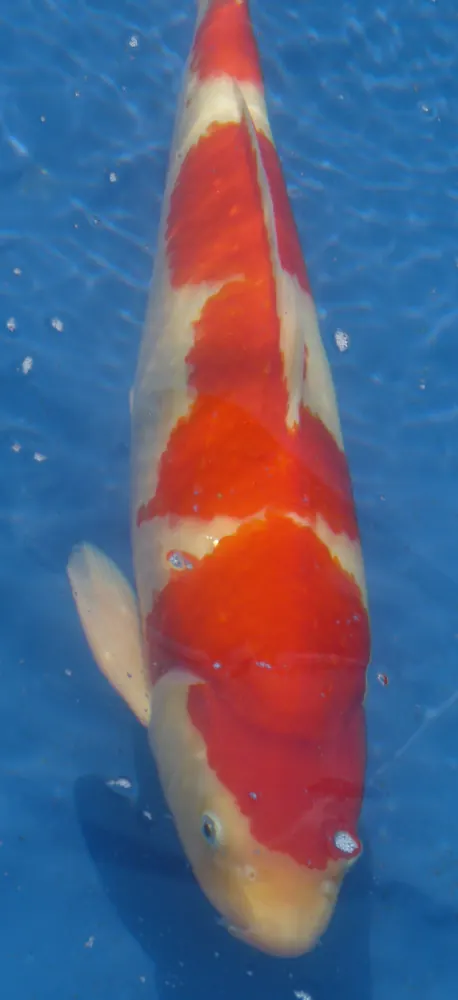











Common questions
What does the name Kohaku refer to?
Is Kohaku part of the Gosanke?
Yes. Kohaku is one of the three Gosanke varieties, along with Taisho Sanke and Showa Sanshoku, according to Kodama Koi Farm.[2]
What is the difference between Nidan, Sandan and Inazuma Kohaku?
What is a Maruten Kohaku?
What are shiroji, kiwa and sashi in Kohaku judging?
Related koi topics
References
- ^ Kohaku - Variety - All Japan Nishikigoi Promotion Association. All Japan Nishikigoi Promotion Association. jnpa.info/en/nishikigoi/varieties/type/kohaku/. Retrieved November 2026.
- ^ All About Gosanke Koi Fish Varieties "The Big Three!". Kodama Koi Farm (koi dealer). kodamakoifarm.com/gosanke-koi-fish/. Retrieved November 2026.
- ^ Kōhaku (fish) (Wikipedia). Wikipedia. en.wikipedia.org/wiki/Kohaku_(fish). Retrieved November 2026.
- ^ Koi classification (ZNA 2021), NMZNA 2026 show documents. nmzna.net. nmzna.net/2026%20Show%20Docs/NMZNA%202026%20Koi%20Classification%20…. Retrieved November 2026.
- ^ JAS 0020 Nishikigoi. Vocabulary (MAFF) — Ministry of Agriculture, Forestry and Fisheries (Japan). maff.go.jp/j/jas/jas_standard/attach/pdf/index-536.pdf. Retrieved November 2026.
- ^ Koi (Wikipedia). Wikipedia. en.wikipedia.org/wiki/Koi. Retrieved November 2026.
- ^ Goshiki - Koi for Sale - Kodama Koi Farm. Kodama Koi Farm (koi dealer). kodamakoifarm.com/variety/goshiki/. Retrieved November 2026.
- ^ Koromo - Koi For Sale - Kodama Koi Farm. Kodama Koi Farm (koi dealer). kodamakoifarm.com/variety/koromo/. Retrieved November 2026.
- ^ KOHAKU | Zen Nippon Airinkai. Zen Nippon Airinkai. zna.jp/en/keep-nishikigoi/varieties-of-nishikigoi/kohaku/. Retrieved November 2026.
- ^ Glossary – American Koi Judges Association (AKJA). American Koi Judges Association. akjajudges.com/glossary/. Retrieved November 2026.
- ^ Kohaku - Koi for Sale and History - Kodama Koi Farm. Kodama Koi Farm (koi dealer). kodamakoifarm.com/variety/kohaku/. Retrieved November 2026.
- ^ ニシキゴイ (Wikipedia). Wikipedia (Japanese). ja.wikipedia.org/wiki/錦鯉. Retrieved November 2026.
- ^ NISHIKIGOI TERMINOLOGY 2 HI and HI MARKINGS | Zen Nippon Airinkai. Zen Nippon Airinkai. zna.jp/en/keep-nishikigoi/nishikigoi-terminology/nishikigoi-termino…. Retrieved November 2026.
- ^ Koi Patterns and Markings: A Guide to Their Meaning, Types, and Selection. Kodama Koi Farm (koi dealer). kodamakoifarm.com/koi-patterns-and-markings/. Retrieved November 2026.
- ^ Tancho - Variety - All Japan Nishikigoi Promotion Association. All Japan Nishikigoi Promotion Association. jnpa.info/en/nishikigoi/varieties/type/tancho/. Retrieved November 2026.
- ^ Tancho - Koi For Sale - Kodama Koi Farm. Kodama Koi Farm (koi dealer). kodamakoifarm.com/variety/tancho/. Retrieved November 2026.
- ^ Kawarigoi - Variety - All Japan Nishikigoi Promotion Association. All Japan Nishikigoi Promotion Association. jnpa.info/en/nishikigoi/varieties/type/kawarigoi/. Retrieved November 2026.
- ^ Taisho Sanke - Koi For Sale - Kodama Koi Farm. Kodama Koi Farm (koi dealer). kodamakoifarm.com/variety/taisho-sanke/. Retrieved November 2026.