
Tancho
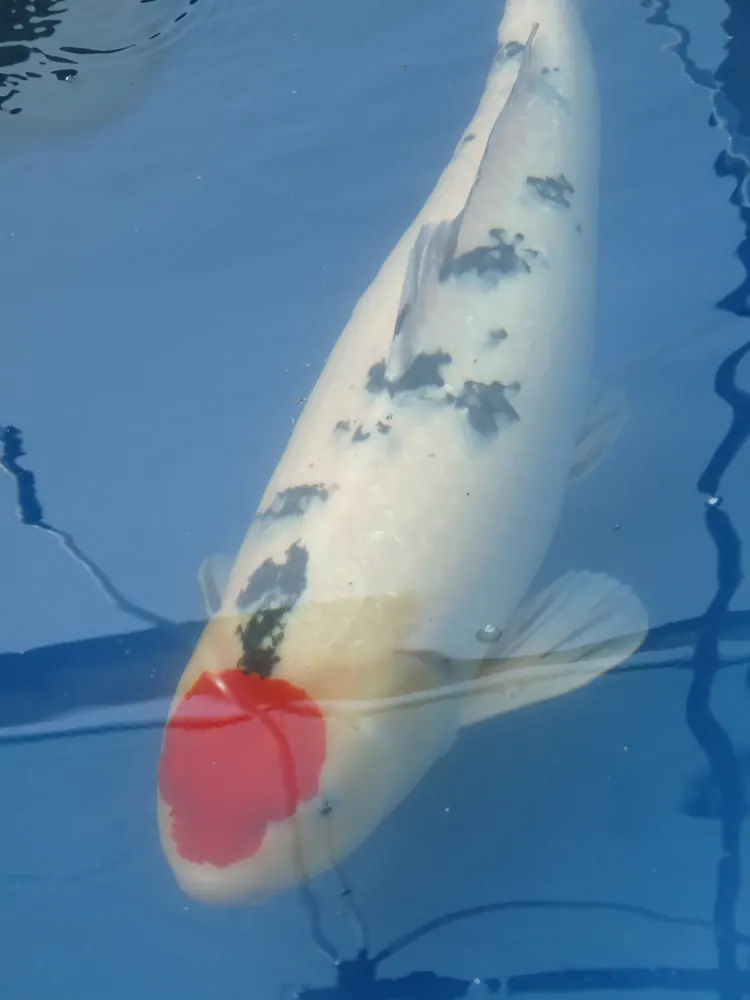
Key facts: Tancho (丹頂) is not a single variety but a pattern classification: a koi with one round, or almost round, red (hi) marking on the head and no other hi anywhere else on the body [1]. It is applied across several ground varieties, including Tancho Kohaku, Tancho Sanke, Tancho Showa and Tancho Goshiki[2].
Colors:
Tancho takes its name from the Tancho crane (丹頂鶴), a red-crowned crane, because the single circular red mark on an otherwise white head recalls the bird’s crown[2]. The pattern is popular partly because it is reminiscent of the Japanese national flag[1][2].Because Tancho describes a head pattern rather than a body-color scheme, it can occur on several underlying varieties, most commonly Kohaku, Sanke, Showa and Goshiki[2].- hi (red)
- shiroji (white ground)
- sumi (black)
Name and meaning
The word “Tancho” generally refers to Tancho Kohaku by default, since this is the most commonly seen form, but the term applies to the head-spot pattern across many varieties[2]. According to the American Koi Judges Association glossary, Tancho means “red cap,” describing a red spot on the head used when the koi has no other red on the body, as distinct from a “maruten” head spot, which is accompanied by additional body hi[6].Judging points
Appearance and the standard definition
According to the Zen Nippon Airinkai (ZNA), a koi qualifies as Tancho when it has one round or almost round hi marking on the head with no other hi anywhere else on the body; ZNA treats Tancho as a pattern category rather than a specific variety[1].The Japanese Agricultural Standard (JAS) for nishikigoi vocabulary defines Tancho (丹頂) simply as having a circular hi imprint on the head, noting that the circular marking may occasionally be a color other than scarlet[5][2].The All Japan Nishikigoi Promotion Association (JNPA) adds detail on ideal form: the red pattern should be close to a perfect circle, centered on the head, and sized to fit between the two eyes — not too large and not too small. If the head carries a round marking but the body also shows pattern, the fish is excluded from the Tancho group and instead called Maruten or Komaruten[2].The US dealer Kodama Koi Farm describes additional selection criteria used by breeders and buyers: the hi should cover as much area as possible between the eyes and nose without touching either, the edge should be sharp, the coloration deep red, the hi should not spread onto the shoulders or back, and the white body should be free of blemishes[7].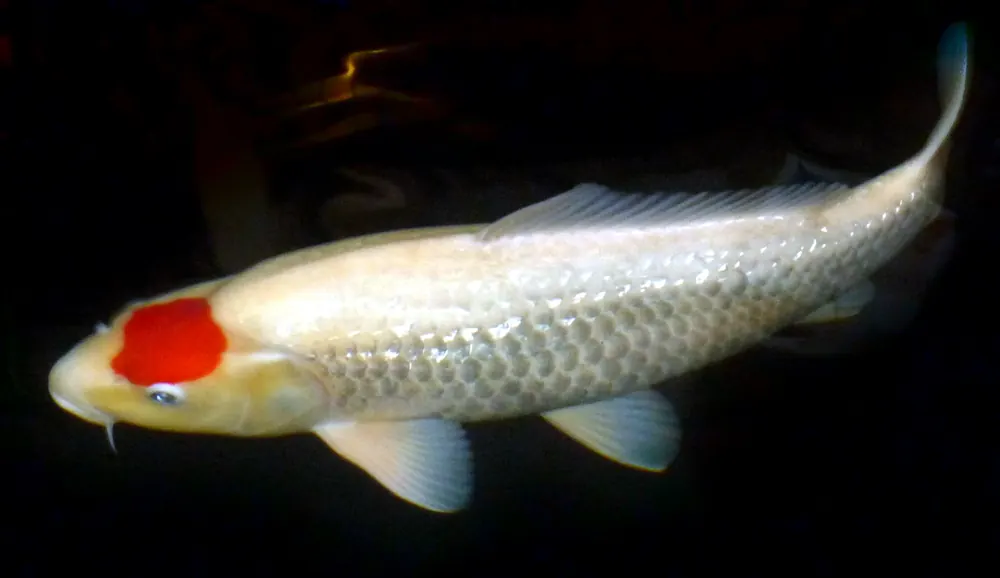

Tancho Kohaku, Tancho Sanke, Tancho Showa and Tancho Goshiki
Because Tancho is a pattern rather than a fixed color scheme, JNPA lists it as occurring across multiple underlying varieties: Tancho-sanshoku (Tancho Sanke), Tancho-showa and Tancho-goshiki, in addition to the default Tancho Kohaku[2]. Each retains the body characteristics of its base variety — Tancho Sanke shows the appearance of Taisho Sanshoku, Tancho Showa that of Showa Sanshoku, and Tancho Goshiki that of Goshiki — combined with the single round head spot and no other hi on the body[2].JNPA also lists further forms, including Tancho-sakura-ogon (with Sakura Ogon body characteristics), Tancho-kujaku (with Kujaku characteristics) and Tancho-ochiba (with Ochiba Shigure characteristics, where the circular marking may be a color other than scarlet)[2]. The AKJA glossary similarly defines Tancho Kohaku, Tancho Sanke and Tancho Showa as koi whose only red marking is a head spot[6].Scale forms: Ginrin and Doitsu Tancho
Tancho patterns are also combined with alternative scale types. JNPA lists Ginrin-tancho-kohaku, which carries shining gold or silver scales along with Tancho Kohaku characteristics, and Ginrin-tancho-showa, the metallic-scaled equivalent for Tancho Showa[2]. A doitsu (nearly scaleless) form also exists: Doitsu-tancho-showa, which has almost no scales over the body with exposed skin, combined with Tancho Showa characteristics; Doitsu-tancho-kujaku is listed similarly for the Kujaku base[2]. A Tancho-kin-showa form, with gold or silver shine and Kin-showa characteristics, is also listed[2]. See also Doitsugoi and Kinginrin for background on these scale forms.Classification at shows
Show organizations generally treat Tancho as its own judging class covering any variety with a Tancho head marking, separate from the base variety's own class. ZNA's nationwide classification system lists Tancho as class 17, encompassing Tancho, Tancho Sanke, Tancho Showa, Tancho Goshiki, Ginrin Tancho and other Tancho forms[3]. ZNA International Koi Show entry rules confirm that Kohaku, Taisho Sanshoku, Showa Sanshoku and Utsurimono classes specifically exclude their Tancho forms, which instead compete under the dedicated Tancho class covering “all varieties with a Tancho mark”[4]. ZNA also notes that within its Kinginrin Group 2 class, Ginrin Tancho is excluded and instead grouped under the Tancho class[8].Other organizations follow a similar approach. The American Koi Judges Association (AKJA) lists Tancho as one of its standard classifications alongside Kohaku, Sanke, Showa and others[9]. ZNA SoCal's show registration groups “all Tancho including Tancho GoSanke, Gin Rin and non-gosanke” into one Tancho category[10]. Kodama Koi Farm's show-category guidance likewise lists Tancho as a separate variety category from Kohaku, Sanke and Showa[11]. At the Sydney Koi Show, results confirm Tancho as its own judged class across multiple size categories, with individual variety champions awarded[12].JNPA and its US affiliate Shinkokai USA also list Tancho among the recognized variety groups shown in their reference material[13][14].How Tancho differs from similar patterns
Tancho is distinguished from Maruten, a related head-marking term. In Maruten, the koi has an independent round hi marking on the head, but — unlike Tancho — also carries additional hi markings elsewhere on the body; ZNA notes that Tancho Kohaku is in effect a Kohaku with only the independent round forehead spot and nothing more[15]. JNPA states explicitly that if a round head marking is present alongside body pattern, the fish is called Maruten or Komaruten rather than Tancho[2]. The AKJA glossary defines maruten as a crown-type marking contrasted directly with Tancho, where Tancho denotes no other red on the body[6].Tancho is also distinct from a step-patterned (dan-moyo) Kohaku, in which hi appears in discrete steps down the body; a rarity discussion by the US dealer Kodama Koi Farm notes that common step counts include Tancho, 1-step, 2-step and 3-step patterns, with 4- and 5-step patterns being rarer[16].Cultural significance and appreciation
The resemblance of the Tancho pattern to the Japanese national flag — a red circle on a white field — is frequently cited as a reason for its popularity[1][2][7]. Kodama Koi Farm, a US importer, states that Tancho koi are named after the sacred red-crowned crane of Japan and are associated with good fortune, love and long life[7].General nishikigoi appreciation guidance from Ojiya Nishikigoi no Sato in Niigata notes that body shape (体形) is considered the most important viewing point across all varieties, followed by vivid, deep coloration (色彩) and balanced pattern (斑紋), along with shine, luster and orderly scale arrangement; this source also states that essentially all varieties can occur in Tancho form[17].Images

Common questions
Is Tancho a separate variety of koi?
What is the difference between Tancho and Maruten?
Why is the Tancho pattern so popular?
How are Tancho koi judged at shows?
Related koi topics
References
- ^ TANCHO | Zen Nippon Airinkai. Zen Nippon Airinkai. zna.jp/en/keep-nishikigoi/varieties-of-nishikigoi/tancho/. Retrieved November 2026.
- ^ Tancho - Variety - All Japan Nishikigoi Promotion Association. All Japan Nishikigoi Promotion Association. jnpa.info/en/nishikigoi/varieties/type/tancho/. Retrieved November 2026.
- ^ Koi classification (ZNA 2021), NMZNA 2026 show documents. nmzna.net. nmzna.net/2026%20Show%20Docs/NMZNA%202026%20Koi%20Classification%20…. Retrieved November 2026.
- ^ 59th ZNA International Koi Show entry rules (ZNA). Zen Nippon Airinkai. zna.jp/wp-content/uploads/2023/07/59th-zna-koishow.pdf. Retrieved November 2026.
- ^ JAS 0020 Nishikigoi. Vocabulary (MAFF) — Ministry of Agriculture, Forestry and Fisheries (Japan). maff.go.jp/j/jas/jas_standard/attach/pdf/index-536.pdf. Retrieved November 2026.
- ^ Glossary – American Koi Judges Association (AKJA). American Koi Judges Association. akjajudges.com/glossary/. Retrieved November 2026.
- ^ Tancho - Koi For Sale - Kodama Koi Farm. Kodama Koi Farm (koi dealer). kodamakoifarm.com/variety/tancho/. Retrieved November 2026.
- ^ KINGINRIN 2 | Zen Nippon Airinkai. Zen Nippon Airinkai. zna.jp/en/keep-nishikigoi/varieties-of-nishikigoi/kinginrin-2/. Retrieved November 2026.
- ^ AKJA Classifications – American Koi Judges Association (AKJA). American Koi Judges Association. akjajudges.com/akja_classifications/. Retrieved November 2026.
- ^ ZNA SoCal 50th Annual Koi Show exhibitor registration packet (2026). znasocal.org. znasocal.org/wp-content/uploads/2026/02/2026-entrant-registration-1…. Retrieved November 2026.
- ^ Preparing for Koi Competition and Tips for Winning Koi Shows. Kodama Koi Farm (koi dealer). kodamakoifarm.com/koi-show-competition-tips-preparation/. Retrieved November 2026.
- ^ 49th Sydney Koi Show 2026 results (Sydney Koi Show). Sydney Koi Show. sydneykoishow.com/admin/photoresultsnew.toy?eid=206700. Retrieved November 2026.
- ^ Variety - All Japan Nishikigoi Promotion Association. All Japan Nishikigoi Promotion Association. jnpa.info/en/nishikigoi/varieties/. Retrieved November 2026.
- ^ Variety - Shinkokai USA Official Website. Shinkokai USA (JNPA). shinkokaiusa.com/variety. Retrieved November 2026.
- ^ KOHAKU | Zen Nippon Airinkai. Zen Nippon Airinkai. zna.jp/en/keep-nishikigoi/varieties-of-nishikigoi/kohaku/. Retrieved November 2026.
- ^ Which Koi is the Rarest: How Can I Judge Superiority?. Kodama Koi Farm (koi dealer). kodamakoifarm.com/rarest-koi-fish/. Retrieved November 2026.
- ^ 小千谷市 錦鯉の里-つちかわれた伝統と地場産業を明日へ伝える総合産業会館サンプラザ. Ojiya Nishikigoi no Sato. nishikigoinosato.jp/appreciation.html. Retrieved November 2026.