
Ochiba Shigure
Key facts: Ochiba Shigure (落葉しぐれ) is a non-metallic koi variety with a light pale body showing a mesh-like net pattern from its scale arrangement, overlaid with earthenware or bronze-brown markings, likened to fallen leaves floating on water.
Colors:
Ochiba Shigure (落葉しぐれ) is classified within the Kawarimono (変わり鯉) group and is described by the All Japan Nishikigoi Promotion Association (JNPA) as having a light pale yellow body with earthenware-colored imprints and a mesh-like pattern across the back formed by the arrangement of its scales[1]. According to a secondary source (Wikipedia), Ochiba is a light blue/gray koi with copper, bronze, or yellow Kohaku-style pattern, a combination said to resemble fallen leaves on water, which is also the meaning given for its Japanese name in that source[7]. The American Koi Judges Association (AKJA) glossary similarly describes Ochiba-shigure as “autumn leaves on water,” a blue-gray koi with brown pattern, often shortened in conversation to simply “Ochiba”[2].The variety combines the net-like Asagi-style ground skin with a secondary pattern color, and is grouped with other Kawarimono (literally the catch-all class for varieties that do not fit the major named groups) at shows[3][10].- sora (gray-blue)
- cha (brown)
- ki (yellow)
Name and meaning
The JNPA describes Ochiba-shigure as having “a light pale yellow body, and there are earthenware color imprints across the body,” with “a mesh-like pattern on the entire back due to the arrangement of scales”[1]. The AKJA glossary renders the variety in English as “Autumn leaves on water,” describing it as a blue-gray koi with brown pattern[2]. A secondary source gives the Japanese characters 落葉 as meaning “fallen leaves,” describing the koi as light blue/gray with copper, bronze, or yellow pattern reminiscent of autumn leaves floating on water[7].Judging points
Official classification and standard definition
Under the Japanese Agricultural Standard (JAS) for nishikigoi vocabulary, Ochiba Shigure is not given its own standalone numbered entry but falls under entry 2010, kawarigoi (変わり鯉), defined as koi that do not correspond to the other specifically defined varieties (numbers 2001–2009 and 2011–2022)[5]. The explanatory note to that entry states that kawarigoi is a group treated at shows as Kawarimono, encompassing varieties with distinctive or numerous appearance characteristics, and explicitly names Ochiba Shigure (落ち葉しぐれ) and Kage Shiroutsuri (影白写り) as examples included within this group[5]. A 2026 revision notice to the same JAS standard confirms this note and also separately lists a metallic version, Kogane-ochiba (こがね落葉), as an example under the related hikari-kawarigoi (光り変わり鯉) entry, which covers varieties not otherwise defined that shine over the whole body[6].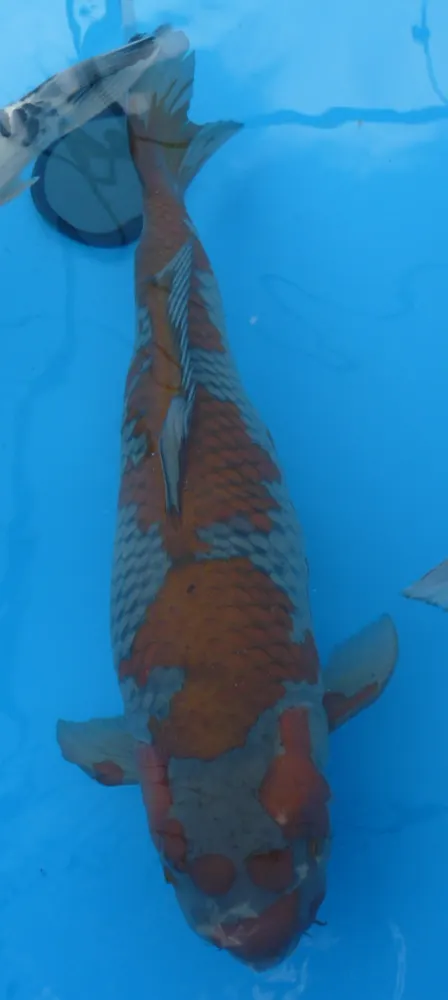

Appearance
The JNPA's description emphasizes two components: a pale ground color and secondary “earthenware-colored” imprints laid over a netted scale pattern on the back[1]. The AKJA glossary describes the ground as blue-gray with a brown pattern[2], while a secondary source broadens the pattern color range to copper, bronze, or yellow, in a style compared to Kohaku markings[7]. The mesh-like net effect over the back is produced by the arrangement of the scales themselves rather than by pigment alone, according to the JNPA[1].Sub-types and related names
- Ochiba-utsuri: described by the JNPA as having a light pale yellow body with earthenware color and black imprints, retaining the same mesh-like back pattern as Ochiba Shigure[1].Kogane-ochiba: a fully metallic (shining) koi that otherwise has the appearance characteristics of Ochiba-shigure, according to the JNPA[1]; the JAS revision notice places this variety as an example under the hikari-kawarigoi (metallic kawarigoi) entry[6].Metallic-doitsu-ochiba: a doitsu-scaled, metallic form with almost no scales and exposed skin, described by the JNPA as shining silver over the entire back while retaining Ochiba-shigure's appearance characteristics[1].Tancho-ochiba: per the JNPA, a koi with a circular scarlet (or, in some individuals, a different-colored) imprint on the head combined with the appearance characteristics of Ochiba-shigure[9].Goshiki-shigure: a related but distinct variety described by the JNPA as having an “asagidi” pattern with yellow imprints and a gentle overall glow, grouped near Ochiba varieties in JNPA listings[1].
Scale forms: doitsu and ginrin
A doitsu-scaled version, Doitsu-ochiba-shigure, is recorded by the JNPA as having almost no scales with exposed skin while retaining the appearance characteristics of Ochiba-shigure[8]. The JAS standard's entry on doitsugoi (2012/2011 depending on revision) defines the doitsu form generally as koi with almost no scales across the body, exposing the skin, a characteristic that can be combined with other named varieties including Ochiba Shigure[5][6]. No ginrin (metallic-scale) form of Ochiba Shigure is described in the sources reviewed.Classification at shows
The Zen Nippon Airinkai (ZNA) lists Ochiba Shigure under the “Ochiba family” within its Kawarimono class description, alongside Koyo[3]. A 2026 ZNA America show classification document similarly places Ochiba Shigure within class 10, KAWARIMONO, alongside varieties such as Hajiro, Kumonryu, Kage Utsuri, and Kanoko[4]. The koi dealer Kodama Koi Farm describes Kawarimono broadly as nonmetallic koi that do not fit into the other established classes, each considered unique[10]. Under the JAS vocabulary standard, the variety corresponds to the kawarigoi entry (2010), a category explicitly reserved for varieties not matching the other specifically defined terms[5].Differences from similar varieties
Ochiba Shigure shares its pale, netted ground pattern with Asagi, but differs in its secondary leaf-colored imprints rather than Asagi's red (hi) markings; the JAS asagi entry (2019/2005) defines Asagi strictly by its blue or pale-blue netted back with scarlet imprints on the body, distinct from the earthenware tones of Ochiba[5][6]. It is also distinguished from Soragoi, a plain gray-blue, non-metallic koi without the leaf-pattern overlay, and from Chagoi, a solid tea-brown koi without the netted ground, both of which the AKJA glossary groups as separate Kawarimono varieties[2]. Ochiba-utsuri adds black imprints not present in standard Ochiba Shigure, per the JNPA[1].Images
Common questions
What does the name Ochiba Shigure mean?
Is Ochiba Shigure its own official JAS variety?
How is Ochiba Shigure classified at koi shows?
What is the difference between Ochiba Shigure and Ochiba-utsuri?
The JNPA describes Ochiba-utsuri as having the same pale body and netted back pattern as Ochiba Shigure but with added black imprints alongside the earthenware-colored ones[1].
Related koi topics
References
- ^ Kawarigoi - Variety - All Japan Nishikigoi Promotion Association. All Japan Nishikigoi Promotion Association. jnpa.info/en/nishikigoi/varieties/type/kawarigoi/. Retrieved November 2026.
- ^ Glossary – American Koi Judges Association (AKJA). American Koi Judges Association. akjajudges.com/glossary/. Retrieved November 2026.
- ^ KAWARIMONO | Zen Nippon Airinkai. Zen Nippon Airinkai. zna.jp/en/keep-nishikigoi/varieties-of-nishikigoi/kawarimono/. Retrieved November 2026.
- ^ Koi classification (ZNA 2021), NMZNA 2026 show documents. nmzna.net. nmzna.net/2026%20Show%20Docs/NMZNA%202026%20Koi%20Classification%20…. Retrieved November 2026.
- ^ JAS 0020 Nishikigoi. Vocabulary (MAFF) — Ministry of Agriculture, Forestry and Fisheries (Japan). maff.go.jp/j/jas/jas_standard/attach/pdf/index-536.pdf. Retrieved November 2026.
- ^ JAS 0020 revision notice, 2026 (MAFF). Ministry of Agriculture, Forestry and Fisheries (Japan). maff.go.jp/j/jas/jas_kikaku/attach/pdf/kokujikaisei-733.pdf. Retrieved November 2026.
- ^ Koi (Wikipedia). Wikipedia. en.wikipedia.org/wiki/Utsurimono. Retrieved November 2026.
- ^ Doitsugoi - Variety - All Japan Nishikigoi Promotion Association. All Japan Nishikigoi Promotion Association. jnpa.info/en/nishikigoi/varieties/type/doitsugoi/. Retrieved November 2026.
- ^ Tancho - Variety - All Japan Nishikigoi Promotion Association. All Japan Nishikigoi Promotion Association. jnpa.info/en/nishikigoi/varieties/type/tancho/. Retrieved November 2026.
- ^ Kawarimono Archives - Kodama Koi Farm. Kodama Koi Farm (koi dealer). kodamakoifarm.com/variety/kawarimono/. Retrieved November 2026.