
Kumonryu
Key facts: Kumonryu (九紋竜) is a scaleless (doitsu) koi variety with intense black markings that appear to rise across a white body like clouds, and whose pattern is known to change over time.[1][2]
Colors:
Kumonryu is classified within the Kawarimono group, specifically the Karasu-goi family, alongside Karasu-goi, Hajiro, Matsukawabake and Sumi Nagashi[3]. According to the All Japan Nishikigoi Promotion Association (JNPA), the variety has the characteristic of German carp (Doitsugoi, ドイツ鯉) with almost no scales, and is known for an intense black pattern across a white body that resembles black clouds freely rising from the body, unlike the utsurizumi seen in Showa Sanshoku[1].The Japanese Agricultural Standard (JAS) for nishikigoi vocabulary defines Kumonryu (九紋竜, no. 2011) as originally having a black background, with white areas increasing during growth so that a black cloud-like pattern appears to surface over the whole body, with the appearance characteristics of Doitsugoi; it also notes the black cloud-like pattern may change markedly in a short period due to environmental changes, and that some individuals carry red markings[5].- sumi (black)
- shiroji (white ground)
- hi (red)
Name and meaning
According to the JNPA, the name Kumonryu comes from a legend in which a dragon becomes a cloud and rises to the sky[1]. Wikipedia states the name is literally translated as "nine tattooed dragons" and that the shifting black patterns are thought to be reminiscent of Japanese ink paintings of dragons[2]. A secondary dealer source, Kodama Koi Farm, describes the name as meaning "Nine-Crested Dragon" and notes that, together with Kikokuryu, it is one of several Japanese koi varieties carrying dragon-associated names, though neither variety is claimed to represent the mythical Dragon Gate transformation itself[7].Judging points
Appearance and the JAS standard
Kumonryu is a doitsu (almost scaleless) koi with a black ground that develops increasing white area as the fish grows, producing a black, cloud-like pattern over the body[5][1]. Wikipedia describes it as a black doitsu-scaled fish with curling white markings across the head, fins, and body[2]. A commonly repeated characteristic, noted by both the JNPA and the JAS standard, is that the black pattern is unusually changeable: it is said to sink into the white body at higher water temperatures and to re-emerge at lower temperatures, so that the pattern is understood to shift with the seasons[1][5][2]. The San Diego Zoo describes Kumonryu as either solid black or a white body with black spots whose pattern changes as the koi grows, associating this with symbolism of life changes and transformation[8]. Kodama Koi Farm, a koi dealer, similarly describes Kumonryu as a striking black-and-white doitsu koi whose black markings can shift with seasonal and water-temperature conditions, calling it one of the more visually unpredictable nishikigoi varieties[7][9].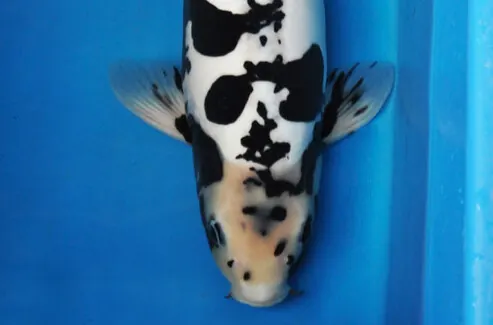
Beni Kumonryu
According to the JNPA, when a Kumonryu carries red imprints it is called Beni-kumonryu[1]. The JAS standard likewise notes that some Kumonryu individuals have red markings (beni)[5]. The Kodama Koi Farm account of the related Kin Kikokuryu line notes that breeder Mr. Matsuo created Beni Kumonryu by adding hi (red) onto Kumonryu through mixing with Kohaku bloodlines[10]. Beni Kumonryu is listed as a distinct entry under the Kawarimono class by the ZNA classification used for the ZNA America Koi Show[4] and separately by Zen Nippon Airinkai among the "Others" group within Kawarimono[3].Related varieties: Kikokuryu and Kin Kikokuryu
Kikokuryu (輝黒竜) is described by Wikipedia as a metallic-skinned version of Kumonryu[2]. The American Koi Judges Association (AKJA) glossary states Kikokuryu was developed by a breeder named Aoki, who crossed a Kumonryu with a Kikisui (a doitsu platinum koi), producing a koi with many Kumonryu characteristics but a metallic finish; further development produced Kin Kikokuryu and Beni Kikokuryu[11]. Kodama Koi Farm, describing its own stock, states Kikokuryu was created by breeding Kumonryu and platinum koi, resulting in a metallic Kumonryu with platinum skin and fins combined with deep sumi, and notes that, like Kumonryu, its colors are likely to change throughout the year due to factors including lighting and water temperature[12]. The JNPA defines Kikokuryu as having the whole body shine while carrying the appearance characteristics of Kumonryu, with Beni-kikokuryu adding scarlet imprints and Kin-kikokuryu adding golden imprints[6]. Kin-Kikokuryū is further described by Wikipedia as a metallic-skinned version of Kumonryu with a Kohaku-style hi pattern, developed by Seiki Igarashi of Ojiya City, with at least six genetic subvarieties noted[2].Classification at shows
- Zen Nippon Airinkai (ZNA) places Kumonryu, Beni Kumonryu, Ki Kokuryu and Beni Ki Kokuryu among the Kawarimono varieties, within or alongside the Karasu-goi family[3].The ZNA 2021 classification used for the ZNA America Koi Show lists Kumonryu and Beni Kumonryu explicitly under category 10, Kawarimono, alongside Kikokuryu[4].The AKJA glossary defines Kawarimono as a classification of all non-metallic koi not included in any other group, and separately defines Kumonryu as a black doitsu koi with changing white markings on its head, fins and body, placed in Kawarimono[11].Under the JAS vocabulary standard, Kumonryu (no. 2011) is defined as a distinct named variety rather than left within the general kawarigoi (変わり鯉) catch-all, reflecting its status as a variety that has become formally established, unlike less fixed kawarigoi types[5][6].
How it differs from similar varieties
The JNPA distinguishes the black-cloud pattern of Kumonryu from the utsurizumi (black markings) seen in Showa Sanshoku, describing the Kumonryu pattern instead as appearing to rise freely across the body like clouds[1]. Within the broader Karasu-goi family grouped by Zen Nippon Airinkai, Kumonryu is listed separately from related black-patterned kawarimono such as Karasu-goi, Hajiro, Hage Shiro, Yotsu Jiro, Matsukawa-bake and Sumi Nagashi[3]. The JNPA's description of Matsukawabake notes that it has white and jet-black patterns across the body with scales covering the whole body except the head, and that its black pattern can also change frequently in a short period due to environmental changes, a trait it shares with Kumonryu[6]. Kumonryu is distinguished from its metallic derivative, Kikokuryu, by the absence of metallic (platinum) skin; Kikokuryu is described as a metallic version carrying Kumonryu's appearance characteristics[6][2].Pattern change and keeping notes
Both the JNPA and the JAS standard describe the black pattern of Kumonryu as unusually changeable, sinking into the white skin at higher water temperatures and emerging more strongly at lower temperatures, with changes possible over a short period due to environmental conditions[1][5]. Kodama Koi Farm, a koi dealer, likewise describes the black markings as capable of becoming more prominent or fading over time with shifts in water temperature and seasonal conditions, and considers this one of the more visually unpredictable traits among nishikigoi varieties[7]. The San Diego Zoo associates this pattern change with symbolism of life changes and transformation[8].Images
Common questions
What does the name Kumonryu mean?
Why does a Kumonryu's pattern change?
What is Beni Kumonryu?
How is Kumonryu classified at shows?
Related koi topics
References
- ^ Kumonryu - Variety - All Japan Nishikigoi Promotion Association. All Japan Nishikigoi Promotion Association. jnpa.info/en/nishikigoi/varieties/type/kumonryu/. Retrieved November 2026.
- ^ Koi (Wikipedia). Wikipedia. en.wikipedia.org/wiki/Koi. Retrieved November 2026.
- ^ KAWARIMONO | Zen Nippon Airinkai. Zen Nippon Airinkai. zna.jp/en/keep-nishikigoi/varieties-of-nishikigoi/kawarimono/. Retrieved November 2026.
- ^ Koi classification (ZNA 2021), NMZNA 2026 show documents. nmzna.net. nmzna.net/2026%20Show%20Docs/NMZNA%202026%20Koi%20Classification%20…. Retrieved November 2026.
- ^ JAS 0020 Nishikigoi. Vocabulary (MAFF) — Ministry of Agriculture, Forestry and Fisheries (Japan). maff.go.jp/j/jas/jas_standard/attach/pdf/index-536.pdf. Retrieved November 2026.
- ^ Kawarigoi - Variety - All Japan Nishikigoi Promotion Association. All Japan Nishikigoi Promotion Association. jnpa.info/en/nishikigoi/varieties/type/kawarigoi/. Retrieved November 2026.
- ^ The Koi Dragon Legend: The Myth of the Dragon Gate. Kodama Koi Farm (koi dealer). kodamakoifarm.com/koi-dragon-legend/. Retrieved November 2026.
- ^ Koi | San Diego Zoo Animals & Plants. animals.sandiegozoo.org. animals.sandiegozoo.org/animals/koi. Retrieved November 2026.
- ^ Which Koi is the Rarest: How Can I Judge Superiority?. Kodama Koi Farm (koi dealer). kodamakoifarm.com/rarest-koi-fish/. Retrieved November 2026.
- ^ Kin Kikokuryu: The sensational new variety. Kodama Koi Farm (koi dealer). kodamakoifarm.com/sensational-variety-kin-kikokuryu/. Retrieved November 2026.
- ^ Glossary – American Koi Judges Association (AKJA). American Koi Judges Association. akjajudges.com/glossary/. Retrieved November 2026.
- ^ Kikokuryu - Koi For Sale - Kodama Koi Farm. Kodama Koi Farm (koi dealer). kodamakoifarm.com/variety/kikokuryu/. Retrieved November 2026.