
Taisho Sanshoku (Sanke)
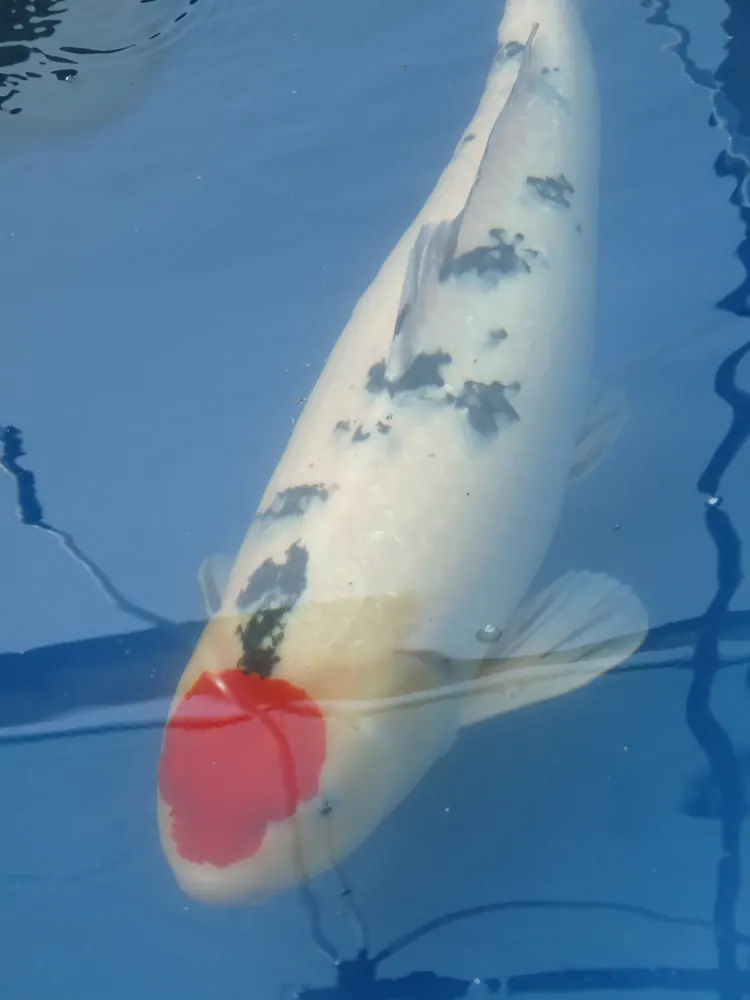
Key facts: Taisho Sanshoku (大正三色), usually shortened to Sanke, is a nishikigoi variety with red (hi) and black (sumi) markings on a white ground (shiroji)[1][2]. It is one of the three Gosanke varieties, alongside Kohaku and Showa Sanshoku[3].
Colors:
Taisho Sanshoku (大正三色), often abbreviated to Sanke, is a koi variety defined by red and black markings over a white body[10][2]. The All Japan Nishikigoi Promotion Association describes it as essentially a Kohaku pattern with the addition of black imprints called urushizumi[10]. Niigata breeders reportedly call it simply Sanke[1].Along with Kohaku and Showa Sanshoku, Taisho Sanshoku forms the Gosanke, the three varieties most prominent in competition and private collections[3].- shiroji (white ground)
- hi (red)
- sumi (black)
Name and meaning
The variety was named Taisho Sanshoku because it was produced at the beginning of the Taisho era, combining a white background with red and black imprints — the three colors referenced by "sanshoku"[10]. According to the American Koi Judges Association, the kanji 三色 can be read as either sanshoku or sanke, the latter deriving from an earlier term, 三毛[9][4]. In the United States the name is often shortened simply to "Sanke"[4].Judging points
- placeholder
History and origin
Accounts of the variety's origin differ in detail across sources. According to the Japanese-language Wikipedia article on the variety, in 1915 a breeder named Heitaro Sato in Niigata Prefecture found koi with black markings among the fry of a Kohaku pair he kept, and the fixation of the variety is credited to Eizaburo Hoshino, who acquired that pair from Sato in 1917 and bred a black-marked female Kohaku with a white Bekko male to stabilize the pattern[6]. English Wikipedia instead states the variety was first exhibited in 1914 by breeder Gonzo Hiroi during the reign of the Taisho Emperor, and separately records that "the Taisho Sanshoku (by Eizaburo Hoshino) was fixed as a breed" in 1917[4]. A secondary source, the US dealer Kodama Koi Farm, states the variety was developed from Kohaku around 1918 after scattered, "dirty" sumi appeared unexpectedly in a Kohaku breeding, and that breeders worked to consolidate the scattered sumi into larger, balanced areas; the same source separately dates the variety's creation by Eizaburo Hoshino in Yamakoshi village, Niigata, to 1919[7]. Wikipedia further notes that the name Nishikigoi itself is said to have been coined by Kei Abe, a Niigata prefectural fisheries officer, after he admired a Taisho Sanshoku[4].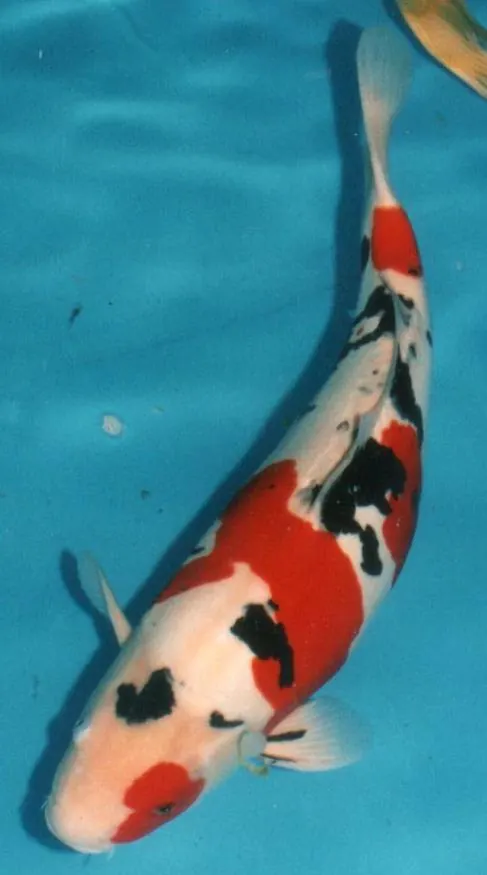

Appearance and the standard definition
The Japanese Agricultural Standard (JAS 0020) for nishikigoi vocabulary defines taisho-sanshoku (JAS No. 2002) as having a white body with scarlet (hi) and black markings across the body[2][10]. The Zen Nippon Airinkai (ZNA) describes the variety as koi with hi and sumi markings on a white ground, to be appreciated for the elegant combination of white, red and black[1]. Unlike Showa Sanshoku, Taisho Sanshoku typically has no sumi markings on the head, though a small sumi marking can appear on the gill cover, and sumi stripes often appear on the pectoral and dorsal fins, a feature called te jima[1][11].Fry can help distinguish the variety early: according to Kodama Koi Farm, Taisho Sanshoku fry are born with pinkish-colored bodies, unlike Showa Sanshoku fry, which are born black[7][12].Sumi characteristics
Sumi quality and placement are central to appreciating Taisho Sanshoku. ZNA and the American Koi Judges Association both describe several named sumi types. Tsubo-zumi (or subo-sumi) is sumi appearing on the white ground, especially a marking placed effectively on the shoulder area[1][9]. Kasane-zumi is sumi overlaying the hi plate, appearing darker because of the red beneath[1][9]. Urushi-zumi describes quality, lustrous purple-black sumi with sharply defined edges, considered characteristic of good Taisho Sanshoku, while nabe-zumi describes lower-quality brownish, soot-like sumi lacking luster[1][11]. Kodama Koi Farm similarly emphasizes that sumi on the shoulder, called kata zumi, is considered an absolute necessity, with overall sumi balance being critical to quality[7][9].Sub-types and scale forms
Doitsu Sanke, a scaleless or partially scaled (doitsu) form of Taisho Sanshoku, is recognized as a distinct class by the Zen Nippon Airinkai for its international koi show classification[5]. Ginrin forms also exist: the JAS standard defines A-ginrin and B-ginrin categories for koi with gold- or silver-sparkling scales that otherwise show the appearance of Kohaku, Taisho Sanshoku, or Showa Sanshoku[2]. Related crosses include Koromo Sanke, produced by cross-breeding Ai Goromo with Taisho Sanshoku to combine Koromo-style scale edging with Sanke sumi markings[8]. Yamato Nishiki is described by the American Koi Judges Association as a metallic white koi with red and black markings, essentially a metallic Sanke, arising from a cross between a Sanke and a Fuji Ogon[9].Classification at shows
Taisho Sanshoku is classified under its own heading, "Taisho Sanshoku," within the ZNA's nishikigoi classification used for the ZNA International Koi Show, which groups together Taisho Sanshoku and Doitsu Sanke[5]. Ginrin examples of the variety instead fall under the Kinginrin 1 class alongside ginrin Kohaku, Showa and Utsuri[5]. Under the JAS vocabulary standard, taisho-sanshoku is recorded as variety number 2002[2]. At club-level competitions, Taisho Sanke appears as its own judged class; for example, results from the Sydney Koi Show list separate Taisho Sanke placings across multiple size classes[13].Differences from similar varieties
Taisho Sanshoku is most often compared with Showa Sanshoku, since both are tri-colored (white, red, black) varieties. The principal distinction is the head and ground color: Showa Sanshoku has a black base with sumi commonly appearing on the head, including patterns such as hachi-ware and moto-guro at the base of the pectoral fins, whereas Taisho Sanshoku generally lacks black on the head and instead shows sumi stripes (te jima) on the pectoral fins[14][1][11]. English Wikipedia notes that as the proportion of white on modern Showa (kindai Showa) has increased, it can become difficult to distinguish from Taisho Sanke[4]. Taisho Sanshoku can also be confused with Shiro Bekko, which has similar sumi markings on a white ground but, according to ZNA, lacks any hi markings entirely[15].Images
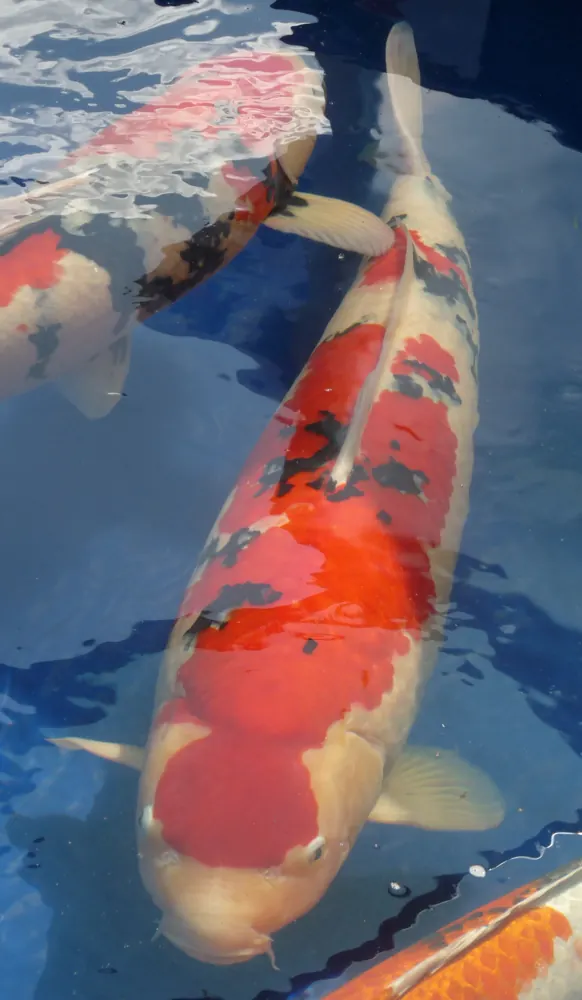

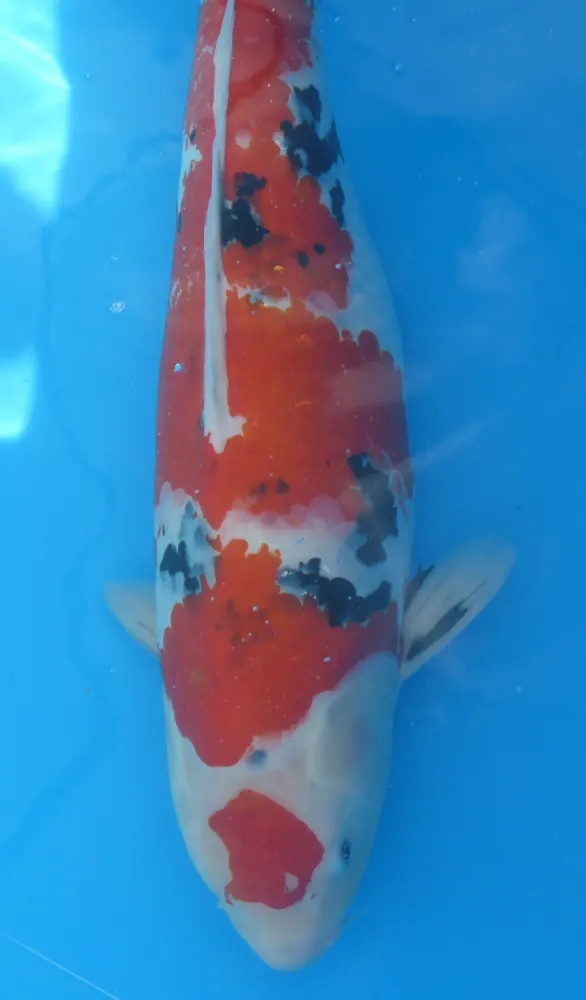

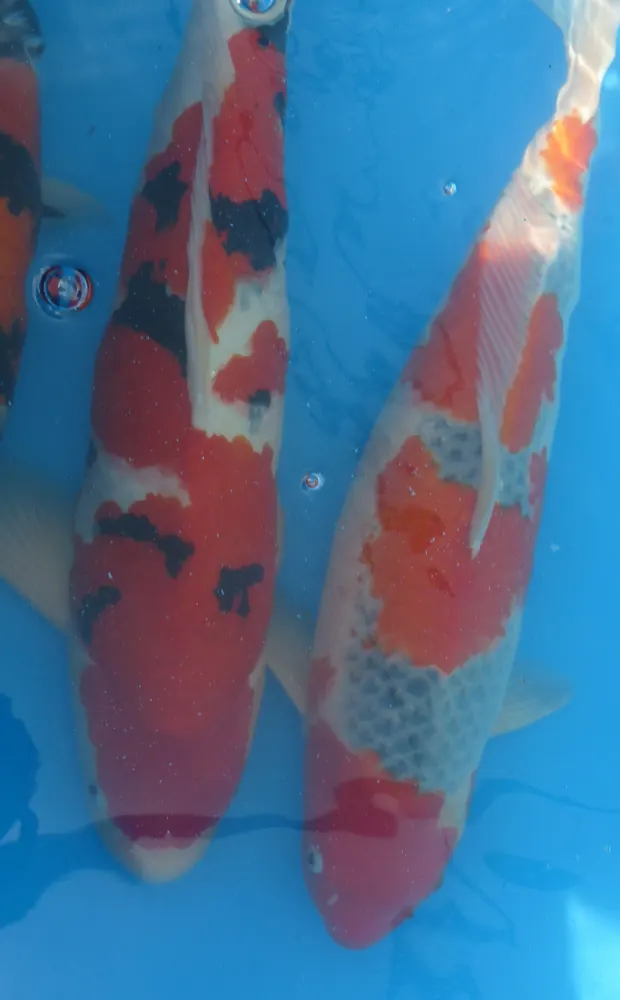


Common questions
What is the difference between Taisho Sanshoku and Sanke?
How can you tell Taisho Sanshoku from Showa Sanshoku as young fish?
According to the dealer Kodama Koi Farm, Taisho Sanshoku fry are born pinkish, while Showa Sanshoku fry are born with black bodies, which helps breeders sort large spawns[7].
Does Taisho Sanshoku have black markings on the head?
What is urushi-zumi?
When was Taisho Sanshoku first fixed as a breed?
Related koi topics
References
- ^ Taisho Sanshoku | Zen Nippon Airinkai. Zen Nippon Airinkai. zna.jp/en/keep-nishikigoi/varieties-of-nishikigoi/taisho-sanshoku/. Retrieved November 2026.
- ^ JAS 0020 Nishikigoi. Vocabulary (MAFF) — Ministry of Agriculture, Forestry and Fisheries (Japan). maff.go.jp/j/jas/jas_standard/attach/pdf/index-536.pdf. Retrieved November 2026.
- ^ All About Gosanke Koi Fish Varieties "The Big Three!". Kodama Koi Farm (koi dealer). kodamakoifarm.com/gosanke-koi-fish/. Retrieved November 2026.
- ^ Koi (Wikipedia). Wikipedia. en.wikipedia.org/wiki/Koi. Retrieved November 2026.
- ^ Koi classification (ZNA 2021), NMZNA 2026 show documents. nmzna.net. nmzna.net/2026%20Show%20Docs/NMZNA%202026%20Koi%20Classification%20…. Retrieved November 2026.
- ^ 大正三色 (Wikipedia). Wikipedia (Japanese). ja.wikipedia.org/wiki/大正三色. Retrieved November 2026.
- ^ Taisho Sanke - Koi For Sale - Kodama Koi Farm. Kodama Koi Farm (koi dealer). kodamakoifarm.com/variety/taisho-sanke/. Retrieved November 2026.
- ^ KOROMO | Zen Nippon Airinkai. Zen Nippon Airinkai. zna.jp/en/keep-nishikigoi/varieties-of-nishikigoi/koromo/. Retrieved November 2026.
- ^ Glossary – American Koi Judges Association (AKJA). American Koi Judges Association. akjajudges.com/glossary/. Retrieved November 2026.
- ^ Taisho-sanshoku - Variety - All Japan Nishikigoi Promotion Association. All Japan Nishikigoi Promotion Association. jnpa.info/en/nishikigoi/varieties/type/taisho-sanshoku/. Retrieved November 2026.
- ^ NISHIKIGOI TERMINOLOGY 3 SUMI | Zen Nippon Airinkai. Zen Nippon Airinkai. zna.jp/en/keep-nishikigoi/nishikigoi-terminology/nishikigoi-termino…. Retrieved November 2026.
- ^ Showa - Koi for Sale and History - Kodama Koi Farm. Kodama Koi Farm (koi dealer). kodamakoifarm.com/variety/showa/. Retrieved November 2026.
- ^ 49th Sydney Koi Show 2026 results (Sydney Koi Show). Sydney Koi Show. sydneykoishow.com/admin/photoresultsnew.toy?eid=206700. Retrieved November 2026.
- ^ SHOWA SANSHOKU | Zen Nippon Airinkai. Zen Nippon Airinkai. zna.jp/en/keep-nishikigoi/varieties-of-nishikigoi/showa-sanshoku/. Retrieved November 2026.
- ^ BEKKO | Zen Nippon Airinkai. Zen Nippon Airinkai. zna.jp/en/keep-nishikigoi/varieties-of-nishikigoi/bekko/. Retrieved November 2026.