
Koromo
Key facts: Koromo (衣, “robed”) is a group of nishikigoi varieties built on a Kohaku-style red (hi) pattern whose red scales carry a half-moon-shaped indigo or black edge, giving a layered, textile-like look on a white ground.[1][2]
Colors:
Koromo (衣) describes nishikigoi in which the tips of the scales within the red (hi) markings are dyed indigo or black in a crescent, or half-moon, shape, producing a “robed” effect over an otherwise Kohaku-like pattern.[1][3] The Zen Nippon Airinkai (ZNA) groups several related forms under this name, including Ai Goromo, Budo Goromo, Koromo Sanke and Koromo Showa.[7][4]According to the All Japan Nishikigoi Promotion Association (JNPA), Koromo is considered an improved variety of Kohaku, with the indigo or black tint appearing only on the tips of scales that sit inside the red pattern, not on the white ground.[1][7] A secondary source, Wikipedia, states that the variety first arose in the 1950s from a cross between a Kohaku and an Asagi.[8]- hi (red)
- shiroji (white ground)
- ai (indigo blue)
- sumi (black)
Name and Meaning
The Japanese word koromo (衣) is glossed by the American Koi Judges Association (AKJA) as meaning “robed,” referring to koi whose hi pattern is outlined in a darker color.[2] The JNPA states the variety was named Koromo because of the pattern formed on the scales.[1]Judging points
Appearance and the JAS Standard
The Japanese Agricultural Standard (JAS) for nishikigoi vocabulary, issued by Japan’s Ministry of Agriculture, Forestry and Fisheries, defines koromo (衣) as having hi markings whose scale tips are dyed indigo or black in a half-moon shape within those markings.[3] The standard notes that scale tips dyed indigo are called ai-goromo (藍衣), while tips dyed black are called sumi-goromo (黒衣) or budo-goromo (葡萄衣).[3]The JAS standard also distinguishes Koromo from Goshiki: Goshiki has an asagi-style reticulated pattern over its white body areas, while Koromo does not show this netting on the white ground, only within the red markings.[1][3]According to the US importer Kodama Koi Farm, Koromo have a Kohaku-style hi pattern on pure white skin, with an indigo-blue pattern on each scale of the hi markings; it states that it is ideal for the indigo to appear in regular crescent shapes across the entire hi pattern.[9]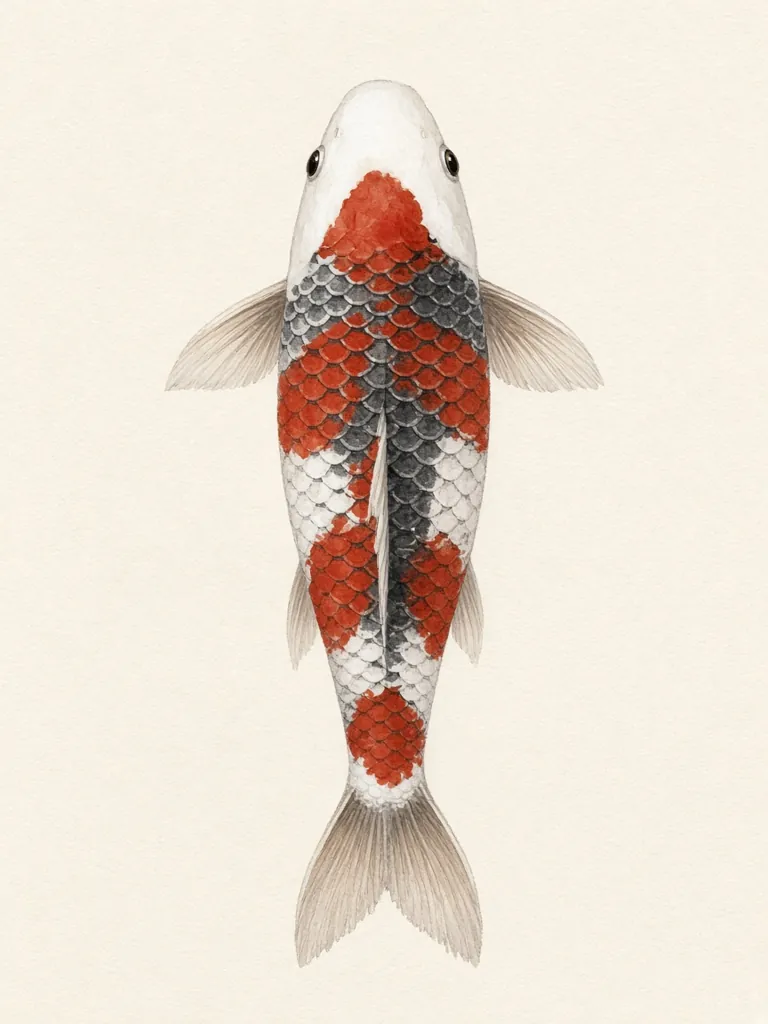
Sub-types: Ai Goromo
Ai Goromo (藍衣) is described by the JNPA as having a white body with scarlet (hi) imprints across it, the tips of the scales on those imprints dyed indigo in a half-moon shape.[1] The AKJA defines Ai Goromo similarly, as a Kohaku whose red scales have blue semi-circular borders, giving a reticulated appearance.[2] According to Wikipedia, Ai Goromo is the most commonly encountered Koromo form.[8] Kodama Koi Farm, a koi dealer, notes that as Koromo age, their ai (indigo) markings may gradually darken.[9]Budo Goromo and Sumi Goromo
Budo Goromo (葡萄衣, “grape-robed”) is described by ZNA as having sumi markings resembling bunches of grapes largely overlaid on the hi.[7] The JNPA describes Budo Goromo as having a white body with reddish-brown imprints across it and a black pattern of grape-like tufts throughout those imprints.[1] The AKJA similarly defines Budo Goromo as having a purplish, grape-like pattern over the red.[2] According to Wikipedia, the darker, burgundy hi overlay gives Budo Goromo the appearance of bunches of grapes.[8]Sumi Goromo (墨衣, sometimes called “ink-robed” or black koromo) is defined by the AKJA as an Ai Goromo whose koromo pattern is overlaid with solid black markings.[2] Wikipedia describes it as similar to Budo Goromo but with a hi pattern so dark it appears nearly black, noting it is very rarely seen.[8] The JAS standard uses the terms kuro-goromo (黒衣) and budo-goromo interchangeably for scale tips dyed black.[3]Koromo Sanke and Koromo Showa
ZNA describes Koromo Sanke as produced by cross-breeding Ai Goromo with Taisho Sanshoku (Sanke), resulting in a koromo pattern combined with Sanke-style sumi markings.[7] The JNPA states that Koromo-sanshoku has the appearance characteristics of Taisho Sanshoku, with half-moon-shaped scale tips dyed indigo over the scarlet imprints.[1] The AKJA defines Koromo Sanke as a koi with the koromo reticulated pattern over the hi marking combined with the sumi markings of a traditional Sanke.[2] A related term, Budo Sanke, is defined by the AKJA as a koi combining the Budo Goromo pattern with solid black markings.[2]Koromo Showa is described by ZNA as produced by crossing Ai Goromo with Showa Sanshoku, giving a Koromo with Showa-style sumi markings.[7] The JNPA states Koromo-showa has the appearance characteristics of Showa Sanshoku along with half-moon-shaped indigo scale tips on the scarlet imprints, and also records a Doitsu-koromo-showa form, in which the body has almost no scales and the skin is exposed, combined with Koromo Showa appearance characteristics.[1] The AKJA defines Koromo Showa (also called Ai-Showa) as a koi with Showa markings overlaid with the koromo pattern.[2]Scale Forms: Ginrin and Doitsu Koromo
Ginrin (metallic scale) forms exist for several koromo varieties. The JNPA describes Ginrin-ai-goromo and Ginrin-budo-goromo as having shiny golden or silver scales combined with the respective appearance characteristics of Ai-goromo and Budo-goromo.[6] The ZNA 2021 classification used for the NMZNA show places Ginrin Koromo varieties within a dedicated Kinginrin class alongside other ginrin forms.[4]Doitsu (scaleless or part-scaled, German-type) forms are also recorded. The JNPA describes Doitsu-ai-goromo and Doitsu-budo-goromo as having almost no scales across the body, with the skin exposed, while retaining the respective Koromo appearance characteristics.[5] A Doitsu-koromo-showa form is likewise recorded by the JNPA.[1]Classification at Shows
- The ZNA 2021 nishikigoi classification used for the NMZNA 2026 show lists Koromo as its own numbered class (class 9), covering Koromo, Ai Goromo, Sumi Goromo, Budo Goromo, Koromo Sanke and Koromo Showa.[4]Ginrin versions of Koromo are benched separately, under the Kinginrin 1 class for gosanke-related ginrin varieties.[4]At the ZNA SoCal show, exhibitor registration documents place Koromo together with Goshiki in a single benching group, covering Ai, Sumi and Budo Goromo plus Koromo Sanke and Koromo Showa.[10]The JAS vocabulary standard records koromo (koromo, 衣) as JAS term number 2013, and distinguishes it from the related entries for goshiki (五色) and asagi (浅黄).[3]
How Koromo Differs from Similar Varieties
According to the JAS standard, Koromo is similar in appearance to Goshiki but can be distinguished because Koromo does not carry the asagi-style reticulated pattern on the white parts of the body, whereas Goshiki does.[1][3] Wikipedia notes that Goshiki has little or no hi below the lateral line and a reticulated base pattern over a dark body, which also separates it visually from Koromo.[11]Koromo is also distinct from plain Kohaku, which lacks any indigo or black tinting on its red scales, and from Asagi, whose reticulated pattern covers the entire back rather than only the hi markings.[1][2]Images
Entries in this section
- Ai Goromo — Ai Goromo (藍衣) is a Koromo variety with Kohaku-style red and white patterning overlaid with indigo-blue reticulation on each scale within the hi.
Common questions
What does “koromo” mean on a koi?
What is the difference between Ai Goromo and Budo Goromo?
How is Koromo different from Goshiki?
Are there Sanke and Showa versions of Koromo?
Related koi topics
References
- ^ Koromo - Variety - All Japan Nishikigoi Promotion Association. All Japan Nishikigoi Promotion Association. jnpa.info/en/nishikigoi/varieties/type/koromo/. Retrieved November 2026.
- ^ Glossary – American Koi Judges Association (AKJA). American Koi Judges Association. akjajudges.com/glossary/. Retrieved November 2026.
- ^ JAS 0020 Nishikigoi. Vocabulary (MAFF) — Ministry of Agriculture, Forestry and Fisheries (Japan). maff.go.jp/j/jas/jas_standard/attach/pdf/index-536.pdf. Retrieved November 2026.
- ^ Koi classification (ZNA 2021), NMZNA 2026 show documents. nmzna.net. nmzna.net/2026%20Show%20Docs/NMZNA%202026%20Koi%20Classification%20…. Retrieved November 2026.
- ^ Doitsugoi - Variety - All Japan Nishikigoi Promotion Association. All Japan Nishikigoi Promotion Association. jnpa.info/en/nishikigoi/varieties/type/doitsugoi/. Retrieved November 2026.
- ^ B-ginrin - Variety - All Japan Nishikigoi Promotion Association. All Japan Nishikigoi Promotion Association. jnpa.info/en/nishikigoi/varieties/type/b-ginrin/. Retrieved November 2026.
- ^ KOROMO | Zen Nippon Airinkai. Zen Nippon Airinkai. zna.jp/en/keep-nishikigoi/varieties-of-nishikigoi/koromo/. Retrieved November 2026.
- ^ Koi (Wikipedia). Wikipedia. en.wikipedia.org/wiki/Utsurimono. Retrieved November 2026.
- ^ Koromo - Koi For Sale - Kodama Koi Farm. Kodama Koi Farm (koi dealer). kodamakoifarm.com/variety/koromo/. Retrieved November 2026.
- ^ ZNA SoCal 50th Annual Koi Show exhibitor registration packet (2026). znasocal.org. znasocal.org/wp-content/uploads/2026/02/2026-entrant-registration-1…. Retrieved November 2026.
- ^ Koi (Wikipedia). Wikipedia. en.wikipedia.org/wiki/Goshiki. Retrieved November 2026.