
Ai Goromo
Key facts: Ai Goromo (藍衣) is a white-bodied koi with a Kohaku-style red (hi) pattern in which each scale within the red patches carries a crescent-shaped indigo (ai) edge, placing it within the Koromo family of varieties.[1][2]
Colors:
Ai Goromo is the most commonly encountered member of the Koromo group, a lineage described by the All Japan Nishikigoi Promotion Association as an improved form of Kohaku in which the tips of the red scales take on a half-moon shape dyed indigo or black.[1] According to Wikipedia, the Koromo variety first arose in the 1950s as a cross between a Kohaku and an Asagi, with Ai Goromo being the most frequently seen form, colored like a Kohaku except that each scale within the red patches carries a blue or black edge.[3]The American Koi Judges Association glossary describes Ai Goromo as a Kohaku whose red scales have blue semi-circular borders, producing a reticulated pattern.[2] The Zen Nippon Airinkai (ZNA) places Ai Goromo within the Koromo variety as the form with mesh-patterned sumi specifically on the hi plate, noting that this sumi does not appear on the white ground.[8]- hi (red)
- shiroji (white ground)
- ai (indigo blue)
Name and classification
The All Japan Nishikigoi Promotion Association (JNPA) states that Koromo varieties are named for the pattern of the scales, with Ai-goromo and Budo-goromo distinguished by the color of the pattern on the body.[1] The Japanese Agricultural Standard (JAS) for nishikigoi vocabulary defines koromo (衣, No. 2014) as a koi with scarlet (hi) imprints across the body whose scale tips are dyed indigo or black in a half-moon shape, further noting that when the half-moon tips are dyed indigo the fish is called ai-goromo (藍衣), and when dyed black it is called koku-goromo or budo-goromo (葡萄衣).[5] A separate JNPA entry on the Koromo type gives the same distinction: Ai-goromo has a white body with scarlet imprints whose scale tips are dyed indigo in a half-moon shape, while Budo-goromo shows reddish-brown imprints with a black grape-tuft pattern.[1]According to a secondary source (Wikipedia), the Japanese name is written 藍衣, combining the Koromo group designation with the color ai (indigo).[3]Judging points
- A clean red and white pattern with each red scale showing a uniform, crescent-shaped indigo base is considered good Koromo.[1]
- The indigo should ideally appear in regular crescent shapes across the entire hi pattern, not outside the red markings.[9]
- Prize-winning fish keep indigo confined to the hi areas rather than scattered along the body outside the red pattern.[9]
- The sashi (scale-edge color) should show true indigo rather than appearing simply black.[9]
- General nishikigoi appreciation criteria of body conformation, color, and pattern balance apply.[10]
Appearance and the JAS standard
The JAS standard defines koromo generally as having scarlet imprints across the body with scale tips dyed indigo or black in a half-moon shape, and distinguishes it from the superficially similar Goshiki by the absence of an asagi-style netted pattern on the white part of the body.[5] The JNPA's variety page repeats this distinction, noting that Koromo is considered good when the red and white pattern is clean and each red scale carries a uniform crescent-shaped indigo base.[1]Kodama Koi Farm, a US-based koi importer, describes Ai Goromo as having a Kohaku-style hi pattern on pure white skin with an indigo-blue pattern on each scale of the hi, stating that it is ideal for the indigo to appear in regular crescent shapes across the entire hi pattern.[9] The same source notes that the indigo coloring on the hi scales can look black, but that the sashi (scale-edge color) reveals true indigo, and that as Ai Goromo age their ai markings may gradually darken.[9]Kodama Koi Farm's general guide to koi patterns places Ai Goromo in the "Ai" pattern category, describing the indigo-blue netting over red markings as adding depth and contrast to the fish, distinct from the Asagi's netted body pattern.[11]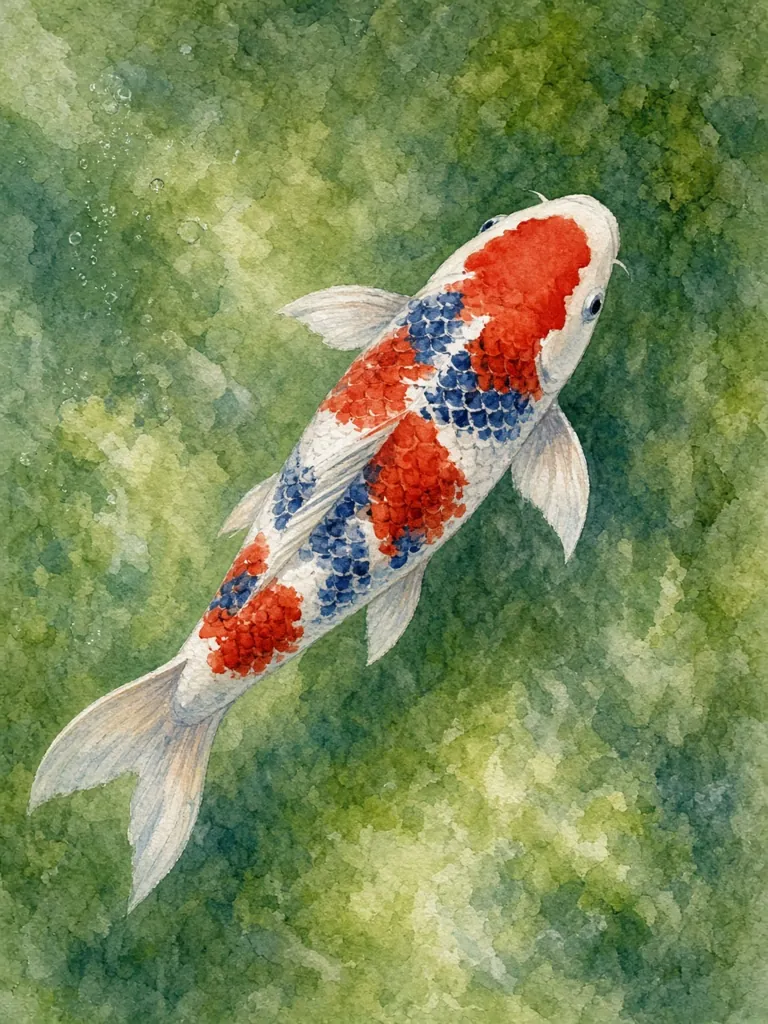
Sub-types and related varieties
ZNA lists several Koromo sub-varieties alongside Ai Goromo: Budo Goromo, with sumi markings resembling bunches of grapes overlaid largely on the hi; Koromo Sanke, produced by cross-breeding Ai Goromo with Taisho Sanshoku to give Koromo with Sanke-style sumi; and Koromo Showa, produced by crossing Ai Goromo with Showa Sanshoku to give Koromo with Showa-style sumi.[8]The JNPA describes a further sub-type, Doitsu-koromo-showa, which has almost no scales over the body, exposed skin, and the appearance characteristics of Koromo Showa.[1] A dedicated JNPA page on scaleless (doitsu) varieties likewise lists Doitsu-ai-goromo and Doitsu-budo-goromo as scaleless forms retaining Ai Goromo and Budo Goromo's respective appearance characteristics.[7]The AKJA glossary additionally records Sumi-goromo as an Ai Goromo whose koromo pattern is overlaid with solid black markings, and Shochikubai as a metallic Ai Goromo classed among Hikari Moyomono.[2] ZNA's Hikari-Moyomono listing confirms a "Metallic Ai Goromo" (Sho-chiku-bai Kujaku) within that metallic, multi-colored class.[12]Scale forms: ginrin and doitsu
A sparkling-scaled (ginrin) form exists: the JNPA's B-ginrin variety page describes Ginrin-ai-goromo as having shining golden or silver scales combined with the appearance characteristics of Ai-goromo, alongside a comparable Ginrin-budo-goromo.[6] A scaleless (doitsu) form, Doitsu-ai-goromo, is also recognized, having almost no scales across the body with exposed skin and the appearance characteristics of Ai-goromo.[7]Classification at shows
- ZNA's nishikigoi classification places Ai Goromo within category 9, Koromo, alongside Sumi Goromo, Budo Goromo, Koromo Sanke and Koromo Showa.[4]Ginrin-scaled Ai Goromo fall under the dedicated Kinginrin classes at ZNA shows; Kinginrin 1 covers ginrin forms of Kohaku, Sanke, Showa and Utsuri, while Kinginrin 2 covers all other ginrin varieties, which would include ginrin Koromo forms.[4]At the ZNA SoCal show, exhibitor rules bench Ai, Sumi, Budo, Goromo Sanke and Showa together with Goshiki in a combined "Koromo/Goshiki" group (Group B), with separate Ginrin B benching for ginrin versions of Group B varieties.[13]
Differences from similar varieties
The JAS standard explicitly distinguishes Koromo (and therefore Ai Goromo) from Goshiki: both show a Kohaku-style hi pattern with a networked overlay, but Goshiki has an overall asagi-style netted ground color across the back, while Koromo does not carry this netting on the white body areas.[5] Wikipedia similarly describes Goshiki as resembling an Asagi with a Kohaku hi pattern over reticulated scales, as distinct from Koromo's localized sumi restricted to the hi areas.[14]Within the Koromo group itself, Ai Goromo is distinguished from Budo Goromo by color: ZNA notes Budo Goromo carries grape-cluster-like sumi markings largely overlaid on the hi, whereas Ai Goromo's sumi is mesh-patterned and confined to the hi plate.[8] The JNPA adds that Budo-goromo shows reddish-brown imprints rather than the scarlet imprints of Ai-goromo.[1]Regional context
According to a facility in Ojiya, Niigata, a center associated with the history of nishikigoi breeding, the general Koromo (衣) group is described as having indigo appear over the red patches of a Kohaku, with the indigo-colored form called ai-goromo (藍衣), alongside other forms such as budo-goromo and koku-goromo.[10] The same source states that nishikigoi appreciation is judged on three basic criteria common to all varieties: body conformation, color, and pattern.[10]Images
Common questions
What does the name Ai Goromo refer to?
Ai Goromo (藍衣) belongs to the Koromo group of varieties; JAS defines koromo as a koi with hi imprints whose scale tips are dyed indigo or black in a half-moon shape, with the indigo-dyed form specifically called ai-goromo.[5]
How is Ai Goromo different from Goshiki?
Both show a Kohaku-style red pattern with dark reticulation, but according to the JAS standard, Goshiki has an asagi-style netted ground color across the back while Koromo (including Ai Goromo) does not show this netting on the white body areas.[5]
Is there a sparkling-scaled version of Ai Goromo?
Yes; the All Japan Nishikigoi Promotion Association describes Ginrin-ai-goromo as having shining golden or silver scales combined with the appearance characteristics of Ai-goromo.[6]
How is Ai Goromo classified at koi shows?
Does Ai Goromo's color change as the fish ages?
According to the US importer Kodama Koi Farm, the indigo (ai) markings on Ai Goromo may gradually darken as the koi ages.[9]
Related koi topics
References
- ^ Koromo - Variety - All Japan Nishikigoi Promotion Association. All Japan Nishikigoi Promotion Association. jnpa.info/en/nishikigoi/varieties/type/koromo/. Retrieved November 2026.
- ^ Glossary – American Koi Judges Association (AKJA). American Koi Judges Association. akjajudges.com/glossary/. Retrieved November 2026.
- ^ Koi (Wikipedia). Wikipedia. en.wikipedia.org/wiki/Koi. Retrieved November 2026.
- ^ Koi classification (ZNA 2021), NMZNA 2026 show documents. nmzna.net. nmzna.net/2026%20Show%20Docs/NMZNA%202026%20Koi%20Classification%20…. Retrieved November 2026.
- ^ JAS 0020 Nishikigoi. Vocabulary (MAFF) — Ministry of Agriculture, Forestry and Fisheries (Japan). maff.go.jp/j/jas/jas_standard/attach/pdf/index-536.pdf. Retrieved November 2026.
- ^ B-ginrin - Variety - All Japan Nishikigoi Promotion Association. All Japan Nishikigoi Promotion Association. jnpa.info/en/nishikigoi/varieties/type/b-ginrin/. Retrieved November 2026.
- ^ Doitsugoi - Variety - All Japan Nishikigoi Promotion Association. All Japan Nishikigoi Promotion Association. jnpa.info/en/nishikigoi/varieties/type/doitsugoi/. Retrieved November 2026.
- ^ KOROMO | Zen Nippon Airinkai. Zen Nippon Airinkai. zna.jp/en/keep-nishikigoi/varieties-of-nishikigoi/koromo/. Retrieved November 2026.
- ^ Koromo - Koi For Sale - Kodama Koi Farm. Kodama Koi Farm (koi dealer). kodamakoifarm.com/variety/koromo/. Retrieved November 2026.
- ^ 小千谷市 錦鯉の里-つちかわれた伝統と地場産業を明日へ伝える総合産業会館サンプラザ. Ojiya Nishikigoi no Sato. nishikigoinosato.jp/appreciation.html. Retrieved November 2026.
- ^ Koi Patterns and Markings: A Guide to Their Meaning, Types, and Selection. Kodama Koi Farm (koi dealer). kodamakoifarm.com/koi-patterns-and-markings/. Retrieved November 2026.
- ^ HIKARI-MOYOMONO | Zen Nippon Airinkai. Zen Nippon Airinkai. zna.jp/en/keep-nishikigoi/varieties-of-nishikigoi/hikari-moyomono/. Retrieved November 2026.
- ^ ZNA SoCal 50th Annual Koi Show exhibitor registration packet (2026). znasocal.org. znasocal.org/wp-content/uploads/2026/02/2026-entrant-registration-1…. Retrieved November 2026.
- ^ Koi (Wikipedia). Wikipedia. en.wikipedia.org/wiki/Goshiki. Retrieved November 2026.