
Asagi
Key facts: Asagi (浅黄) is a nishikigoi variety with blue or indigo net-patterned scales covering the body, typically with red on the belly, fins and cheeks.[1][2] It is considered one of the original Nishikigoi varieties from which many later varieties were produced.[2][1]
Colors:
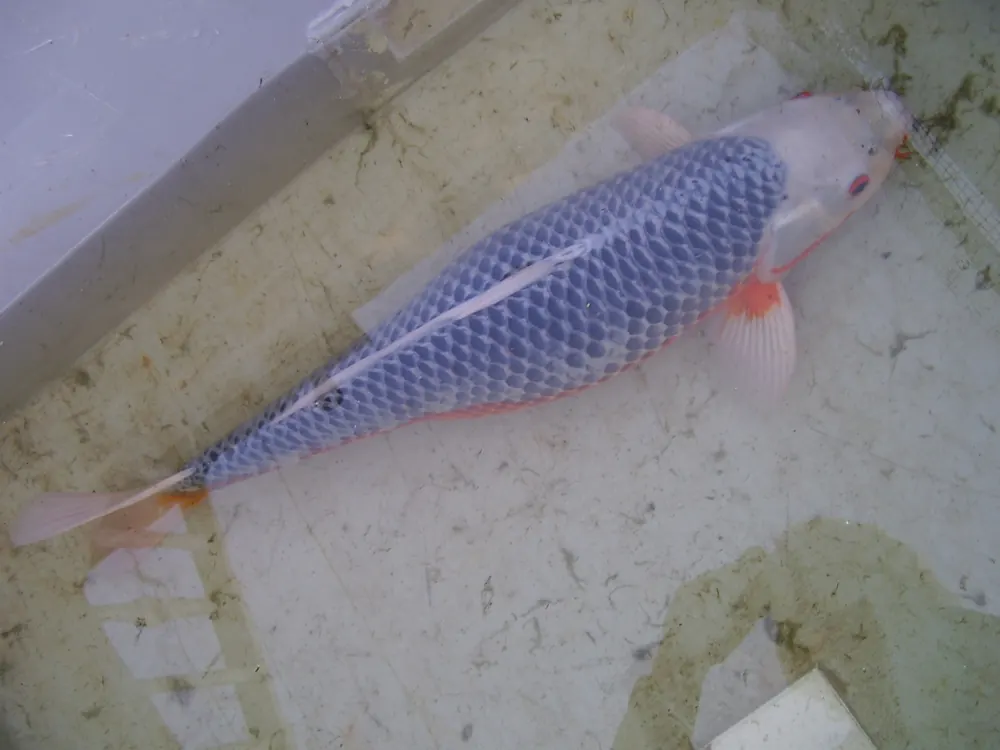
Asagi is classified by the Japan Agricultural Standard (JAS) as koi with an "asagi-ground" (浅黄地) reticulated scale pattern across the back and, as a general rule, scarlet markings on the abdomen.[5] The All Japan Nishikigoi Promotion Association describes it as covered in blue, such as indigo or sky blue, over all parts of the body except the head, with every scale showing a net pattern.[1]According to the Zen Nippon Airinkai (ZNA), Asagi-lineage koi from the early 19th century are believed to be ancestors of modern Nishikigoi.[2] A secondary source notes that a three-colored carp recorded in 1900 at Ritsurin Garden in Takamatsu had a red belly and an asagi (light blue) back with black spots, thought to resemble today's Asagi.[3]- ai (indigo blue)
- hi (red)
- shiroji (white ground)
- sora (gray-blue)
Name and Meaning
The Japanese name 浅黄 has been rendered in secondary sources as meaning pale greenish-blue, spring onion color, or indigo.[3] The American Koi Judges Association glossary gives the term ai as indigo blue and akebi as light blue, both used in describing Asagi shades.[9]Judging points
- Head should be bold, clear white, free of black jyami dots or yellowish tinge.[6]
- Scales should form 5–6 even rows from the dorsal fin to the lateral line without gaps.[6]
- Motoaka covering about one third to one half of the pectoral fin is considered ideal balance.[6]
- Well-defined, undisturbed net pattern with balanced red on belly, fins and cheeks.[1]
- As Asagi matures the net pattern becomes the key point of its beauty, as young fish lack full patterning.[6]
Appearance and the JAS Standard
Under JAS classification, Asagi (entry 2019) is defined as having an asagi-ground body with, as a general rule, scarlet imprints on the abdomen.[5] The AKJA glossary describes Asagi more broadly as a gray-blue koi with red along the sides, cheeks and in the fins.[9] According to Kodama Koi Farm, a US importer, Asagi are characterized by a blue or indigo body and red at the base of the pectoral fins, known as motoaka, which is considered important to the variety's beauty along with Shusui, since both come from the same bloodlines.[6]The All Japan Nishikigoi Promotion Association notes that Asagi with a lot of red patterning are called Hi-asagi in Japan.[1] The AKJA glossary similarly defines Hi Asagi as an Asagi whose red marking extends over the lateral line.[9]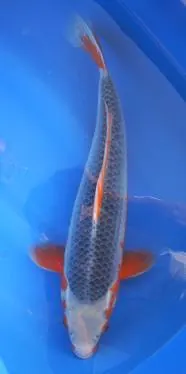

Types of Asagi
- Konjo Asagi — described by the AKJA glossary as a dark blue fish and an early ancestor of the modern Asagi.[9]Gunjo Asagi — according to ZNA, has a clear indigo blue body; Aka Matsuba, Ki Matsuba and Kigoi were produced from Gunjo Asagi lines, though those resulting varieties are placed in the Mujimono class at shows rather than Asagi.[2]Narumi Asagi — ZNA describes scales with two-toned color, darker indigo in the center and paler blue around the edge of each scale.[2] The AKJA glossary calls narumi a mid-blue shade and describes Narumi Asagi as the typical light blue patterned Asagi.[9]Mizu Asagi — ZNA states the body color is pale and light blue, sometimes called Akebi Asagi.[2] AKJA simply defines it as a very light Asagi.[9]Taki Asagi — per ZNA, has white lines between the blue and the hi (red) markings and is described as a very rare variety.[2]Hi Asagi — an Asagi whose red pattern extends over the lateral line, as noted by both the JNPA and the AKJA glossary.[1][9]Asagi Sanke — listed as an Asagi-class variety in ZNA show classification documents.[4]
Scale Forms: Ginrin and Doitsu Asagi
Ginrin forms exist: the All Japan Nishikigoi Promotion Association describes Ginrin-asagi as having shining silver scales with the appearance characteristics of Asagi, and Ginrin-yuki-asagi as having a white body with shining silver scales and red imprints on the belly.[7] ZNA's show classification separately lists Ginrin Asagi within its Kinginrin groupings.[4]The scaleless (doitsu) counterpart of Asagi is Shusui, created by crossing Japanese Asagi with German mirror carp; under JAS definitions, Shusui (entry 2018) is classed as an Asagi possessing the appearance characteristics of Doitsugoi.[5] Kodama Koi Farm describes Shusui as a Doitsu version of Asagi with scales largely confined to a row along the dorsal line.[10][11]Classification at Shows
In the ZNA America classification used for the 2026 ZNA America Koi Show, Asagi forms its own numbered class (class 7), which includes Asagi, Ki Asagi, Hi Asagi and Asagi Sanke, separate from the Shusui class.[4] Results from the 49th Sydney Koi Show list Asagi as its own judged class across multiple size categories, separate from Shusui, Utsurimono, Bekko and Hikari Muji.[12]Under the JAS vocabulary standard, Asagi is one of the named nishikigoi varieties (entry 2019), defined by an asagi-ground body with scarlet imprints generally on the abdomen.[5]Judging and Quality Points
According to Kodama Koi Farm, the head of an Asagi must be a bold, clear white regardless of the body's blue beauty; small black dots (jyami) or yellowish skin on the head are considered faults.[6] The JNPA similarly states that Asagi should have a beautiful white or candy-colored head that is not dark and muddy, a well-defined and undisturbed scale pattern, and a well-balanced arrangement of red on the belly, fins and cheeks.[1]Kodama Koi Farm notes that motoaka (red at the pectoral fin base) covering about one third to one half of the fin is considered the best balance, and that scales should run in 5–6 even rows from the dorsal fin down to the lateral line without gaps or unevenness.[6] Young koi have not yet developed the full net pattern, which the source identifies as the key point of Asagi beauty as the fish matures.[6]Related Varieties
Several later varieties trace their origin to Asagi crosses. Koromo first arose in the 1950s as a cross between a Kohaku and an Asagi, giving red scales a blue or black-edged border.[3] Goshiki was produced by crossbreeding Asagi with Taisho Sanshoku, combining the blue and dark blue of Asagi with the white, red and black of Sanshoku, according to the JNPA; the dealer source Kodama Koi Farm dates Goshiki's creation to 1918 from an Asagi and Kohaku cross.[8][13] The JAS standard notes that Goshiki can be distinguished from Koromo by its asagi-ground base.[5]Shusui, the scaleless form related to Asagi, was created by crossing Japanese Asagi with imported German mirror carp, and is described by one encyclopedia entry as being made by Yoshigoro Akiyama around 1910, while ZNA attributes the cross to Kichigoro Akiyama with notable specimens appearing from around 1928.[3][14]Images

Common questions
What colors does an Asagi koi have?
What is Hi Asagi?
How is Asagi related to Shusui?
What are the main sub-varieties of Asagi?
Related koi topics
References
- ^ Asagi - Variety - All Japan Nishikigoi Promotion Association. All Japan Nishikigoi Promotion Association. jnpa.info/en/nishikigoi/varieties/type/asagi/. Retrieved November 2026.
- ^ ASAGI | Zen Nippon Airinkai. Zen Nippon Airinkai. zna.jp/en/keep-nishikigoi/varieties-of-nishikigoi/asagi/. Retrieved November 2026.
- ^ Koi (Wikipedia). Wikipedia. en.wikipedia.org/wiki/Koi. Retrieved November 2026.
- ^ Koi classification (ZNA 2021), NMZNA 2026 show documents. nmzna.net. nmzna.net/2026%20Show%20Docs/NMZNA%202026%20Koi%20Classification%20…. Retrieved November 2026.
- ^ JAS 0020 Nishikigoi. Vocabulary (MAFF) — Ministry of Agriculture, Forestry and Fisheries (Japan). maff.go.jp/j/jas/jas_standard/attach/pdf/index-536.pdf. Retrieved November 2026.
- ^ Asagi - Koi For Sale - Kodama Koi Farm. Kodama Koi Farm (koi dealer). kodamakoifarm.com/variety/asagi/. Retrieved November 2026.
- ^ B-ginrin - Variety - All Japan Nishikigoi Promotion Association. All Japan Nishikigoi Promotion Association. jnpa.info/en/nishikigoi/varieties/type/b-ginrin/. Retrieved November 2026.
- ^ Goshiki - Variety - All Japan Nishikigoi Promotion Association. All Japan Nishikigoi Promotion Association. jnpa.info/en/nishikigoi/varieties/type/goshiki/. Retrieved November 2026.
- ^ Glossary – American Koi Judges Association (AKJA). American Koi Judges Association. akjajudges.com/glossary/. Retrieved November 2026.
- ^ Shusui - Koi For Sale - Kodama Koi Farm. Kodama Koi Farm (koi dealer). kodamakoifarm.com/variety/shusui/. Retrieved November 2026.
- ^ All About Gosanke Koi Fish Varieties "The Big Three!". Kodama Koi Farm (koi dealer). kodamakoifarm.com/gosanke-koi-fish/. Retrieved November 2026.
- ^ 49th Sydney Koi Show 2026 results (Sydney Koi Show). Sydney Koi Show. sydneykoishow.com/admin/photoresultsnew.toy?eid=206700. Retrieved November 2026.
- ^ Goshiki - Koi for Sale - Kodama Koi Farm. Kodama Koi Farm (koi dealer). kodamakoifarm.com/variety/goshiki/. Retrieved November 2026.
- ^ SHUSUI | Zen Nippon Airinkai. Zen Nippon Airinkai. zna.jp/en/keep-nishikigoi/varieties-of-nishikigoi/shusui/. Retrieved November 2026.