
Utsurimono
Key facts: Utsurimono (写りもの) is a koi variety group defined by a black (sumi) base with white, red, or yellow markings arranged in a zebra-like pattern, encompassing Shiro Utsuri, Hi Utsuri and Ki Utsuri[1][2].
Colors:
Utsurimono (写りもの) koi carry Showa-type sumi patterns over a white, red/orange, or yellow body, according to Zen Nippon Airinkai (ZNA)[2]. The English-language Wikipedia article on koi describes the group as black koi with white, red, or yellow markings in a zebra color pattern, genetically the same as Showa Sanshoku but lacking either the red or the white pigment[1].The three principal members are Shiro Utsuri (white ground), Hi Utsuri (red or orange ground) and Ki Utsuri (yellow ground)[2]. The Japan Agricultural Standard (JAS) for nishikigoi vocabulary separately defines Shiroutsuri (白写り, JAS No. 2004) and Hiutsuri/Kiutsuri (緋写り・黄写り, JAS No. 2021)[4].- sumi (black)
- shiroji (white ground)
- hi (red)
- ki (yellow)
Name and meaning
The word utsuri means “to print” or “reflection,” referring to how the black markings resemble ink stains or impressions on the body[1]. The All Japan Nishikigoi Promotion Association (JNPA) notes that the black pattern running continuously across the body is called utsurizumi (写り墨), the same term used to describe sumi development in Showa Sanshoku[7][8].Judging points
- More extensive white and a well-proportioned, upward-swirling ink pattern are favored in Shiroutsuri[7]
- Even color staining to the pectoral fin tips and a bold, balanced black pattern are valued in Hiutsuri and Kiutsuri[8]
- Sumi should ideally reach the mouth and fins and wrap around the body[5]
- Checkered (Ichimatsu) tail or half-and-half (Hariwake) face patterns add value[5]
- Hachiware/Menware, a half-white half-black face, is considered an ideal pattern for Shiro Utsuri[9]
History and origin
According to Wikipedia, the oldest attested form of the variety was the yellow one, originally called Kuro Ki Madara (黒黄斑, “black and yellow markings”) in the 19th century, later renamed Ki Utsuri (黄写り) by the early 20th-century breeder Elizaburo Hoshino[1]. The red and white forms are referred to as Hi Utsuri (緋写り) and Shiro Utsuri (白写り)[1]. Genetically, Utsurimono share the same background as Showa Sanshoku, differing only in which pigment (red or white) is absent[1]. The US dealer Kodama Koi Farm states that Shiro Utsuri became popular partly because its contrasting black-and-white pattern was especially striking under the indoor lighting of Japanese koi shows, and that the Omosako koi farm was noted as the first breeder to produce a Shiro Utsuri exceeding 40 inches, a size the variety had historically struggled to reach[9].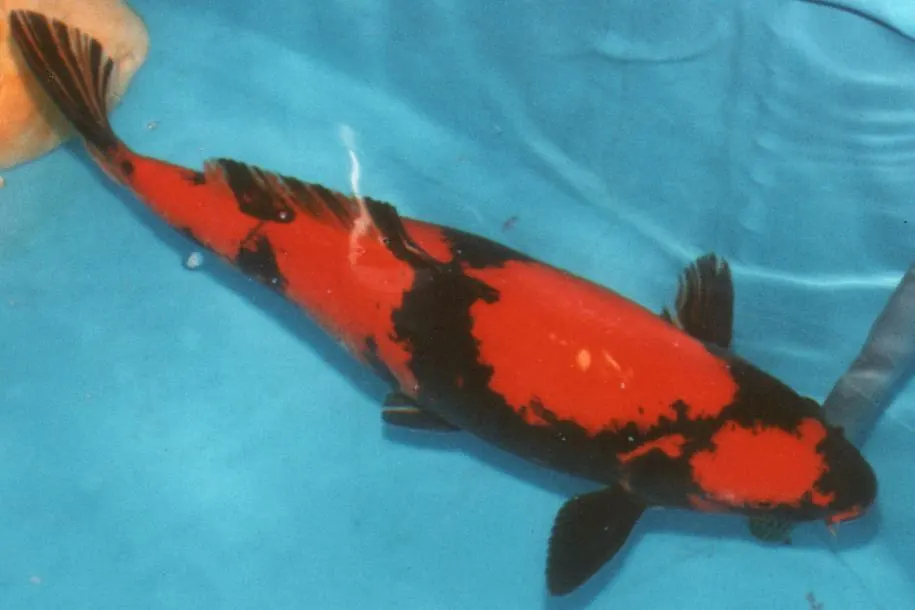

Appearance and the JAS standard
ZNA states that Utsurimono differ from Showa Sanshoku in that Shiro Utsurimono carries no hi (red) markings at all, being purely a black-and-white fish[2]. ZNA also notes that the sumi of Utsurimono koi is said not to fully settle until the fish reaches four or five years of age[2].The JAS vocabulary standard defines Shiroutsuri (白写り, No. 2004) as having a black ground with white markings, bearing utsurizumi, and distinguishable from Bekko by its black (rather than white, red, or yellow) ground[4]. Hiutsuri and Kiutsuri (緋写り・黄写り, No. 2021) are defined as having a black ground with scarlet-red or yellow markings respectively, also bearing utsurizumi, and similarly distinguished from Bekko by the black ground[4]. JNPA paraphrases this, describing Shiroutsuri as monotone black-and-white with no red imprints, noting it can resemble a “white tortoiseshell” (Shiro Bekko) but is distinguishable by the black background and darker ink tone; a useful mnemonic given is that Showa Sanshoku without red is Shiroutsuri, while Taisho Sanshoku without red is Shiro Bekko[7].Sub-types: Shiro, Hi and Ki Utsuri
- Shiro Utsuri (白写り) — Showa-style sumi on a white ground, with no hi markings[2][1]. The Shiro Utsuri page covers this form in detail.Hi Utsuri (緋写り) — Showa-style sumi on a red or orange ground[2]; described by Kodama Koi Farm as having a black base with red patches[10]. See Hi Utsuri.Ki Utsuri (黄写り) — Showa-style sumi on a yellow ground[2]; JNPA describes Kiutsuri as having an “unassuming atmosphere” compared with the more compelling appeal attributed to Hiutsuri[8]. See Ki Utsuri.
Scale forms and related metallic lines
Doitsu-scaled Utsurimono exist; the ZNA America classification lists “Doitsu Utsuri” alongside the scaled forms in its Utsurimono class[3], and dealer listings include examples such as a Doitsu Shiro Utsuri[5]. Ginrin versions also occur; ZNA America groups Ginrin Utsuri within its first Kinginrin class alongside Ginrin Kohaku, Sanke and Showa[3], and dealer listings show Ginrin Shiro Utsuri and Kin Ki Utsuri examples[9][5].Metallic-skinned Utsurimono form a separate class called Hikari-utsurimono, described by ZNA as the Utsurimono family with a metallic body, including Kin Showa, Gin Showa, Gin Shiro and Kin Ki Utsuri[6]. Wikipedia similarly describes Hikari-utsurimono as a cross between the Utsurimono series and Ōgon[1]. The American Koi Judges Association (AKJA) glossary lists several specific examples, such as Gin Shiro (a metallic Shiro Utsuri) and Kin Hi Utsuri and Kin Ki Utsuri (metallic Hi and Ki Utsuri)[11]. Kage-patterned forms, with a shadowed, reticulated black overlay, also exist within related classes; the AKJA glossary defines Kage Shiro Utsuri and Kage Hi Utsuri as non-metallic Utsuri with an added kage pattern, classed under Kawarimono[11], and ZNA lists a Kage Utsuri family comprising Shiro Kage Utsuri, Hi Kage Utsuri and Kage Showa within its Kawarimono grouping[12].Classification at shows
The 2021 ZNA nishikigoi classification used for the ZNA America Koi Show lists Utsurimono as its own class (class 3, alongside Showa Sanshoku), covering Shiro Utsuri, Hi Utsuri, Ki Utsuri and Doitsu Utsuri[3]. A separate Hikari Utsurimono class (class 13) covers the metallic forms such as Kin Showa, Gin Showa, Gin Shiro and Kin Kiutsuri[3]. The ZNA SoCal exhibitor registration packet similarly benches non-metallic Shiro, Hi and Ki Utsuri together under “Utsurimono,” in its Group A, and places Hikari Utsurimono (metallics with Utsuri patterns, including Kin Showa) in Group B[13]. Under the JAS vocabulary standard, Shiroutsuri (No. 2004) and Hiutsuri/Kiutsuri (No. 2021) are listed as distinct named varieties within the broader standard[4].Differences from similar varieties
Utsurimono is most often confused with Bekko (鼈甲), which also pairs black sumi markings with a white, red, or yellow ground. Both the JAS standard and JNPA note that the distinguishing feature is the ground color underneath: Bekko has a white, red, or yellow ground with black spots, whereas Utsurimono (Shiroutsuri, Hiutsuri, Kiutsuri) has a black ground with white, red, or yellow markings on top[4][7][8]. Kodama Koi Farm’s guide to koi patterns likewise places Shiro Utsuri, Ki Utsuri and Bekko together in the “Sumi pattern” category, noting that in each case the black markings create contrast against the base color, but it also describes Shiro Utsuri and Ki Utsuri as black-based rather than light-based[14]. ZNA further distinguishes Shiro Utsurimono from Showa Sanshoku by noting that Shiro Utsurimono has no hi markings at all[2].Judging and selection notes
JNPA states that for Shiroutsuri, quality is associated with more extensive white markings and an ink pattern that is well-proportioned from head to tail and swirls upward[7]. For Hiutsuri and Kiutsuri, JNPA states that color should ideally be evenly stained to the tips of the pectoral fins, with a well-balanced ink pattern that boldly curls from head to tail[8]. Kodama Koi Farm advises that the pigment and placement of sumi is important and should reach the mouth and fins, ideally wrapping around the entire body, and notes that an Ichimatsu (checkered) tail pattern or a Hariwake (half-and-half) face pattern adds value[5]. Kodama separately notes that an ideal face pattern for Shiro Utsuri is Hachiware (or Menware), where one half of the head is white and the other half black[9]. ZNA notes that sumi in the Utsurimono family is said not to fully settle until the koi is four or five years old, which is relevant when judging young specimens[2].Images
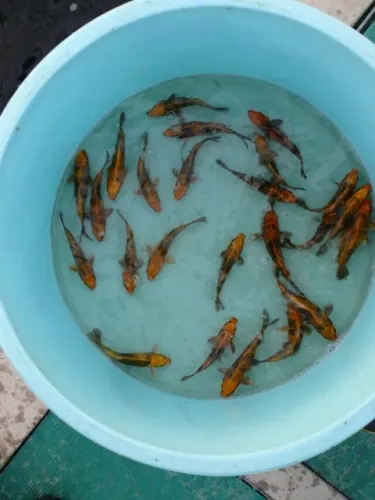

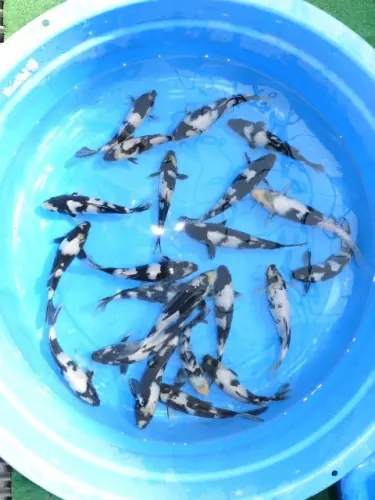

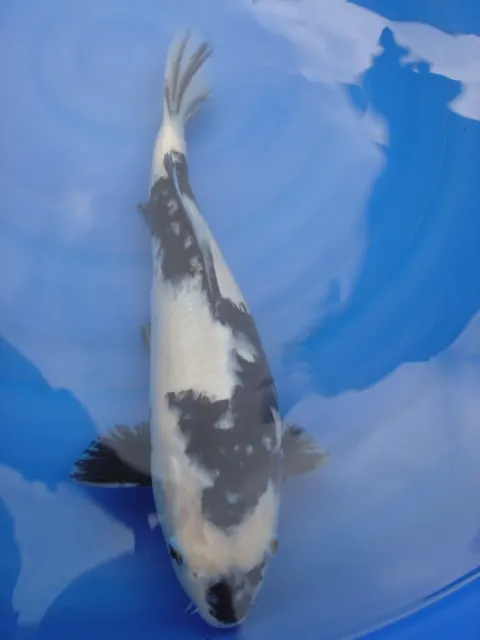

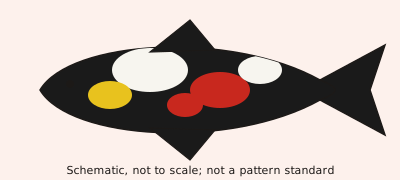
Entries in this section
- Shiro Utsuri — Shiro Utsuri (白写り) is a black koi variety with white markings, part of the Utsurimono family. Learn its JAS definition, history and judging points.
- Hi Utsuri — Hi Utsuri is a black-bodied koi with red (hi) markings, part of the Utsurimono family. Learn its JAS definition, ZNA class, and judging points.
- Ki Utsuri — Ki Utsuri (黄写り) is a black koi with yellow Showa-type sumi patterning, part of the Utsurimono family. Learn its JAS definition, classification and traits.
Common questions
What is the difference between Utsurimono and Bekko?
What are the three main types of Utsurimono?
Shiro Utsuri (white ground), Hi Utsuri (red/orange ground) and Ki Utsuri (yellow ground), all showing Showa-style sumi patterns[2].
Is Utsurimono genetically related to Showa Sanshoku?
Yes; according to Wikipedia, Utsurimono is genetically the same as Showa Sanshoku but lacks either the red pigment (Shiro Utsuri) or the white pigment (Hi Utsuri/Ki Utsuri)[1].
How are metallic Utsurimono classified?
When does the sumi (black) pattern fully develop in Utsurimono?
ZNA states that sumi in the Utsurimono family is said not to settle down until the koi reaches four or five years of age[2].
Related koi topics
References
- ^ Koi (Wikipedia). Wikipedia. en.wikipedia.org/wiki/Utsurimono. Retrieved November 2026.
- ^ UTSURI MONO | Zen Nippon Airinkai. Zen Nippon Airinkai. zna.jp/en/keep-nishikigoi/varieties-of-nishikigoi/utsuri-mono/. Retrieved November 2026.
- ^ Koi classification (ZNA 2021), NMZNA 2026 show documents. nmzna.net. nmzna.net/2026%20Show%20Docs/NMZNA%202026%20Koi%20Classification%20…. Retrieved November 2026.
- ^ JAS 0020 Nishikigoi. Vocabulary (MAFF) — Ministry of Agriculture, Forestry and Fisheries (Japan). maff.go.jp/j/jas/jas_standard/attach/pdf/index-536.pdf. Retrieved November 2026.
- ^ Utsurimono - Koi For Sale - Kodama Koi Farm. Kodama Koi Farm (koi dealer). kodamakoifarm.com/variety/utsurimono/. Retrieved November 2026.
- ^ HIKARI-UTSURIMONO | Zen Nippon Airinkai. Zen Nippon Airinkai. zna.jp/en/keep-nishikigoi/varieties-of-nishikigoi/hikari-utsurimono/. Retrieved November 2026.
- ^ Shiroutsuri - Variety - All Japan Nishikigoi Promotion Association. All Japan Nishikigoi Promotion Association. jnpa.info/en/nishikigoi/varieties/type/shiroutsuri/. Retrieved November 2026.
- ^ Hiutsuri and Kiutsuri - Variety - All Japan Nishikigoi Promotion Association. All Japan Nishikigoi Promotion Association. jnpa.info/en/nishikigoi/varieties/type/hiutsuri-and-kiutsuri/. Retrieved November 2026.
- ^ Shiro Utsuri - Koi For Sale - Kodama Koi Farm. Kodama Koi Farm (koi dealer). kodamakoifarm.com/variety/shiro-utsuri/. Retrieved November 2026.
- ^ Hi Utsuri - Koi for Sale - Kodama Koi Farm. Kodama Koi Farm (koi dealer). kodamakoifarm.com/variety/hi-utsuri/. Retrieved November 2026.
- ^ Glossary – American Koi Judges Association (AKJA). American Koi Judges Association. akjajudges.com/glossary/. Retrieved November 2026.
- ^ KAWARIMONO | Zen Nippon Airinkai. Zen Nippon Airinkai. zna.jp/en/keep-nishikigoi/varieties-of-nishikigoi/kawarimono/. Retrieved November 2026.
- ^ ZNA SoCal 50th Annual Koi Show exhibitor registration packet (2026). znasocal.org. znasocal.org/wp-content/uploads/2026/02/2026-entrant-registration-1…. Retrieved November 2026.
- ^ Koi Patterns and Markings: A Guide to Their Meaning, Types, and Selection. Kodama Koi Farm (koi dealer). kodamakoifarm.com/koi-patterns-and-markings/. Retrieved November 2026.