
Hikari-utsurimono
Key facts: Hikari-utsurimono (光り写りもの) is the ZNA classification for metallic Utsurimono and Showa-type koi, combining a black body and sumi pattern with overall metallic luster.[1][2]
Colors:
Hikari-utsurimono describes nishikigoi bred from Utsurimono-lineage varieties—such as Showa Sanshoku and Shiro Utsuri—crossed with metallic Ogon stock, producing a black-based fish whose whole body shines.[4][6] According to the Zen Nippon Airinkai (ZNA), the group includes Kin Showa, Gin Showa, Gin Shiro, and Kin Ki Utsuri, along with their doitsu (scaleless) forms.[1]Because the family merges the ink-like sumi markings of Utsurimono with metallic skin, judges and breeders note that the luster allows the texture of the sumi to be seen in a way not possible on non-metallic fish.[4]- sumi (black)
- hi (red)
- shiroji (white ground)
- ki (yellow)
- gin (silver)
Name and classification
The All Japan Nishikigoi Promotion Association (JNPA) describes Hikari-utsuri as a generic name for nishikigoi bred from Utsurizumi varieties such as Showa Sanshoku or Shiro Utsuri combined with Hikari-muji metallic stock.[4] The Japanese Agricultural Standard (JAS) lists a related term, 光り写り (hikari-utsuri), defined as a black-ground koi with imprints across the body, where the whole body shines and shows a continuous black ground pattern (utsuri-zumi).[3]The ZNA places Hikari Utsurimono as its own numbered class, separate from the non-metallic Utsurimono class and from Hikari Moyomono.[2][7] The American Koi Judges Association (AKJA) glossary similarly defines Hikari Utsurimono simply as “Metallic Utsuri and Showa.”[5]Judging points
Appearance and the JAS definition
The JAS vocabulary standard defines 光り写り (hikari-utsuri) as having a black ground color, imprints (patterned markings) across the body, and an overall metallic shine, with “utsuri-zumi” — a continuous black ground area — present across the body.[3] Within this category JAS separately defines Kin-showa, described as having a black body with scales, scarlet and white imprints across the body, overall shine, and utsuri-zumi pattern.[4]The ZNA notes that in the broader Utsurimono family more generally, sumi does not fully settle until a koi reaches four or five years of age, a point also relevant to metallic Utsuri-derived fish.[8]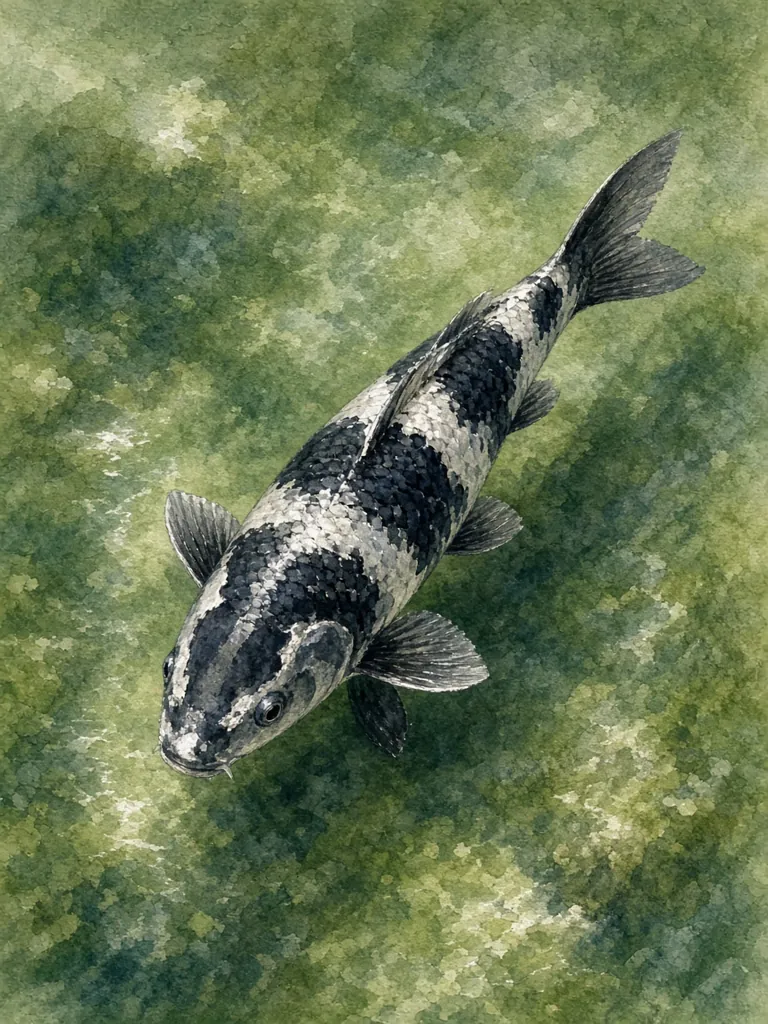
Sub-types
- Kin Showa — a metallic version of Showa Sanshoku, described by the ZNA and JNPA as having the Showa pattern with the whole body shining brightly.[1][4]Gin Showa — termed a “platinum metallic Showa Sanshoku” by the ZNA.[1]Gin Shiro (Gin Shiroutsuri) — a metallic Shiro Utsuri, with a black body, scales, white imprints, overall shine, and utsuri-zumi pattern, per JNPA/JAS description.[4][5]Kin Ki Utsuri — a metallic Ki Utsuri, described as black-bodied with gold imprints and overall shine.[4][5]Kin Hi Utsuri — listed by the AKJA glossary as a metallic Hi Utsuri.[5]Koromo Kin Showa — has the appearance characteristics of Koromo Showa with overall metallic shine, per JNPA.[4]
Scale forms: doitsu, kage, and ginrin
Doitsu forms exist across the family. JNPA describes Doitsu-kin-showa as having almost no scales with exposed skin, otherwise showing Kin-showa’s characteristics, and Doitsu-gin-shiroutsuri similarly.[4] The ZNA also lists doitsu versions of the Hikari-utsurimono varieties generally.[1]Kage (shadow) forms also occur: Kage-gin-shiroutsuri shows a mesh-like ink pattern over the white imprints, and Kage-kin-kiutsuri shows the same mesh pattern over yellow imprints, according to JNPA.[4] Kage variants are discussed further on the page for Kage Utsuri and Kage Showa.Sparkling scale types, known as Kinginrin (Ginrin), are judged as a separate classification from Hikarimono, including Hikari Utsurimono, at ZNA shows.[2][9]Classification at shows
The ZNA lists Hikari Utsurimono as class 13 in its standard nishikigoi classification, giving examples of Kin Showa, Gin Showa, Gin Shiro, Kin Kiutsuri, and Doitsu Kin Showa.[2] At the 59th ZNA International Koi Show, Hikari Utsurimono was judged as its own numbered variety group (code 13) with size categories alongside other classes.[7]Regional shows handle the class somewhat differently. The ZNA SoCal exhibitor packet lists “Hikari Utsurimono” as a group within its Group B categories, described as “Metallics with Utsuri patterns & Kin Showa.”[10] The American Koi Judges Association recognizes “Hikari Utsuri” as a distinct classification in its own list.[11]How it differs from similar varieties
Non-metallic Utsurimono (Shiro Utsuri, Hi Utsuri, Ki Utsuri) share the same sumi-over-ground-color structure but lack the metallic skin, placing them in a separate ZNA class (class 4/3) from Hikari Utsurimono (class 13).[2][8]Hikari Moyomono is a related but distinct metallic class that covers multi-colored metallic koi other than metallic Utsuri and Showa, according to the AKJA glossary, which separately defines Hikari Moyomono and Hikari Utsurimono.[5] Wikipedia similarly describes Hikari-utsurimono as a cross between the Utsurimono series and Ōgon, distinguishing it from Hikari-moyomono, which is described as koi with colored markings over a metallic base or in two metallic colors.[6]Judging notes
According to JNPA, the best Hikari-utsuri specimens, as with Hikarimono generally, show high luster throughout the body, well-balanced and clearly arranged patterns, and a dynamic curl of the ink pattern from head to tail.[4] The US dealer Kodama Koi Farm states that for Utsurimono generally, the pigment and location of the sumi is important and should extend into the mouth and fins, ideally wrapping around the entire body; a checkered (ichimatsu) tail pattern or a half-and-half face (hariwake) is considered highly valuable.[12]Images
Common questions
What is the difference between Hikari-utsurimono and regular Utsurimono?
Regular Utsurimono (Shiro Utsuri, Hi Utsuri, Ki Utsuri) are non-metallic, while Hikari-utsurimono are the metallic versions of these same sumi patterns, placed in a separate ZNA class.[8][2]
What are Kin Showa and Gin Shiro?
Does Hikari-utsurimono include doitsu (scaleless) koi?
Related koi topics
References
- ^ HIKARI-UTSURIMONO | Zen Nippon Airinkai. Zen Nippon Airinkai. zna.jp/en/keep-nishikigoi/varieties-of-nishikigoi/hikari-utsurimono/. Retrieved November 2026.
- ^ Koi classification (ZNA 2021), NMZNA 2026 show documents. nmzna.net. nmzna.net/2026%20Show%20Docs/NMZNA%202026%20Koi%20Classification%20…. Retrieved November 2026.
- ^ JAS 0020 Nishikigoi. Vocabulary (MAFF) — Ministry of Agriculture, Forestry and Fisheries (Japan). maff.go.jp/j/jas/jas_standard/attach/pdf/index-536.pdf. Retrieved November 2026.
- ^ Hikari-utsuri - Variety - All Japan Nishikigoi Promotion Association. All Japan Nishikigoi Promotion Association. jnpa.info/en/nishikigoi/varieties/type/hikari-utsuri/. Retrieved November 2026.
- ^ Glossary – American Koi Judges Association (AKJA). American Koi Judges Association. akjajudges.com/glossary/. Retrieved November 2026.
- ^ Koi (Wikipedia). Wikipedia. en.wikipedia.org/wiki/Utsurimono. Retrieved November 2026.
- ^ 59th ZNA International Koi Show entry rules (ZNA). Zen Nippon Airinkai. zna.jp/wp-content/uploads/2023/07/59th-zna-koishow.pdf. Retrieved November 2026.
- ^ UTSURI MONO | Zen Nippon Airinkai. Zen Nippon Airinkai. zna.jp/en/keep-nishikigoi/varieties-of-nishikigoi/utsuri-mono/. Retrieved November 2026.
- ^ KINGINRIN 1 | Zen Nippon Airinkai. Zen Nippon Airinkai. zna.jp/en/keep-nishikigoi/varieties-of-nishikigoi/kinginrin-1/. Retrieved November 2026.
- ^ ZNA SoCal 50th Annual Koi Show exhibitor registration packet (2026). znasocal.org. znasocal.org/wp-content/uploads/2026/02/2026-entrant-registration-1…. Retrieved November 2026.
- ^ AKJA Classifications – American Koi Judges Association (AKJA). American Koi Judges Association. akjajudges.com/akja_classifications/. Retrieved November 2026.
- ^ Utsurimono - Koi For Sale - Kodama Koi Farm. Kodama Koi Farm (koi dealer). kodamakoifarm.com/variety/utsurimono/. Retrieved November 2026.