
Hikari-moyomono
Key facts: Hikari-moyomono (光り模様) is a classification for metallic koi bearing a pattern of two or more colors, excluding the metallic Utsuri and Showa families, which are classed separately as Hikari-utsurimono[1][2].
Colors:
Hikari-moyomono (光り模様) describes nishikigoi that combine a metallic luster across the whole body with a visible pattern, as opposed to single-colored metallic koi (Hikari-mujimono) or metallic Utsuri/Showa (Hikari-utsurimono)[4][2]. The All Japan Nishikigoi Promotion Association (JNPA) describes it as having a metallic luster and pattern over the whole body, judged on the degree of gloss and the balance of the pattern[4].The group includes widely kept varieties such as Hariwake, Kujaku, Yamato Nishiki, Kikusui, Platinum Kohaku, Shochikubai, Kinsui and Ginsui, among others[1][2].- gin (silver)
- kin (gold)
- hi (red)
- shiroji (white ground)
- sumi (black)
Name and classification
Zen Nippon Airinkai (ZNA) defines Hikari-moyomono as a metallic-bodied koi with two or more colors, explicitly excluding the Utsuri family[1]. The American Koi Judges Association (AKJA) similarly defines the class as including all metallic koi with two or more colors, except metallic Utsuri and Showa[2]. The Japanese Agricultural Standard (JAS) term 光り模様 (hikari-moyo) is defined as a koi that is not black-skinned, carries a pattern, and shines brightly over the whole body[3].In the ZNA show classification, Hikari Moyomono forms class 12, listing Hariwake, Doitsu Hariwake, Kikusui, Platinum Kohaku, Yamato Nishiki, Kinsui, Ginsui, Kujaku, Kujaku Ogon and Kujaku Doitsu among its members[5].Judging points
- High degree of gloss (metallic luster) over the entire body is valued[4].
- Pattern should be arranged in a well-balanced manner across the body[4].
- In Kujaku, a distinct mesh (asagi-like) scale pattern with well-balanced red imprints is sought[6].
- Metallic Utsuri and Showa are excluded from this class and judged separately as Hikari-utsurimono[2][5].
- Doitsu forms are judged for the appearance characteristics of their scaled counterpart despite exposed skin[4].
Appearance and the JAS standard
The JAS definition states that hikari-moyo koi have imprints across the body, other than on a black background, with the whole body shining brightly[4][3]. JNPA notes that quality is assessed by the degree of gloss over the whole body and how well-balanced the pattern arrangement is[4].Specific varieties within the class each carry additional appearance criteria. Sakura-ogon (also called Platinum Kohaku or Kin-Fuji) shows the pattern characteristics of Kohaku over a fully shining body[4][2]. Yamato Nishiki carries the pattern characteristics of Taisho Sanshoku with full-body shine[4]. Hariwake-ogon is described as a white or platinum body with golden imprints across it[4], and the AKJA glossary defines Hariwake as a koi with two colors, one platinum and the other metallic orange, gold or yellow[2].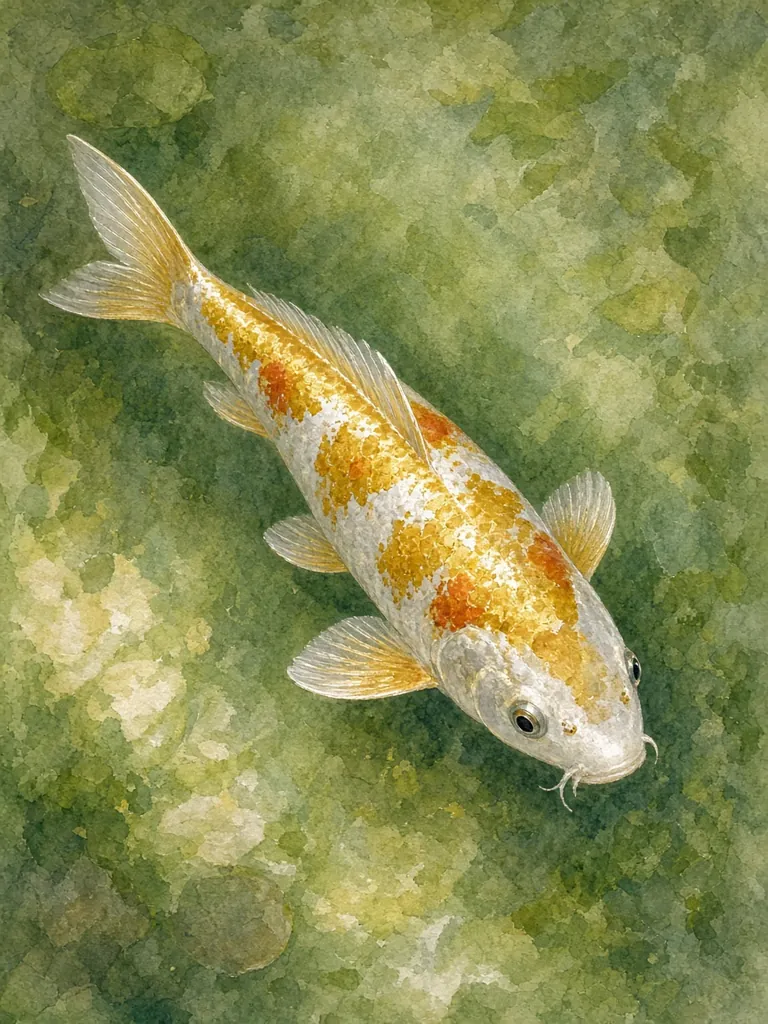
Sub-types
- Hariwake (Hariwake): a platinum koi with metallic orange, gold or yellow markings; variants include Yamabuki Hariwake and Orenji Hariwake[2][1].Kujaku (Kujaku): produced from Asagi stock with added hi pattern through crossbreeding; JNPA describes it as having an asagi-like net pattern with scarlet imprints on the back and a fully shining body[6]. The JAS definition matches this, calling for an asagi pattern and scarlet imprints over a shining whole body[3]. The koi dealer Kodama Koi Farm states that Kujyaku was first bred by a breeder it names as Mr. Nishi Hiranishi in 1960, describing the body as an Ogon with a Matsuba netted pattern of indigo blue along the back[7].Yamato Nishiki (Yamato Nishiki): a metallic koi with the pattern characteristics of Taisho Sanshoku[4].Kikusui (Kikusui): JNPA describes it as having almost no scales, exposed skin, a shining body, and Kohaku-like pattern characteristics[4]. The AKJA glossary defines Kikisui as essentially a doitsu platinum Kohaku[2].Doitsu variants, including Doitsu Yamato Nishiki (also called Heisei Nishiki) and Doitsu Hariwake-ogon, which have almost no scales and exposed skin while retaining the pattern characteristics of their scaled counterparts[4].
Platinum Kohaku, Shochikubai, Kinsui and Ginsui
ZNA lists several additional members of the Hikari-moyomono group, including Metallic Kohaku, Metallic Taisho Sanshoku, Kinsui, Ginsui, Metallic Shusui, Sho-chiku-bai Kujaku, Metallic Ai Goromo, Sakura Ogon, Metallic Kanoko Kohaku, Gin Bekko, Metallic Shiro Bekko, Tora Ogon and Metallic Ki Bekko[1].Platinum Kohaku, also known as Kin-Fuji, is defined by AKJA as a metallic white koi with an overlaying hi pattern[2]. Shochikubai is defined as a metallic Ai Goromo[2]. Kinsui is a metallic Shusui with a gold luster, while Ginsui is a metallic Shusui with a silver luster[2]. Kinzakura is described as a metallic Gotenzakura, and Orenji Hariwake as a silver koi with metallic orange markings[2]. ZNA notes that Kikokuryu and Beni Kikokuryu, although metallic and patterned, are classified in the Kawarimono class at its shows rather than Hikari Moyomono[1][5].Classification at shows
At the ZNA International Koi Show, Hikari Moyomono forms its own numbered class (class 12), separate from Hikari Mujimono (single-colored metallics, class 16) and Hikari Utsurimono (metallic Utsuri, class 13)[5]. The ZNA notes this classification can be adjusted by individual districts or chapters for local shows[5].Under the JAS vocabulary standard, 光り模様 (hikari-moyo) is one of several related terms distinguishing non-black-skinned shining patterned koi (hikari-moyo) from black-skinned shining patterned koi, termed 光り写り (hikari-utsuri), and from unpatterned shining koi, termed 光り無地 (hikari-muji)[3].How it differs from similar varieties
Hikari-moyomono is distinguished from Hikari-mujimono, which covers single-colored metallic koi such as Ogon, Platinum Ogon and Yamabuki Ogon[2][5]. It is also distinguished from Hikari-utsurimono, the class for metallic Utsuri and Showa such as Kin Showa, Gin Showa and Gin Shiro[2][5]. The JAS standard separates these by whether the base is black-skinned and whether a pattern is present at all, giving three distinct terms: hikari-moyo (patterned, non-black skin), hikari-utsuri (patterned, black skin) and hikari-muji (no pattern)[3].Images
Entries in this section
- Hariwake — Hariwake is a metallic two-color koi in the Hikari-moyomono group, combining a platinum ground with gold, orange, or yellow markings.
- Kujaku — Kujaku (孔雀) is a metallic koi with an Asagi-style reticulated net pattern and red hi markings, classed in Hikari-moyomono at shows.
- Yamato Nishiki — Yamato Nishiki (大和錦) is a metallic Sanke, combining the white, red and black pattern of Taisho Sanshoku with a shiny metallic skin, classed under Hikari-moyom
- Kikusui — Kikusui is a doitsu platinum Kohaku-patterned koi with scaleless, exposed skin and a metallic body, classed in Hikari-moyomono.
Common questions
What is Hikari-moyomono?
Is Kujaku a Hikari-moyomono variety?
Are Kikokuryu and Beni Kikokuryu part of this class?
What is the difference between Hikari-moyomono and Hikari-mujimono?
What does JNPA say makes a good Hikari-moyo koi?
According to the All Japan Nishikigoi Promotion Association, a good Hikari-moyo koi has a high degree of gloss over the whole body and a well-balanced pattern arrangement[4].
Related koi topics
References
- ^ HIKARI-MOYOMONO | Zen Nippon Airinkai. Zen Nippon Airinkai. zna.jp/en/keep-nishikigoi/varieties-of-nishikigoi/hikari-moyomono/. Retrieved November 2026.
- ^ Glossary – American Koi Judges Association (AKJA). American Koi Judges Association. akjajudges.com/glossary/. Retrieved November 2026.
- ^ JAS 0020 Nishikigoi. Vocabulary (MAFF) — Ministry of Agriculture, Forestry and Fisheries (Japan). maff.go.jp/j/jas/jas_standard/attach/pdf/index-536.pdf. Retrieved November 2026.
- ^ Hikari-moyo - Variety - All Japan Nishikigoi Promotion Association. All Japan Nishikigoi Promotion Association. jnpa.info/en/nishikigoi/varieties/type/hikari-moyo/. Retrieved November 2026.
- ^ Koi classification (ZNA 2021), NMZNA 2026 show documents. nmzna.net. nmzna.net/2026%20Show%20Docs/NMZNA%202026%20Koi%20Classification%20…. Retrieved November 2026.
- ^ Kujaku - Variety - All Japan Nishikigoi Promotion Association. All Japan Nishikigoi Promotion Association. jnpa.info/en/nishikigoi/varieties/type/kujaku/. Retrieved November 2026.
- ^ Kujyaku - Koi For Sale - Kodama Koi Farm. Kodama Koi Farm (koi dealer). kodamakoifarm.com/variety/kujyaku/. Retrieved November 2026.