
Hariwake
Key facts: Hariwake (張分け) is a metallic nishikigoi variety with a platinum base and bold metallic orange, gold, or yellow markings, classified within the Hikari-moyomono (光り模様) group. [1][2]
Colors:
Hariwake is a two-color metallic koi, one of its colors being platinum and the other metallic orange, gold, or yellow, according to the American Koi Judges Association glossary[1]. It is grouped under Hikari-moyomono, the classification for metallic koi carrying patterns across the body[3][2]. The All Japan Nishikigoi Promotion Association describes Hariwake-ogon as having a white body with scales and golden imprints across the body, with the whole body shining brightly[2].Named sub-varieties include Yamabuki Hariwake and Orange Hariwake, alongside a scaleless Doitsu Hariwake form, as listed by Zen Nippon Airinkai[3].- gin (silver)
- orenji (orange)
- ki (yellow)
- kin (gold)
Name and classification
The American Koi Judges Association glossary defines Hariwake as a koi with two colors, one of which is platinum, the other metallic orange, gold, or yellow, placing it in the Hikari Moyomono group[1]. Zen Nippon Airinkai lists Hariwake Ogon, along with Yamabuki Hariwake, Orange Hariwake, and Hariwake Doitsu, as members of its Hikari-moyomono class[3]. The All Japan Nishikigoi Promotion Association similarly places Hariwake-ogon and Doitsu-hariwake-ogon within its Hikari-moyo category[2].Judging points
Appearance and standard definition
According to the All Japan Nishikigoi Promotion Association, Hariwake-ogon has a white body with scales present and golden imprints spread across the body, with the whole body shining brightly[2]. The Doitsu-hariwake-ogon form has almost no scales across the body, exposing the skin, while retaining the same appearance characteristics as scaled Hariwake-ogon[2].The Japanese Agricultural Standard (JAS) for nishikigoi vocabulary defines the broader Hikari-moyo (光り模様) category as koi with a ground color other than black, bearing imprints, with the whole body shining[5]. Hariwake falls within this category as a patterned metallic koi rather than a single-colored one[2][5].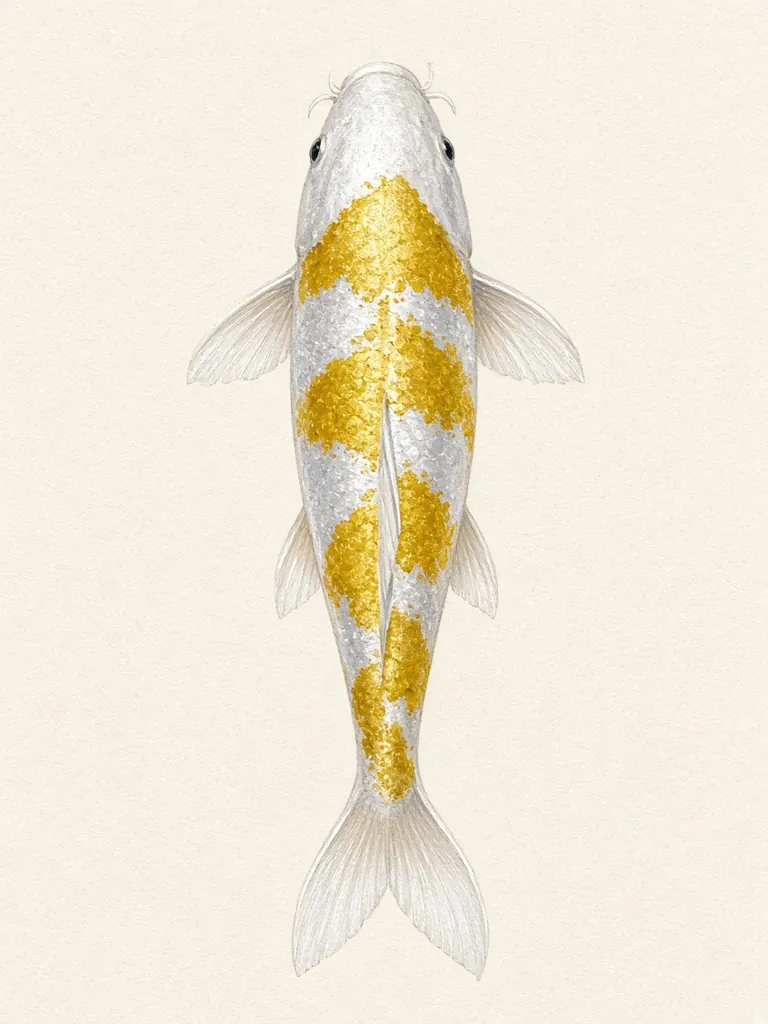
Sub-types
- Yamabuki Hariwake: a platinum koi with metallic yellow markings, per the American Koi Judges Association[1].Orenji (Orange) Hariwake: a silver koi with metallic orange markings[1].Hariwake Matsuba: a silver and yellow metallic koi with a black pattern within each scale, classified under Hikari Moyomono[1].Hariwake Ogon, Yamabuki Hariwake, and Orange Hariwake are named directly by Zen Nippon Airinkai within its Hikari-moyomono list[3].
Scale forms: Doitsu Hariwake
A scaleless Doitsu (ドイツ鯉) form of Hariwake exists, listed as Hariwake Doitsu by Zen Nippon Airinkai and as Doitsu-hariwake-ogon by the All Japan Nishikigoi Promotion Association, which describes it as having almost no scales across the whole body with the skin exposed, while carrying the same appearance characteristics as the scaled Hariwake-ogon[3][2]. The JAS vocabulary standard defines Doitsugoi generally as koi with almost no scales across the body and exposed skin, a trait originating from German food-carp stock later crossed with Japanese nishikigoi varieties[5]. According to the US dealer Kodama Koi Farm, Doitsu lines were imported from Germany around 1904 and were valued for disease resistance and growth rate before being crossed into Japanese varieties such as Asagi to develop scaleless nishikigoi[6]. The same dealer source references a "Lemon Hariwake" produced by a named Japanese breeder as an example of a distinctive Doitsu form, though this remains a single dealer-sourced description rather than an officially defined variety[7].Classification at shows
Zen Nippon Airinkai places Hariwake Ogon, Yamabuki Hariwake, Orange Hariwake, and Hariwake Doitsu within its Hikari-moyomono class[3]. The ZNA America 2026 show classification document likewise lists Hariwake and Doitsu Hariwake under its Hikari Moyomono category, grouped alongside Kikusui, Platinum Kohaku, Yamato Nishiki, Kinsui, Ginsui, and Kujaku varieties[4]. A regional show registration packet from ZNA SoCal describes its benching group for "Hikari Moyomono" as metallics with patterns, explicitly naming Hariwake and Kikokuryu as examples[8]. The American Koi Judges Association glossary also assigns Hariwake, Hariwake Matsuba, and Orenji Hariwake to the Hikari Moyomono classification[1].How it differs from similar varieties
Hariwake is distinguished from single-colored metallic koi such as Platinum Ogon and Yamabuki Ogon, which fall under the single-color Hikari Mujimono (光り無地) classification rather than Hikari-moyomono, since Hikari-muji koi have no imprints and shine in one uniform color across the body, according to the All Japan Nishikigoi Promotion Association[9]. By contrast, Hariwake carries a distinct two-color pattern of platinum plus metallic orange, gold, or yellow[1]. It also differs from other Hikari-moyomono members such as Kikusui, which combines a Doitsu Kohaku-style pattern with reduced scaling, and Yamato Nishiki, which carries a metallic Taisho Sanshoku pattern rather than the simpler two-color scheme of Hariwake[3][2].Images
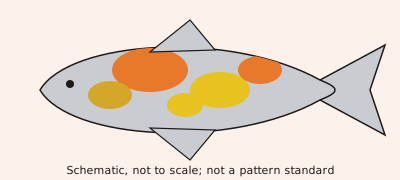
Common questions
What does Hariwake mean as a koi variety?
Hariwake refers to a metallic koi with two colors, one platinum and the other metallic orange, gold, or yellow, according to the American Koi Judges Association glossary[1].
Is Hariwake the same as Yamabuki Hariwake?
What show category does Hariwake compete in?
Is there a scaleless version of Hariwake?
Related koi topics
References
- ^ Glossary – American Koi Judges Association (AKJA). American Koi Judges Association. akjajudges.com/glossary/. Retrieved November 2026.
- ^ Hikari-moyo - Variety - All Japan Nishikigoi Promotion Association. All Japan Nishikigoi Promotion Association. jnpa.info/en/nishikigoi/varieties/type/hikari-moyo/. Retrieved November 2026.
- ^ HIKARI-MOYOMONO | Zen Nippon Airinkai. Zen Nippon Airinkai. zna.jp/en/keep-nishikigoi/varieties-of-nishikigoi/hikari-moyomono/. Retrieved November 2026.
- ^ Koi classification (ZNA 2021), NMZNA 2026 show documents. nmzna.net. nmzna.net/2026%20Show%20Docs/NMZNA%202026%20Koi%20Classification%20…. Retrieved November 2026.
- ^ JAS 0020 Nishikigoi. Vocabulary (MAFF) — Ministry of Agriculture, Forestry and Fisheries (Japan). maff.go.jp/j/jas/jas_standard/attach/pdf/index-536.pdf. Retrieved November 2026.
- ^ Doitsu - Koi For Sale - Kodama Koi Farm. Kodama Koi Farm (koi dealer). kodamakoifarm.com/variety/doitsu/. Retrieved November 2026.
- ^ Doitsu Variety - The beauty of Scaleless Koi, Unique Koi Varieties. Kodama Koi Farm (koi dealer). kodamakoifarm.com/doitsu-variety-beauty-no-scales/. Retrieved November 2026.
- ^ ZNA SoCal 50th Annual Koi Show exhibitor registration packet (2026). znasocal.org. znasocal.org/wp-content/uploads/2026/02/2026-entrant-registration-1…. Retrieved November 2026.
- ^ Hikari-muji - Variety - All Japan Nishikigoi Promotion Association. All Japan Nishikigoi Promotion Association. jnpa.info/en/nishikigoi/varieties/type/hikari-muji/. Retrieved November 2026.