
Kin Matsuba and Gin Matsuba
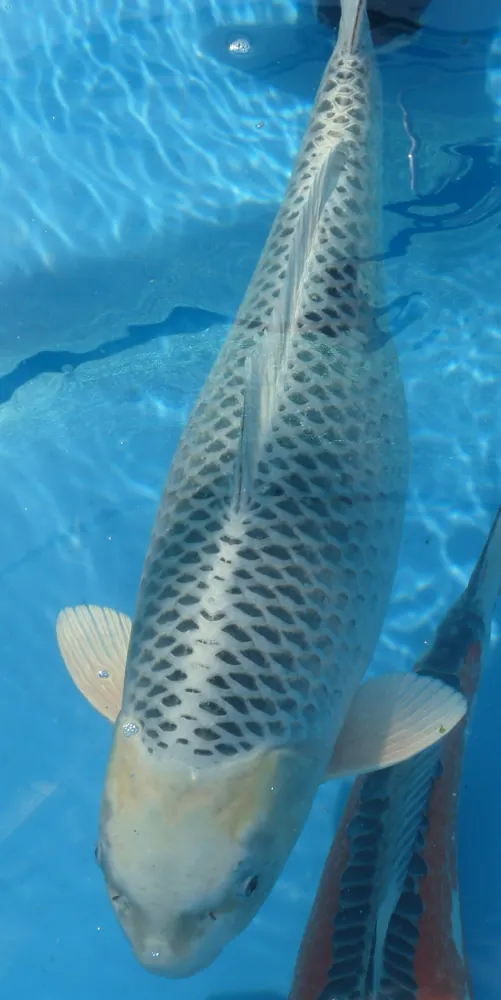
Key facts: Kin Matsuba (金松葉) and Gin Matsuba (銀松葉) are single-colored metallic koi — gold-bodied and silver-bodied respectively — on which every scale carries a black, pine-cone-shaped matsuba marking.[1][2]
Colors:
According to the All Japan Nishikigoi Promotion Association, Nishikigoi with Matsuba-mon — a pattern in which each scale is marked black — are called Matsuba-kei, and those that also shine with metallic luster are called Kin-matsuba and Gin-matsuba.[1] The American Koi Judges Association similarly defines Gin Matsuba as “a metallic silver Koi with a black ‘pinecone’ Matsuba pattern in the scales,” and notes that Matsuba Ogon is another name used for Kin Matsuba.[2]Both varieties belong to the broader Hikari-mujimono group, the classification for single-colored metallic koi with no body pattern other than the scale-by-scale matsuba marking.[7][1]- kin (gold)
- gin (silver)
- sumi (black)
Name and classification
Kin (金) means gold and Gin (銀) means silver, describing the body color beneath the matsuba markings, while matsuba refers to the pine-cone scale pattern.[1][2] The JNPA lists Ki-matsuba-ogon — which “shines in turmeric or dark gold, and has a matsuba-mon on the entire back” and “is also called kin-matsuba in Japan” — alongside Gin-matsuba, which “shines silvery white” with the same matsuba pattern.[1]Judging points
Appearance and the JAS standard
The Japanese Agricultural Standard (JAS 0020) defines the parent category hikari-muji (光り無地, No. 2017) as koi with no pattern (斑紋がない) whose whole body shines (全身が光り輝く), noting that conventional names within this category include Orange Ogon, Platinum Ogon, and Matsuba Ogon (松葉黄金).[5] Kin Matsuba and Gin Matsuba fit this definition: a solid metallic body color, gold for Kin Matsuba and silvery white for Gin Matsuba, overlaid with a matsuba pattern of black-edged scales running along the back.[1][2]The matsuba-mon pattern itself is also seen on non-metallic koi such as Aka Matsuba (red body) and Ki Matsuba (yellow body), which the JNPA classifies under the plain-colored Muji category rather than Hikari-muji because they lack metallic shine.[8][9]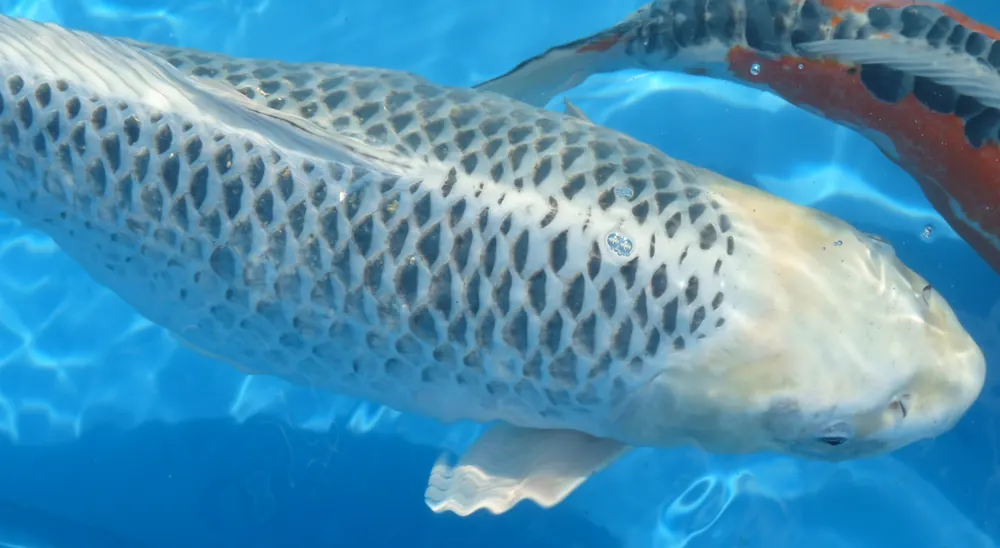

Sub-types and related ogon forms
- Ki-matsuba-ogon (also called Kin Matsuba) — dark gold or turmeric-colored body with matsuba-mon across the entire back.[1]Gin-matsuba — silvery white body with the same matsuba-mon pattern.[1]Aka-matsuba-ogon — a red or vermilion-shining metallic variant with matsuba-mon, listed alongside Kin and Gin Matsuba in the Hikari-muji group.[1]Matsuba Ogon is used by some sources as an alternative English name for Kin Matsuba.[2]
Scale forms: Doitsu and Ginrin
A Doitsu-gin-matsuba form exists, described by the JNPA as having “almost no scales on the whole body,” with the skin exposed, while retaining the appearance characteristics of Gin-matsuba.[1]Ginrin forms also occur: the JNPA describes Ginrin-ki-matsuba as having shining golden or silver scales combined with the appearance characteristics of Ki-matsuba.[6] At the ZNA International Koi Show, Kin Matsuba and Gin Matsuba — including their ginrin forms — are benched together within the Hikari Mujimono class (Class 16).[3]Classification at shows
Under the ZNA's nationwide show classification, Hikari Mujimono (Class 16) explicitly includes Kin Matsuba and Gin Matsuba alongside Ogon, Platinum Ogon, Yamabuki, Orange Ogon, Doitsu Ogon, and Ginrin Hikari-muji.[4] The 59th ZNA International Koi Show entry rules list the same category (Class 16, Hikari Mujimono) as covering Kin Matsuba and Gin Matsuba, including their ginrin and matsuba forms.[3] A regional show packet from ZNA SoCal similarly benches “single-color metallic incl Ginrin & Matsuba” under its Hikari Mujimono group.[10]The non-metallic counterparts, Aka Matsuba and Ki Matsuba, are instead benched in the Mujimono class according to the Zen Nippon Airinkai.[9] At some shows, plain matsuba-patterned koi such as these are also noted within the Kawarimono grouping used for minor varieties, though the ZNA's own documentation places Matsuba specifically within Mujimono.[11][9]How it differs from similar varieties
Kin Matsuba and Gin Matsuba differ from plain Hikari-mujimono varieties such as Yamabuki Ogon and Platinum Ogon in that they carry the black matsuba scale pattern rather than a perfectly unmarked metallic body; the JNPA notes that Yamabuki-ogon and Platinum-ogon “have no imprints,” unlike the matsuba-marked forms.[1]They also differ from Hariwake relatives such as Hariwake Matsuba, which combine platinum with a second metallic color plus matsuba markings and are classified under Hikari Moyomono rather than Hikari Mujimono because they show two colors instead of one.[2][4] According to the Zen Nippon Airinkai, matsuba lines such as Aka Matsuba and Ki Matsuba trace back to the old Gunjo Asagi bloodline, from which Kigoi was also produced; these lineages are non-metallic and therefore distinct from the metallic Kin/Gin Matsuba discussed here.[12]History and keeping notes
The broader Hikari-mujimono group traces to work by Sawata Aoki of Takezawa, Niigata, who from 1921 used a koi showing gold color on its back as a breeding parent, producing dull-metallic forms such as Kin Kabuto, Gin Kabuto and Sakin by the fourth or fifth generation before crossing them with a female koi named ‘Shiro Fuji’ to create the first Ogon, recognized as a variety in 1947.[7][13] Specific history for Kin Matsuba and Gin Matsuba as distinct named forms is not detailed in available sources beyond their listing within this Hikari-muji lineage.[1]A koi named “龍” (Ryu), recorded by the Ojiya Nishikigoi no Sato facility as a Matsuba-ogon (松葉黄金) aged 19 with a body length of 92 cm, is noted by the facility as having scales whose pattern resembled a dragon, giving it its name — an example of the variety kept and displayed in Niigata.[14]Images

Common questions
What is the difference between Kin Matsuba and Gin Matsuba?
Are Kin Matsuba and Gin Matsuba the same as plain Matsuba?
How are Kin Matsuba and Gin Matsuba judged at shows?
Related koi topics
References
- ^ Hikari-muji - Variety - All Japan Nishikigoi Promotion Association. All Japan Nishikigoi Promotion Association. jnpa.info/en/nishikigoi/varieties/type/hikari-muji/. Retrieved November 2026.
- ^ Glossary – American Koi Judges Association (AKJA). American Koi Judges Association. akjajudges.com/glossary/. Retrieved November 2026.
- ^ 59th ZNA International Koi Show entry rules (ZNA). Zen Nippon Airinkai. zna.jp/wp-content/uploads/2023/07/59th-zna-koishow.pdf. Retrieved November 2026.
- ^ Koi classification (ZNA 2021), NMZNA 2026 show documents. nmzna.net. nmzna.net/2026%20Show%20Docs/NMZNA%202026%20Koi%20Classification%20…. Retrieved November 2026.
- ^ JAS 0020 Nishikigoi. Vocabulary (MAFF) — Ministry of Agriculture, Forestry and Fisheries (Japan). maff.go.jp/j/jas/jas_standard/attach/pdf/index-536.pdf. Retrieved November 2026.
- ^ B-ginrin - Variety - All Japan Nishikigoi Promotion Association. All Japan Nishikigoi Promotion Association. jnpa.info/en/nishikigoi/varieties/type/b-ginrin/. Retrieved November 2026.
- ^ HIKARI-MUJIMONO | Zen Nippon Airinkai. Zen Nippon Airinkai. zna.jp/en/keep-nishikigoi/varieties-of-nishikigoi/hikari-mujimono/. Retrieved November 2026.
- ^ Muji - Variety - All Japan Nishikigoi Promotion Association. All Japan Nishikigoi Promotion Association. jnpa.info/en/nishikigoi/varieties/type/muji/. Retrieved November 2026.
- ^ MUJIMONO | Zen Nippon Airinkai. Zen Nippon Airinkai. zna.jp/en/keep-nishikigoi/varieties-of-nishikigoi/mujimono/. Retrieved November 2026.
- ^ ZNA SoCal 50th Annual Koi Show exhibitor registration packet (2026). znasocal.org. znasocal.org/wp-content/uploads/2026/02/2026-entrant-registration-1…. Retrieved November 2026.
- ^ KAWARIMONO | Zen Nippon Airinkai. Zen Nippon Airinkai. zna.jp/en/keep-nishikigoi/varieties-of-nishikigoi/kawarimono/. Retrieved November 2026.
- ^ ASAGI | Zen Nippon Airinkai. Zen Nippon Airinkai. zna.jp/en/keep-nishikigoi/varieties-of-nishikigoi/asagi/. Retrieved November 2026.
- ^ Ogon - Koi For Sale and History - Kodama Koi Farm. Kodama Koi Farm (koi dealer). kodamakoifarm.com/variety/ogon/. Retrieved November 2026.
- ^ 小千谷市 錦鯉の里-つちかわれた伝統と地場産業を明日へ伝える総合産業会館サンプラザ. Ojiya Nishikigoi no Sato. nishikigoinosato.jp/appreciation.html. Retrieved November 2026.