
Yamabuki Ogon
Key facts: Yamabuki Ogon (山吹黄金) is a metallic koi variety whose entire body shines a bright reddish-yellow color known in Japan as yamabuki-color, with no pattern markings.[1] It belongs to the Hikari-mujimono (光無地もの) group of single-colored metallic koi.[2]
Colors:
Yamabuki Ogon (山吹黄金) is one of the named varieties within Hikari-muji, the group of Nishikigoi that have no patterns and whose entire body carries a metallic luster.[1] According to the All Japan Nishikigoi Promotion Association (JNPA), Yamabuki-ogon “has no imprints and its whole body shines bright reddish yellow (Yamabuki-color called in Japan).”[1]The American Koi Judges Association glossary describes Yamabuki Ogon simply as “Metallic solid yellow,” placed in the Hikari Mujimono category.[4] The name yamabuki refers to a plant with pale yellow flowers, used to describe koi with this yellow color.[4]- ki (yellow)
- kin (gold)
History and origin
According to Zen Nippon Airinkai (ZNA), in 1921 Sawata Aoki of Takezawa, Niigata used a koi with some golden color on its back as a breeding parent.[2] By the fourth or fifth generation he had produced dull-metallic forms such as Kin Kabuto, Gin Kabuto, and Sakin, and he eventually produced the first Ogon by cross-breeding these with a female koi named ‘Shiro Fuji’.[2] After many years of further work by Aoki and his son, Ogon became a recognized variety of Nishikigoi in 1947.[2] A secondary dealer source, Kodama Koi Farm, gives a similar account, stating that Sawata Aoki noticed a slight shimmer on a wild black carp during the Taisho period and worked toward creating a fully golden koi, succeeding in 1947.[8] Wikipedia instead dates the variety’s creation to 1946, from wild carp Aoki caught in 1921, illustrating a minor discrepancy between sources on the exact year.[9]Kodama Koi Farm, a koi dealer, also notes that in the Edo period gold, silver, coral, and figured brocade were considered the four national treasures, and that breeders later created Ogon to represent gold, Platinum Ogon to represent silver, Kohaku to represent coral, and Yamato Nishiki to represent the brocade — though this account should be treated as a secondary, dealer-told narrative rather than a formally documented history.[8]Judging points
Appearance and the JAS standard
The official JAS vocabulary standard (JAS 0020, Ministry of Agriculture, Forestry and Fisheries) defines the broader category hikari-muji (光り無地) as koi with no patterning whose whole body shines, noting that conventional hikari-muji names include Orange Ogon, Platinum Ogon, and Matsuba Ogon.[6]Kodama Koi Farm describes Ogon broadly as “a solid color metallic koi, from silver to gold” that shines beautifully in a pond.[8] The Hikari-mujimono group as a whole covers colors including yellow-gold (Yamabuki), silver (Platinum), and orange-gold (Orenji).[2]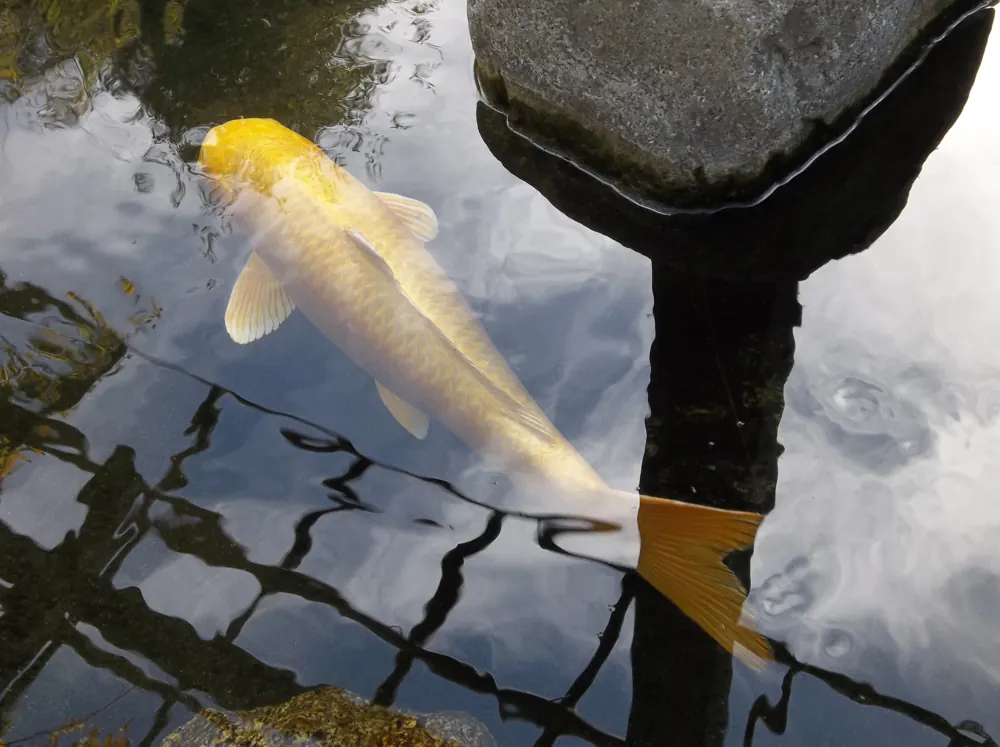

Sub-types and related varieties
Within Hikari-muji, the JNPA lists several related single-colored metallic varieties distinguished by body color: Platinum-ogon (white or light gray), Nezu-ogon (silver-gray), Orange-ogon (reddish yellow called orange-color), and Mukashi-ogon (turmeric or dark gold with some black on scales, fins, and head).[1] Matsuba-patterned metallic forms are also grouped nearby: Ki-matsuba-ogon (also called Kin-matsuba) shines turmeric or dark gold with a pinecone-like matsuba pattern across the back, while Gin-matsuba shines silvery white with the same pattern.[1] Kin Kabuto and Gin Kabuto, early forms in the Ogon lineage, have a shiny gold-brown or silver body with a gold or silver pattern on the head resembling horns.[1]The AKJA glossary likewise lists Yamabuki Ogon as metallic solid yellow under Hikari Mujimono, alongside Orenji Ogon (deep orange metallic), Platinum Ogon (metallic white, also called Purachina), and Tora Ogon (an Ogon with black markings).[4] Yamabuki Hariwake, a related but distinct variety, is a platinum koi with metallic yellow markings and is classified instead as Hikari Moyomono rather than Hikari Mujimono.[4]Scale forms: ginrin and doitsu
A doitsu-scaled version exists: Doitsu-yamabuki-ogon has almost no scales over the whole body, exposing the skin, while retaining the appearance characteristics of Yamabuki-ogon.[1] A sparkling-scaled version also exists under the B-ginrin category: Ginrin-yamabuki-ogon has shining golden or silver scales combined with the appearance characteristics of Yamabuki-ogon.[7] Wikipedia notes more generally that ginrin (金銀鱗, Kinginrin) scales have recently been combined with Ogon varieties to create new ginrin Ogon forms, contrasting with the smooth, even metallic skin typically seen in standard Ogon varieties.[9]Classification at shows
Under the 2021 ZNA classification used for the ZNA America Koi Show, Yamabuki is listed within class 16, Hikari Mujimono, alongside Ogon, Platinum Ogon, Orange Ogon, Doitsu Ogon, Kin Matsuba, Gin Matsuba, and Mizuho Ogon.[5] At the 49th Sydney Koi Show, results list a class titled “Hikari Muji (Ogon)” across multiple size categories, indicating that show organizers commonly group Yamabuki Ogon together with other Ogon varieties for judging purposes.[10]Ogon as a general category is also noted by Wikipedia as competing in the Kawarimono category in some contexts, reflecting variation in how clubs and shows classify metallic single-colored koi.[9]Differences from similar varieties
Yamabuki Ogon is distinguished from Platinum Ogon by body color: Yamabuki shines bright reddish yellow while Platinum Ogon shines white or light gray.[1] It differs from Orange-ogon, which shines a reddish-yellow described specifically as orange-color, and from Mukashi-ogon, which is a more austere turmeric or dark gold with black markings on parts of the scales, fins, and head.[1] Unlike Hikari-moyo varieties such as Hariwake-ogon, which combine metallic luster with a pattern of golden imprints over a white body, Yamabuki Ogon carries no pattern at all.[11] It is also distinct from Yamabuki Hariwake, a platinum-bodied koi with metallic yellow markings classified as Hikari Moyomono rather than a solid-colored Hikari Mujimono variety.[4]Judging and quality
According to Kodama Koi Farm, an ideal prize-winning Ogon is a bright metallic koi without blemishes, with an even pattern of scales and no markings on the face.[8] The JNPA states that a good Hikari-muji is considered to have high luster and even, uniform color spread over the entire body.[1] Ojiya Nishikigoi no Sato, describing Nishikigoi appreciation generally, states that body shape (体形) is the most important point common to all varieties, followed by vivid, deep coloration and balanced patterning, with luster (光り), sheen (艶), and orderly scale arrangement also noted as key points of appreciation.[3]Images
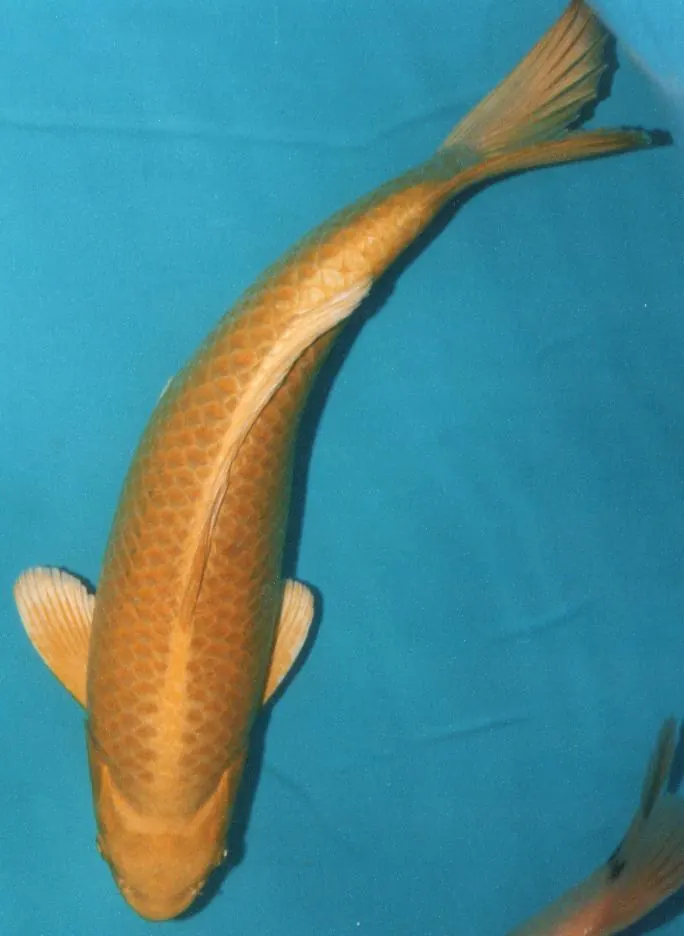

Common questions
What does the name Yamabuki Ogon refer to?
Yamabuki refers to a Japanese plant with pale yellow flowers and is used to describe koi with this yellow color; Ogon means the koi is a solid metallic variety.[4]
How is Yamabuki Ogon different from Platinum Ogon?
Yamabuki Ogon shines bright reddish yellow (yamabuki color), while Platinum Ogon shines white or light gray; both are patternless, single-colored members of Hikari-muji.[1]
Is there a scaleless (doitsu) form of Yamabuki Ogon?
Yes. Doitsu-yamabuki-ogon has almost no scales over the whole body, exposing the skin, while keeping the yellow-golden coloring of standard Yamabuki-ogon.[1]
How is Yamabuki Ogon judged at shows?
Related koi topics
References
- ^ Hikari-muji - Variety - All Japan Nishikigoi Promotion Association. All Japan Nishikigoi Promotion Association. jnpa.info/en/nishikigoi/varieties/type/hikari-muji/. Retrieved November 2026.
- ^ HIKARI-MUJIMONO | Zen Nippon Airinkai. Zen Nippon Airinkai. zna.jp/en/keep-nishikigoi/varieties-of-nishikigoi/hikari-mujimono/. Retrieved November 2026.
- ^ 小千谷市 錦鯉の里-つちかわれた伝統と地場産業を明日へ伝える総合産業会館サンプラザ. Ojiya Nishikigoi no Sato. nishikigoinosato.jp/appreciation.html. Retrieved November 2026.
- ^ Glossary – American Koi Judges Association (AKJA). American Koi Judges Association. akjajudges.com/glossary/. Retrieved November 2026.
- ^ Koi classification (ZNA 2021), NMZNA 2026 show documents. nmzna.net. nmzna.net/2026%20Show%20Docs/NMZNA%202026%20Koi%20Classification%20…. Retrieved November 2026.
- ^ JAS 0020 Nishikigoi. Vocabulary (MAFF) — Ministry of Agriculture, Forestry and Fisheries (Japan). maff.go.jp/j/jas/jas_standard/attach/pdf/index-536.pdf. Retrieved November 2026.
- ^ B-ginrin - Variety - All Japan Nishikigoi Promotion Association. All Japan Nishikigoi Promotion Association. jnpa.info/en/nishikigoi/varieties/type/b-ginrin/. Retrieved November 2026.
- ^ Ogon - Koi For Sale and History - Kodama Koi Farm. Kodama Koi Farm (koi dealer). kodamakoifarm.com/variety/ogon/. Retrieved November 2026.
- ^ Koi (Wikipedia). Wikipedia. en.wikipedia.org/wiki/Koi. Retrieved November 2026.
- ^ 49th Sydney Koi Show 2026 results (Sydney Koi Show). Sydney Koi Show. sydneykoishow.com/admin/photoresultsnew.toy?eid=206700. Retrieved November 2026.
- ^ Hikari-moyo - Variety - All Japan Nishikigoi Promotion Association. All Japan Nishikigoi Promotion Association. jnpa.info/en/nishikigoi/varieties/type/hikari-moyo/. Retrieved November 2026.