
Platinum Ogon
Key facts: Platinum Ogon is a Hikari-mujimono (光無地もの) variety: a single-color metallic koi whose entire body shines white or light gray, with no pattern.[1][2]
Colors:
Platinum Ogon, also known by the Japanese term Purachina (プラチナ), is one of the named varieties within the Hikari-mujimono (光無地もの) group, the solid-colored metallic koi. According to the All Japan Nishikigoi Promotion Association (JNPA), Hikari-muji koi have no pattern and shine with a single metallic color over the whole body, and are classified by that color into varieties such as Yamabuki-ogon, Platinum-ogon, Orange-ogon, Nezu-ogon and Mukashi-ogon.[1] The American Koi Judges Association defines Platinum Ogon simply as a metallic white koi, also known as Purachina.[2]According to the dealer Kodama Koi Farm, Platinum Ogon were produced out of Nezu Ogon, an old variety of gray metallic koi, with Kigoi also playing a part in the broader development of Hikarimoyo lines.[7] The same source states that Ogon varieties trace back to Sawata Aoki, who succeeded in creating the first Ogon koi in 1947 after starting from a carp with a faint shimmer found by children in a brook.[8] Zen Nippon Airinkai gives a related account, crediting Sawato Aoki of Takezawa, Niigata, with beginning selective breeding from a koi with golden color on its back in 1921, eventually producing Kin Kabuto, Gin Kabuto and Sakin, and then the first Ogon by crossing with a female koi named Shiro Fuji; Ogon became a recognized variety in 1947.[9]- gin (silver)
- shiroji (white ground)
Name and classification
The JNPA lists Platinum-ogon among the named members of the Hikari-muji group, describing it as having no imprints, with the whole body shining white or light gray, a shade called “Platinum-color” in Japan.[1] The American Koi Judges Association glossary records the alternate name Purachina for the same variety, and also notes an older name, Shirogane, for Platinum Ogon.[2]Kodama Koi Farm, a US importer, states that breeders historically paired symbolic “treasure” colors with koi varieties of the Edo period's four treasures (gold, silver, coral, and brocade): Ogon representing gold, Platinum Ogon representing silver, Kohaku representing coral, and Yamato Nishiki representing brocade.[8] This account is presented by the dealer and has not been corroborated by other cited sources.Judging points
Appearance and the JAS standard
The Japanese Agricultural Standard (JAS 0020) for nishikigoi terminology defines hikari-muji (光り無地, no. 2017) as a koi with no pattern whose whole body shines; the standard's notes specifically list Purachina Ogon (プラチナ黄金, Platinum Ogon) alongside Orenji Ogon and Matsuba Ogon as conventional names falling under this category, and includes a reference photograph of Purachina Ogon.[3]Kodama Koi Farm describes the ideal Platinum as having a head with a strong metallic shine, with the pectoral fins and entire body shining dazzlingly.[7] As juveniles and in younger years, the whole body shines platinum; the dealer states that once these koi grow beyond 80 cm (28 in), a net-like pattern called fukurin can emerge, and that fukurin is considered the true attractiveness of Hikarimono.[7] The AKJA glossary defines fukurin generally as the area of skin around the smaller scales of good metallic koi, noting that the smaller the scales, the greater the luster.[2]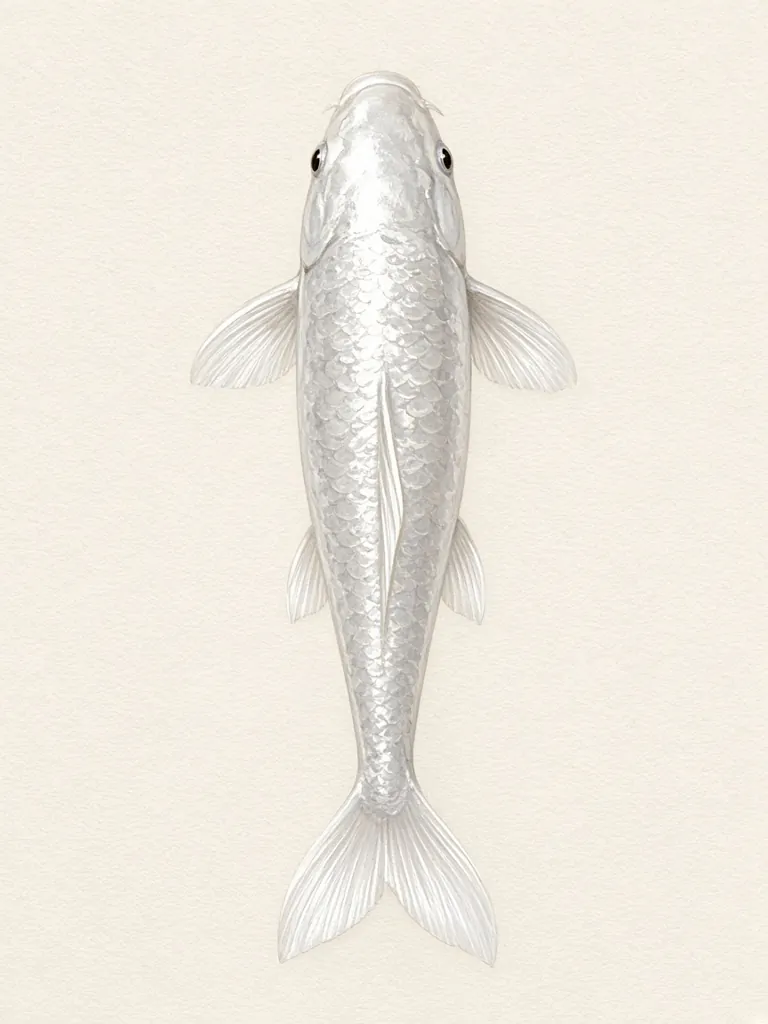
Related Ogon varieties
The JNPA's Hikari-muji listing places Platinum-ogon alongside other single-color metallic varieties distinguished only by body color: Mukashi-ogon (turmeric or dark gold, with some black on scales, fins and head), Yamabuki-ogon (bright reddish yellow), Nezu-ogon (silver-gray), and Orange-ogon (reddish yellow, called “Orange-color” in Japan).[1] Related matsuba-patterned forms are also listed: Gin-matsuba, which shines silvery white with a matsuba pattern across the back, and Ki-matsuba-ogon (also called Kin-matsuba in Japan), which shines turmeric or dark gold with the same pattern.[1]A metallic white koi overlaid with a red (hi) pattern is a separate variety, Platinum Kohaku, also called Kin-fuji, which the AKJA glossary classifies under Hikari Mujimono while JNPA and ZNA both place Sakura-ogon/Platinum Kohaku within the Hikari-moyo (patterned metallic) group rather than the solid Hikari-muji group.[2][6][10] Kujaku, by contrast, is a platinum-based koi with hi markings and matsuba scale patterning classified as Hikari Moyomono.[2]Doitsu and ginrin forms
A scaleless (doitsu) form exists: the JNPA describes Doitsu-platinum-ogon as having almost no scales over the whole body, with the skin exposed, while retaining the appearance characteristics of Platinum-ogon.[1]A sparkling-scaled (ginrin) form is also recognized. The JNPA's entry on B-ginrin describes Ginrin-platinum-ogon as shining with silver scales while retaining the appearance characteristics of Platinum-ogon.[5] Kodama Koi Farm's inventory listings likewise include specimens labeled Ginrin Platinum, indicating the ginrin form is actively bred and traded.[7]Classification at shows
Within the ZNA classification system used for the ZNA America Koi Show, Platinum Ogon is listed under class 16, Hikari Mujimono, alongside Ogon, Yamabuki, Orange Ogon, Doitsu Ogon, Platinum Doitsu, Kin Matsuba, Gin Matsuba, Mizuho Ogon, and Ginrin Hikari-muji.[4] Ginrin versions of Hikari Mujimono varieties, including Ginrin Platinum Ogon, are separately grouped under class 14, Kinginrin 2, which covers all ginrin varieties outside the Gosanke-focused Kinginrin 1 class.[4]The AKJA glossary places Platinum Ogon within the broader Hikari Mujimono category used in North American judging references.[2]Differences from similar varieties
Platinum Ogon is distinguished from Yamabuki Ogon by body color alone: both are solid-color Hikari-muji varieties under the JNPA definitions, but Yamabuki-ogon shines bright reddish yellow (“Yamabuki-color”) while Platinum-ogon shines white or light gray.[1] It differs from Nezu-ogon, which shines silver-gray rather than platinum white, and from Mukashi-ogon, which shines turmeric or dark gold with some black on the scales, fins and head.[1]It is also distinct from matsuba-patterned metallic koi such as Gin Matsuba, which shares a silvery metallic base but carries a black pinecone-like matsuba pattern in the scales, placing it in the Hikari-utsurimono/Hikari Mujimono matsuba group rather than the plain Hikari-muji group.[2][1] Platinum Ogon differs from Platinum Kohaku (Kin-fuji), which has the same metallic white base but carries an overlaying hi (red) pattern and is classified as Hikari-moyo rather than Hikari-muji.[2][6]Images
Common questions
What does “Platinum Ogon” mean?
How is Platinum Ogon different from Yamabuki Ogon?
Both belong to the Hikari-muji group and are judged the same way, but Platinum Ogon shines white or light gray while Yamabuki Ogon shines bright reddish yellow.[1]
Does Platinum Ogon come in a doitsu (scaleless) form?
Yes; Doitsu-platinum-ogon has almost no scales over the body with exposed skin, while keeping the appearance characteristics of standard Platinum-ogon.[1]
Is there a sparkling-scaled version of Platinum Ogon?
How is Platinum Ogon classified at ZNA shows?
Under the ZNA classification used at the ZNA America Koi Show, it sits in class 16, Hikari Mujimono, while ginrin Platinum Ogon falls under class 14, Kinginrin 2.[4]
Related koi topics
References
- ^ Hikari-muji - Variety - All Japan Nishikigoi Promotion Association. All Japan Nishikigoi Promotion Association. jnpa.info/en/nishikigoi/varieties/type/hikari-muji/. Retrieved November 2026.
- ^ Glossary – American Koi Judges Association (AKJA). American Koi Judges Association. akjajudges.com/glossary/. Retrieved November 2026.
- ^ JAS 0020 Nishikigoi. Vocabulary (MAFF) — Ministry of Agriculture, Forestry and Fisheries (Japan). maff.go.jp/j/jas/jas_standard/attach/pdf/index-536.pdf. Retrieved November 2026.
- ^ Koi classification (ZNA 2021), NMZNA 2026 show documents. nmzna.net. nmzna.net/2026%20Show%20Docs/NMZNA%202026%20Koi%20Classification%20…. Retrieved November 2026.
- ^ B-ginrin - Variety - All Japan Nishikigoi Promotion Association. All Japan Nishikigoi Promotion Association. jnpa.info/en/nishikigoi/varieties/type/b-ginrin/. Retrieved November 2026.
- ^ Hikari-moyo - Variety - All Japan Nishikigoi Promotion Association. All Japan Nishikigoi Promotion Association. jnpa.info/en/nishikigoi/varieties/type/hikari-moyo/. Retrieved November 2026.
- ^ Platinum - Koi For Sale - Kodama Koi Farm. Kodama Koi Farm (koi dealer). kodamakoifarm.com/variety/platinum/. Retrieved November 2026.
- ^ Ogon - Koi For Sale and History - Kodama Koi Farm. Kodama Koi Farm (koi dealer). kodamakoifarm.com/variety/ogon/. Retrieved November 2026.
- ^ HIKARI-MUJIMONO | Zen Nippon Airinkai. Zen Nippon Airinkai. zna.jp/en/keep-nishikigoi/varieties-of-nishikigoi/hikari-mujimono/. Retrieved November 2026.
- ^ HIKARI-MOYOMONO | Zen Nippon Airinkai. Zen Nippon Airinkai. zna.jp/en/keep-nishikigoi/varieties-of-nishikigoi/hikari-moyomono/. Retrieved November 2026.