
Kinginrin (Ginrin)
Key facts: Kinginrin (金銀鱗, “gold and silver scales”), usually shortened to Ginrin, refers to koi with metallic, glittering scales rather than a distinct color pattern; ginrin versions exist of almost every other koi variety[1][2].
Colors:
Kinginrin describes a scale type rather than a single pattern: any koi whose scales shine gold (kin) or silver (gin) in a sparkling, glittering way can be called ginrin, as distinct from the smooth, even metallic skin of Ogon varieties[1]. Ginrin forms exist across nearly the full range of koi varieties, from Kohaku and Sanke to Chagoi and Asagi[1][8].Because ginrin scales can appear on any base variety, judging organizations separate ginrin koi into groups so that, for example, a ginrin Kohaku is judged against other ginrin Gosanke rather than against plain Kohaku or against unrelated ginrin kawarimono[2][4].- gin (silver)
- kin (gold)
- shiroji (white ground)
- hi (red)
- sumi (black)
Name and meaning
The term Kinginrin (金銀鱗) is composed of characters referring to gold and silver scales, and is commonly abbreviated to Ginrin in English-language usage[1]. According to the Ojiya Nishikigoi no Sato appreciation guide, 銀鱗 (ginrin) describes koi improved so that only the scales shine in gold or silver, a feature that occurs across many varieties[9].Judging points
- Ginrin scales should appear in two, three, or more clear lines along both sides of the spine; fewer or scattered scales are judged insufficient[2]
- At the ZNA International Koi Show, A Ginrin entries should have more than a set number of clear lines of ginrin scales[10]
- Ginrin should be even throughout the body from shoulders to tail, with at least three rows of shimmering scales and no missing scales[7]
- JNPA states scales shining neatly across the whole body with strong light are considered desirable[6]
- Body shape, color, and pattern are the three basic appreciation criteria for all nishikigoi, alongside shine and orderly scale arrangement[9]
- Judges assess koi by actual appearance rather than variety name when assigning them to a class[10]
Appearance and the standard definition
The Japanese Agricultural Standard (JAS 0020) for nishikigoi vocabulary defines A-ginrin (A銀鱗) as nishikigoi whose scales shine gold (on hi markings, etc.) or silver (on white skin, etc.) and which have the appearance characteristics of Kohaku, Taisho Sanshoku, or Showa Sanshoku; B-ginrin (B銀鱗) is defined as nishikigoi with the same shining gold or silver scales that do not qualify as A-ginrin[5]. Together, A-ginrin and B-ginrin are referred to as Kinginrin (金銀鱗) under the standard[5].For show purposes, the Zen Nippon Airinkai (ZNA) states that ginrin scales should appear clearly in two, three, or more lines along both sides of the spine; koi with fewer or scattered ginrin scales are judged insufficient for the Kinginrin category[2]. The 59th ZNA International Koi Show entry rules similarly specify that A Ginrin entries should have more than a set number of clear lines of ginrin scales[10]. According to the US dealer Kodama Koi Farm, ginrin should be even throughout the body from shoulders to tail, with at least three rows of shimmering scales and no missing scales[7].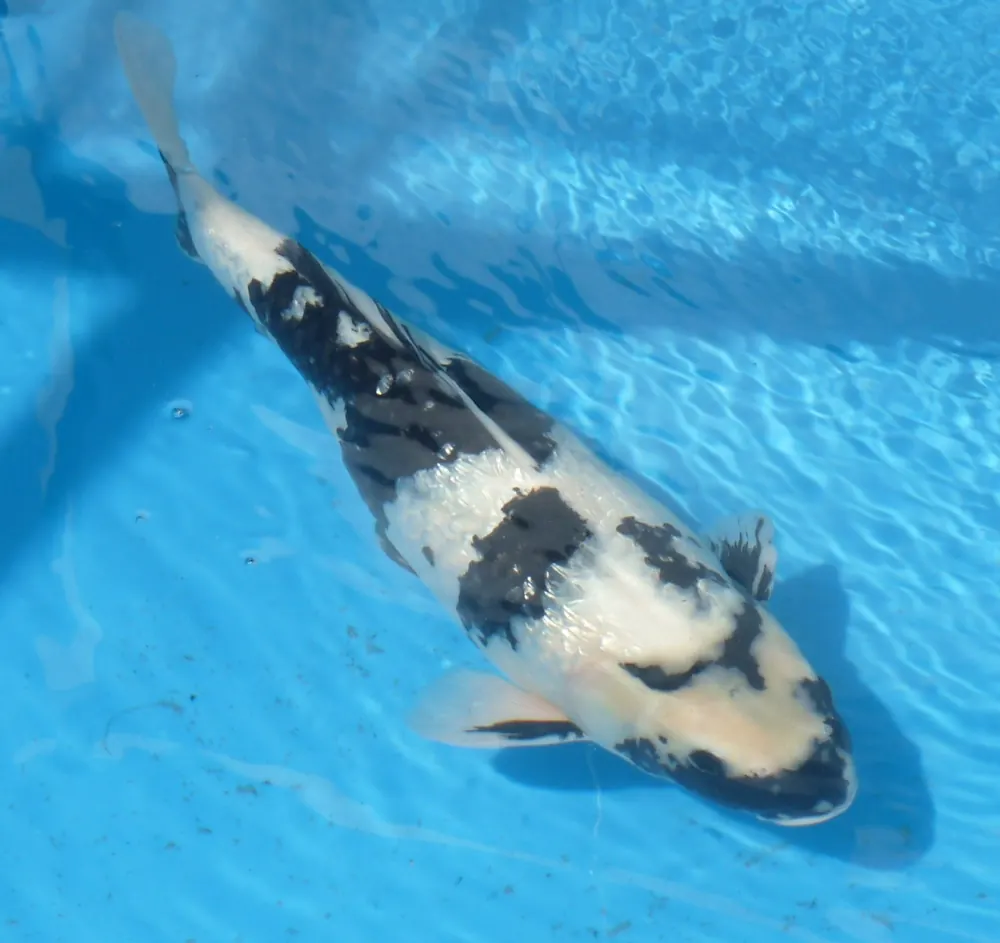

Sub-types and scale styles
- ZNA lists Niigata-style ginrin styles including kado-gin, sudare-gin, kasu-gin, tama-gin, pearl-ginrin, tsubu-gin, and beta-gin, as well as Hiroshima-style styles such as daiya-gin (diamond ginrin), chara-gin, and gacha-gin[2].According to Kodama Koi Farm, Beta Gin is when the entire scale is shining, while Kado Gin has a reflective surface only on the scale edges; Diamond and Pearl Ginrin are also recognized forms[7].The All Japan Nishikigoi Promotion Association (JNPA) states the brightest-shining individuals are called Diamond-ginrin, and those with a round, shining central part of the scale are called Pearl-ginrin[6].The American Koi Judges Association (AKJA) glossary describes pearl ginrin as a solid sparkling area on each scale, also known as Tsuba-gin or Tama-gin[11].According to Kodama Koi Farm, a secondary commercial source, ginrin koi are said to date to the early 1900s, first bred by Mr. Eizaburo Hoshino, with four variations of ginrin appearing since the mid-1900s[7].
Kinginrin A and B (ZNA Group 1 and Group 2)
Because ginrin can occur on almost any variety, show classification systems commonly split Kinginrin into two groups. Under the JAS vocabulary standard, A-ginrin covers individuals with the appearance characteristics of the Gosanke — Kohaku, Taisho Sanshoku, and Showa Sanshoku — while B-ginrin covers shining-scaled individuals that do not qualify as A-ginrin, including varieties such as Ginrin Shiro Utsuri, Ginrin Goshiki, and Ginrin Asagi[6][8][5].ZNA uses a parallel structure at its International Koi Show: Kinginrin 1 (Group 1) is reserved for Ginrin Kohaku, Ginrin Sanke, Ginrin Showa, and Ginrin Utsuri, judged alongside the Gosanke and Utsurimono families, while Kinginrin 2 (Group 2) includes all other kinginrin koi, excluding the Gosanke and Utsurimono families[2][4][3]. ZNA further notes that Ginrin Tancho is instead grouped in the Tancho class, and Ginrin Hikari-mujimono is grouped in the Hikari-mujimono class, rather than in either Kinginrin group[4][10]. The 59th ZNA International Koi Show entry rules likewise list Kinginrin 1 and Kinginrin 2 as separate judging codes, with Kinginrin 2 noted as including Ginrin Goshiki and Ginrin Ochiba among others[10].Regional show rules can vary: registration documents for the ZNA SoCal show list a single combined “Gin Rin B” classification covering all ginrin versions of its non-Gosanke (“B”) groups, rather than following the ZNA International two-group system exactly[12].Classification at shows
The JAS vocabulary standard assigns A-ginrin the code number 2006 and B-ginrin the code number 2007[5]. At the ZNA International Koi Show, Kinginrin 1 is class 5, grouped with Kohaku, Taisho Sanshoku, Showa Sanshoku, and Utsurimono in Group 1, while Kinginrin 2 is class 14, grouped in Group 2[3][10]. The ZNA ruling also notes that any entry koi is judged by its actual appearance, not by its variety name[10].How it differs from similar varieties
Kinginrin scales are distinguished from the smooth, even metallic skin seen in Hikarimono varieties such as Ogon; according to Wikipedia, ginrin's sparkling, glittering scale effect contrasts with that even metallic sheen, and the two traits have more recently been combined to produce ginrin Ogon varieties[1]. Kodama Koi Farm similarly notes that ginrin scales reflect and shine differently from metallic and platinum koi scales[7].Judging notes
Sources describing judging focus on uniformity and density of the shining scales. Kodama Koi Farm states there should be no missing scales for a ginrin koi to win at a show, and that sparkle should be even from shoulders to tail[7]. JNPA states that scales shining neatly across the whole body, with strong light, are considered desirable for both A-ginrin and B-ginrin[6][8]. The Ojiya Nishikigoi no Sato guide lists body shape, color, and pattern as the three basic appreciation criteria common to all nishikigoi varieties, alongside shine, luster, and orderly scale arrangement as additional points of interest[9].Images
Common questions
What does Kinginrin mean?
Kinginrin (金銀鱗) means “gold and silver scales” and describes koi with sparkling, metallic-flake-like scales rather than a specific color pattern; it is commonly shortened to Ginrin[1].
What is the difference between A-ginrin and B-ginrin?
Why are ginrin Gosanke judged separately from other ginrin koi?
What are kado-gin, beta-gin, and diamond ginrin?
Related koi topics
References
- ^ Koi (Wikipedia). Wikipedia. en.wikipedia.org/wiki/Nishikigoi. Retrieved November 2026.
- ^ KINGINRIN 1 | Zen Nippon Airinkai. Zen Nippon Airinkai. zna.jp/en/keep-nishikigoi/varieties-of-nishikigoi/kinginrin-1/. Retrieved November 2026.
- ^ Koi classification (ZNA 2021), NMZNA 2026 show documents. nmzna.net. nmzna.net/2026%20Show%20Docs/NMZNA%202026%20Koi%20Classification%20…. Retrieved November 2026.
- ^ KINGINRIN 2 | Zen Nippon Airinkai. Zen Nippon Airinkai. zna.jp/en/keep-nishikigoi/varieties-of-nishikigoi/kinginrin-2/. Retrieved November 2026.
- ^ JAS 0020 Nishikigoi. Vocabulary (MAFF) — Ministry of Agriculture, Forestry and Fisheries (Japan). maff.go.jp/j/jas/jas_standard/attach/pdf/index-536.pdf. Retrieved November 2026.
- ^ A-ginrin - Variety - All Japan Nishikigoi Promotion Association. All Japan Nishikigoi Promotion Association. jnpa.info/en/nishikigoi/varieties/type/a-ginrin/. Retrieved November 2026.
- ^ Ginrin - Koi for Sale and History - Kodama Koi Farm. Kodama Koi Farm (koi dealer). kodamakoifarm.com/variety/ginrin/. Retrieved November 2026.
- ^ B-ginrin - Variety - All Japan Nishikigoi Promotion Association. All Japan Nishikigoi Promotion Association. jnpa.info/en/nishikigoi/varieties/type/b-ginrin/. Retrieved November 2026.
- ^ 小千谷市 錦鯉の里-つちかわれた伝統と地場産業を明日へ伝える総合産業会館サンプラザ. Ojiya Nishikigoi no Sato. nishikigoinosato.jp/appreciation.html. Retrieved November 2026.
- ^ 59th ZNA International Koi Show entry rules (ZNA). Zen Nippon Airinkai. zna.jp/wp-content/uploads/2023/07/59th-zna-koishow.pdf. Retrieved November 2026.
- ^ Glossary – American Koi Judges Association (AKJA). American Koi Judges Association. akjajudges.com/glossary/. Retrieved November 2026.
- ^ ZNA SoCal 50th Annual Koi Show exhibitor registration packet (2026). znasocal.org. znasocal.org/wp-content/uploads/2026/02/2026-entrant-registration-1…. Retrieved November 2026.