
Shiro Utsuri
Key facts: Shiro Utsuri (白写り) is a black-based koi with white markings, described by the Japan Agricultural Standard as having a black ground color with white imprints across the body[1]. It is a member of the Utsurimono (写り物) family, distinguished from Shōwa Sanshoku by the complete absence of red (hi) markings[2][3].
Colors:
Shiro Utsuri (白写り) is one of the three recognized Utsurimono varieties, alongside Hi Utsuri and Ki Utsuri, and is classed as a black koi carrying white, continuous markings over a black ground[2][4]. Genetically it is considered the same as Showa Sanshoku, but lacking red pigment[3].According to the All Japan Nishikigoi Promotion Association, Shiro Utsuri can be understood as a Showa Sanshoku without the red imprints, just as Shiro Bekko is a Taisho Sanshoku without red[4]. According to the US importer Kodama Koi Farm, the sharp black-and-white contrast made Shiro Utsuri especially eye-catching under the indoor lighting typical of Japanese koi shows, and the variety became popular alongside the Gosanke varieties[7].- sumi (black)
- shiroji (white ground)
Name and classification
The Japanese term utsuri means “to print,” referencing the black markings that resemble ink stains against the body[3]. An older name for the variety was Kuro-Ki-Han, according to a glossary compiled by the American Koi Judges Association[8]. The All Japan Nishikigoi Promotion Association notes the variety looks similar to white-ground Bekko, but the two are distinguished by Shiro Utsuri's black base color rather than a white base with black spots[4].Judging points
- Preferred individuals show more white area and a black pattern well-proportioned from head to tail, appearing to swirl upward[4].
- Sumi pigment and placement should ideally read through the mouth and fins and wrap around the entire body[9].
- A net-like amime pattern on the skin is especially sought after[10].
- Hachiware (Menware), a half-black half-white face pattern, is considered an ideal facial marking[7].
- Body size and conformation matter at shows, as the variety historically struggled to reach large sizes[7].
Appearance and the JAS standard
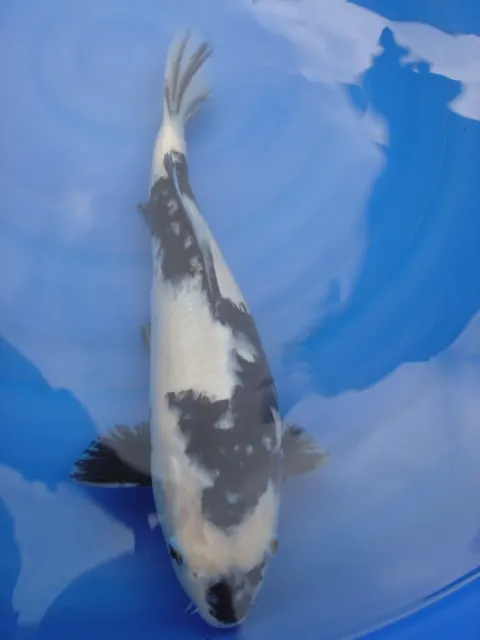
The Ministry of Agriculture, Forestry and Fisheries Japan Agricultural Standard (JAS 0020) defines Shiroutsuri (白写り, entry 2004) as having a black ground color (黒地) with white imprints (白の斑紋) across the body, with the notes that it possesses continuous black areas called utsuri-zumi (写り墨), and that it can be distinguished from Bekko because of its black ground[1].The All Japan Nishikigoi Promotion Association adds that the white and black body color is monotone, with no red imprints at all, and that preferred individuals show more white and a black pattern that is well-proportioned from head to tail and appears to swirl upward[4]. The Zen Nippon Airinkai (ZNA) similarly describes Shiro Utsuri as carrying Showa-typed sumi (black pattern) on a white body, explicitly distinguishing it from Showa Sanshoku by the absence of hi markings[2].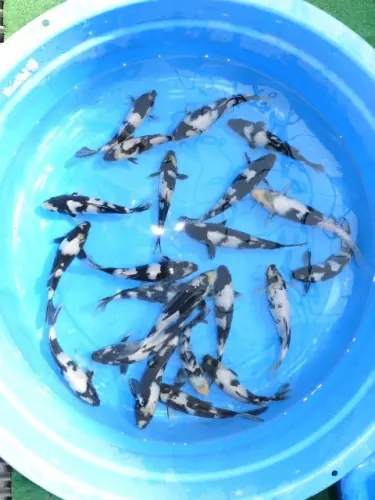

Pattern, sumi and motoguro
According to Kodama Koi Farm, Shiro Utsuri belongs to a category of “sumi pattern” koi, in which bold black markings against white define the variety's appearance, and a fine, net-like black pattern on the skin, called amime, is especially sought after in the variety[10]. ZNA states that sumi in the Utsurimono family is said not to settle until a koi reaches four or five years of age, meaning black markings can continue to develop well into adulthood[2].When judging Utsurimono generally, Kodama Koi Farm notes that the pigment and placement of sumi is important and ideally should read through the mouth and fins, wrapping around the entire body[9]. An ideal face pattern for Shiro Utsuri is Hachiware (also called Menware), where one half of the head is white and the other half black[7].Related forms and sub-types
Kage Shiro Utsuri is a related form with a blurred, reticulated black (kage) pattern over the white areas, and is classed under Kawarimono rather than with standard Utsurimono[8][11]. A metallic version, called Gin Shiro, is a Hikari-Utsurimono classed as a metallic Shiro Utsuri[8][12].Scale forms: doitsu and ginrin
Doitsu Shiro Utsuri, a scaleless or partially scaled form, appears among koi offered by dealers such as Kodama Koi Farm, which lists examples bred by Hiroi Koi Farm[6]. Ginrin Shiro Utsuri, which carries sparkling or mirror-like scales, is likewise offered commercially, for example by Omosako Koi Farm according to Kodama Koi Farm's listings[7]. The JAS standard also recognizes ginrin forms across varieties, categorizing scales that shine gold or silver as A-ginrin or B-ginrin depending on whether they meet specific criteria tied to the Kohaku, Taisho Sanshoku or Showa Sanshoku appearance groups[1].Classification at shows
In the Zen Nippon Airinkai 2021 classification used for the ZNA America Koi Show, Shiro Utsuri is grouped together with Hi Utsuri, Ki Utsuri and Doitsu Utsuri in the Utsurimono class (class 3)[5]. Ginrin-scaled Utsuri are separated into the Kinginrin 1 class alongside ginrin Kohaku, Sanke and Showa[5]. Metallic Shiro Utsuri (Gin Shiro) fall under the Hikari-Utsurimono class[5][12]. At the 14th Asia Cup Koi Show in Thailand, a Shiro Utsuri described as “black & white” won the Jumbo Champion Non-Gosanke B title, according to Zen Nippon Airinkai's show report[13].Distinguishing Shiro Utsuri from similar varieties
Shiro Utsuri can be confused with white-ground Shiro Bekko, but the two differ in base color: Bekko has a white, red, or yellow ground with scattered black spots, while Shiro Utsuri has a black ground with white imprints, per the JAS standard[1][4]. It is genetically equivalent to Showa Sanshoku but lacks the red (hi) pigment that Showa displays[3][2].Size and breeding notes
According to Kodama Koi Farm, Shiro Utsuri historically did not grow as large as other varieties, which made it difficult for the variety to win top show awards despite its visual appeal; the farm states that Omosako Koi Farm became the first breeder to produce a Shiro Utsuri over 40 inches (about 102 cm) in size[7].Images

Common questions
What is the difference between Shiro Utsuri and Showa Sanshoku?
Shiro Utsuri is genetically the same as Showa Sanshoku but lacks red (hi) pigment entirely, showing only black and white[3][2].
How is Shiro Utsuri different from Shiro Bekko?
Shiro Utsuri has a black ground color with white markings, while Shiro Bekko has a white ground color with black spots; the base color is the distinguishing feature[1][4].
At what age does Shiro Utsuri's sumi pattern settle?
According to Zen Nippon Airinkai, sumi in the Utsurimono family, including Shiro Utsuri, is said not to settle until a koi is four or five years old[2].
What is Hachiware on a Shiro Utsuri?
Hachiware, also called Menware, is a face pattern where one half of the head is white and the other half black, considered an ideal facial pattern for the variety according to Kodama Koi Farm[7].
Related koi topics
References
- ^ JAS 0020 Nishikigoi. Vocabulary (MAFF) — Ministry of Agriculture, Forestry and Fisheries (Japan). maff.go.jp/j/jas/jas_standard/attach/pdf/index-536.pdf. Retrieved November 2026.
- ^ UTSURI MONO | Zen Nippon Airinkai. Zen Nippon Airinkai. zna.jp/en/keep-nishikigoi/varieties-of-nishikigoi/utsuri-mono/. Retrieved November 2026.
- ^ Koi (Wikipedia). Wikipedia. en.wikipedia.org/wiki/Utsurimono. Retrieved November 2026.
- ^ Shiroutsuri - Variety - All Japan Nishikigoi Promotion Association. All Japan Nishikigoi Promotion Association. jnpa.info/en/nishikigoi/varieties/type/shiroutsuri/. Retrieved November 2026.
- ^ Koi classification (ZNA 2021), NMZNA 2026 show documents. nmzna.net. nmzna.net/2026%20Show%20Docs/NMZNA%202026%20Koi%20Classification%20…. Retrieved November 2026.
- ^ Doitsu - Koi For Sale - Kodama Koi Farm. Kodama Koi Farm (koi dealer). kodamakoifarm.com/variety/doitsu/. Retrieved November 2026.
- ^ Shiro Utsuri - Koi For Sale - Kodama Koi Farm. Kodama Koi Farm (koi dealer). kodamakoifarm.com/variety/shiro-utsuri/. Retrieved November 2026.
- ^ Glossary – American Koi Judges Association (AKJA). American Koi Judges Association. akjajudges.com/glossary/. Retrieved November 2026.
- ^ Utsurimono - Koi For Sale - Kodama Koi Farm. Kodama Koi Farm (koi dealer). kodamakoifarm.com/variety/utsurimono/. Retrieved November 2026.
- ^ Koi Patterns and Markings: A Guide to Their Meaning, Types, and Selection. Kodama Koi Farm (koi dealer). kodamakoifarm.com/koi-patterns-and-markings/. Retrieved November 2026.
- ^ KAWARIMONO | Zen Nippon Airinkai. Zen Nippon Airinkai. zna.jp/en/keep-nishikigoi/varieties-of-nishikigoi/kawarimono/. Retrieved November 2026.
- ^ HIKARI-UTSURIMONO | Zen Nippon Airinkai. Zen Nippon Airinkai. zna.jp/en/keep-nishikigoi/varieties-of-nishikigoi/hikari-utsurimono/. Retrieved November 2026.
- ^ The 14th Asia Cup Koi Show | Zen Nippon Airinkai. Zen Nippon Airinkai. zna.jp/en/the-14th-asia-cup-koi-show-2/. Retrieved November 2026.