
Kawarimono
Key facts: Kawarimono (変わり鯉, kawarigoi) is a broad, non-metallic koi category used at shows to group varieties that do not fit any of the other standard classes, such as Kohaku or Sanke[1][2].
Colors:
Kawarimono, also romanized as kawarigoi, is described by the Zen Nippon Airinkai (ZNA) as the class into which most minority varieties are grouped at koi shows, since there are over a hundred recognized color and pattern varieties in fine detail[2]. The All Japan Nishikigoi Promotion Association (JNPA) similarly states that Nishikigoi not belonging to the 20 regulated named varieties, such as Kohaku and Taisho Sanshoku, are collectively called Kawarigoi, a term with two senses: fish that cannot be bred stably or that appeared as mutations, and fish that can be produced stably and carry conventional names, such as Ochiba Shigure and Beni Kikokuryu[3].Under the Japanese Agricultural Standard (JAS) definition, kawarigoi (変わり鯉) is defined negatively, as any koi not classified under the other named standards such as kohaku, taisho-sanshoku, showa-sanshoku, and the rest of the JAS vocabulary list; the standard's note states that varieties with especially prominent or numerous distinguishing features are treated as kawarigoi at shows, and that some, such as Kumonryu, have historically graduated into independent named varieties[6][8].- sumi (black)
- shiroji (white ground)
- ki (yellow)
- cha (brown)
- hi (red)
Name and classification concept
The American Koi Judges Association (AKJA) glossary defines Kawarimono as "a classification of all non-metallic Koi not included in any other group," noting that exceptions can shift over time—for example, Kikokuryu, a metallic cross of Kumonryu and Kikusui, was once placed in Kawarimono before being reclassified[9]. The US dealer Kodama Koi Farm describes Kawarimono as nonmetallic koi that "do not fit in to a class of fish like the others do," a broad and individually varied group that may show black or white bodies with markings of various colors on the body, head, tail, and fins[7].Judging points
- Kodama Koi Farm notes that despite being an individually varied class, Kawarimono fish compete well in shows[7]
- ZNA groups entries by named family (Karasu-goi, Matsuba, Kage Utsuri, Kanoko, Ochiba) for show purposes[2]
- The JAS standard specifies precise pattern criteria for named sub-types, such as the mesh-like ink pattern required for Kage forms[3]
- Matsukawa-bake patterns are noted to change with the environment, which can affect how a fish appears at different show dates[3][9]
- At ZNA International Koi Show, Kawarimono (class 10) specifically lists Hajiro, Yotsujiro, and Shikanoko as example judged varieties[5]
Sub-groups and example varieties
ZNA lists several family groupings within Kawarimono: the Karasu-goi family (Karasu-goi, Hajiro, Hage Shiro, Yotsu Jiro, Matsukawabake, Kumonryu, Sumi Nagashi); the Matsuba family (Aka Matsuba, Ki Matsuba, Shiro Matsuba, Matsuba Doitsu); the Kage Utsuri family (Shiro Kage Utsuri, Hi Kage Utsuri, Kage Showa); Kanoko (Kanoko Kohaku, Kanoko Sanke, Kanoko Showa); mono-colored fish (Ki-goi, Aka-muji, Aka Hajiro, Karashi-goi, Chagoi, Soragoi); the Ochiba family (Ochiba Shigure, Koyo); and others, including Doitsu forms of the above, Beni Kumonryu, Ki Kokuryu, and Beni Ki Kokuryu[2].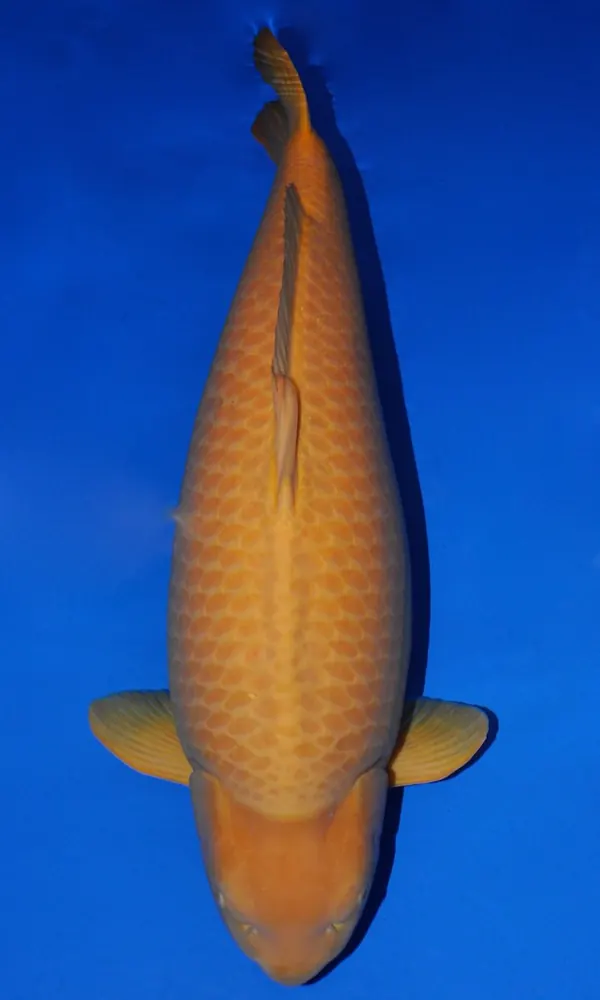
Karasugoi, Matsuba, and Kage patterns
According to the AKJA glossary, Karasugoi are black koi with white or orange bellies, classed as Kawarimono[9]. Matsuba, meaning "pinecone," refers to koi with black markings in the center of each scale; Shiro Matsuba (white body) and Ki Matsuba (yellow body with black pinecone markings) are both placed in Kawarimono, while related metallic forms belong elsewhere[9]. The term kage, meaning "shadow" or "phantom," describes koi with a blurred, reticulated black pattern over white or red skin; the AKJA lists Kage Hi Utsuri, Kage Shiro Utsuri, and Kage Showa as Kawarimono varieties combining an Utsuri or Showa base pattern with this net-like sumi overlay[9]. The JNPA gives parallel definitions: Kage-showa has scarlet and white imprints on a black body with a mesh-like ink pattern over them, Kage-shiroutsuri has white imprints with the same mesh pattern plus an “utsuri-zumi” effect, and Kage-hiutsuri and Kage-kiutsuri follow the same template with red and yellow imprints respectively[3].Kanoko, Ochiba Shigure, and Matsukawabake
Kanoko, meaning "fawn," refers to a dappled red pattern that can appear on several base varieties; the AKJA lists Kanoko Kohaku, Kanoko Sanke, and Kanoko Showa as Kawarimono forms[9]. The JNPA describes Kanoko-kohaku as having a white body with part of the scales dyed red in a dotted pattern, with some individuals showing additional scarlet imprints, and gives similar descriptions for Kanoko-sanshoku, Kanoko-showa, and Kanoko-asagi based on their respective underlying varieties[3]. Ochiba Shigure is described by Wikipedia as a light blue or gray koi with a copper, bronze, or yellow Kohaku-style pattern, reminiscent of fallen autumn leaves on water[1]; the JNPA similarly describes Ochiba-shigure as having a light pale yellow body with earthenware-colored imprints and a mesh-like scale pattern on the back, with Ochiba-utsuri adding black imprints to the same base[3]. Matsukawa-bake is defined by both the AKJA and JNPA as a non-metallic koi with white and jet-black patterns whose black markings can change, sometimes within a short period, due to changes in the fish's environment or water temperature[9][3].Scale forms and related doitsu varieties
ZNA notes that doitsu-scaled forms of the above varieties are themselves grouped within Kawarimono, along with named doitsu-pattern fish such as Beni Kumonryu, Ki Kokuryu, and Beni Ki Kokuryu[2]. Kumonryu, a black doitsu-scaled koi with curling white markings said to resemble Japanese ink paintings of dragons, is known for changing color with the seasons and competes in the Kawarimono category[1]. The JAS definition of kumonryu specifies that the fish is originally black-bodied, developing white areas during growth so that a black, cloud-like pattern appears to float on the surface, with the doitsu scale characteristic, and notes this pattern can change frequently as the environment changes[6].Classification at shows
- At ZNA shows, Kawarimono is listed as class 10 in the ZNA koi classification, covering Hajiro, Hage Shiro, Yotsu Jiro, Sumi Nagashi, Matsukawabake, Kumonryu, Beni Kumonryu, Kage Utsuri, Kanoko, Kikokuryu, and Ochiba Shigure, among others[4].In ZNA International Koi Show entry rules, Kawarimono is coded as class 10, with Hajiro, Yotsujiro, and Shikanoko given as specific example varieties within the class[5].Under the JAS vocabulary standard, kawarigoi is defined as any koi not matching the other listed named varieties (numbered 2001–2007 and 2009–2021), and the standard notes that prominent kawarigoi examples may in future become independent varieties, as Kumonryu already has[6][8].
How Kawarimono differs from related classes
Kawarimono is distinguished from the Mujimono class, which ZNA defines as non-metallic, solid-colored koi including Chagoi, Soragoi, Benigoi, Kigoi, Karasugoi, Karashigoi, and the Matsuba varieties[10]; the JNPA similarly describes Muji as a general name for single-colored Nishikigoi with no pattern, including Karashigoi, Aka-muji, Chagoi, Shiro-muji, and Matsuba[11]. Despite this, ZNA's own Kawarimono listing also places mono-colored fish such as Ki-goi, Aka-muji, Chagoi, and Soragoi within Kawarimono, and the AKJA glossary lists Karasugoi and Soragoi as Kawarimono as well, showing that sources do not always agree on whether solid-colored varieties belong to Kawarimono or to a separate Mujimono class[2][9][10]. Wikipedia describes Kawarimono simply as a "catch-all" competition category for koi that cannot be placed in any other category, into which many new varieties compete[1]. Metallic single-colored koi such as Ōgon are noted by Wikipedia as competing in the Kawarimono category despite being metallic, which the AKJA and JAS standard place instead under Hikarimono or Hikari Mujimono headings, illustrating further inconsistency across classification systems[1][4].Images
Entries in this section
- Kikokuryu and Beni Kikokuryu — Kikokuryu and Beni Kikokuryu are metallic, scaleless koi related to Kumonryu, prized for shifting black and metallic patterns and classified under Kawarimono
- Ochiba Shigure — Ochiba Shigure is a non-metallic koi variety with a pale blue-gray Asagi-style net pattern over a body marked with bronze or tan "autumn leaf" coloring.
- Midorigoi — Midorigoi (緑鯉) is a green-backed, yellow-bodied kawarimono koi related to Shusui, classed under Mujimono in some show systems.
- Kumonryu — Kumonryu (九紋竜) is a black-and-white doitsu koi variety in the Kawarimono class, prized for sumi patterns that shift with the seasons.
- Matsukawabake — Matsukawabake (松川化け) is a scaled, non-metallic black-and-white kawarimono koi whose sumi pattern changes with water temperature and season.
- Karasugoi family — Karasugoi (烏鯉) is an all-black Mujimono koi variety with sub-forms such as Hajiro, Hageshiro and Yotsujiro, classified by ZNA and JNPA.
- Kage Utsuri and Kage Showa — Kage Utsuri and Kage Showa are Kawarimono varieties with a reticulated, shadowy black (sumi) net pattern over the white, red or yellow markings of Utsuri and
- Kanoko — Kanoko is a dappled-red pattern seen on Kohaku, Sanke, Showa and other varieties, caused by scales partly tipped with red rather than solid hi.
- Matsuba — Matsuba (松葉) is a single-colored koi variety with a black pine-cone pattern on each scale, found in red (Aka), yellow (Ki) and white (Shiro) forms within the
Common questions
What does Kawarimono mean?
Is Kawarimono a single variety or a group of varieties?
It is a show category grouping many distinct varieties, including Karasugoi, Matsuba, Kage Utsuri, Kanoko, and Ochiba Shigure forms, rather than a single variety[2].
Why does Kumonryu sometimes appear outside Kawarimono?
The JAS standard notes that varieties classed as kawarigoi can, if they become especially prominent, eventually be given independent named status, as happened historically with Kumonryu[6].
Are solid-colored koi like Chagoi part of Kawarimono?
How is Kawarimono judged at shows?
Kodama Koi Farm, a US koi dealer, states that Kawarimono fish compete "wonderfully" in shows despite their individuality, citing examples like Kumonryu, whose colors change constantly, and Hajiro, a black koi with white fins and tail[7].
Related koi topics
References
- ^ Koi (Wikipedia). Wikipedia. en.wikipedia.org/wiki/Utsurimono. Retrieved November 2026.
- ^ KAWARIMONO | Zen Nippon Airinkai. Zen Nippon Airinkai. zna.jp/en/keep-nishikigoi/varieties-of-nishikigoi/kawarimono/. Retrieved November 2026.
- ^ Kawarigoi - Variety - All Japan Nishikigoi Promotion Association. All Japan Nishikigoi Promotion Association. jnpa.info/en/nishikigoi/varieties/type/kawarigoi/. Retrieved November 2026.
- ^ Koi classification (ZNA 2021), NMZNA 2026 show documents. nmzna.net. nmzna.net/2026%20Show%20Docs/NMZNA%202026%20Koi%20Classification%20…. Retrieved November 2026.
- ^ 59th ZNA International Koi Show entry rules (ZNA). Zen Nippon Airinkai. zna.jp/wp-content/uploads/2023/07/59th-zna-koishow.pdf. Retrieved November 2026.
- ^ JAS 0020 Nishikigoi. Vocabulary (MAFF) — Ministry of Agriculture, Forestry and Fisheries (Japan). maff.go.jp/j/jas/jas_standard/attach/pdf/index-536.pdf. Retrieved November 2026.
- ^ Kawarimono Archives - Kodama Koi Farm. Kodama Koi Farm (koi dealer). kodamakoifarm.com/variety/kawarimono/. Retrieved November 2026.
- ^ JAS 0020 revision notice, 2026 (MAFF). Ministry of Agriculture, Forestry and Fisheries (Japan). maff.go.jp/j/jas/jas_kikaku/attach/pdf/kokujikaisei-733.pdf. Retrieved November 2026.
- ^ Glossary – American Koi Judges Association (AKJA). American Koi Judges Association. akjajudges.com/glossary/. Retrieved November 2026.
- ^ MUJIMONO | Zen Nippon Airinkai. Zen Nippon Airinkai. zna.jp/en/keep-nishikigoi/varieties-of-nishikigoi/mujimono/. Retrieved November 2026.
- ^ Muji - Variety - All Japan Nishikigoi Promotion Association. All Japan Nishikigoi Promotion Association. jnpa.info/en/nishikigoi/varieties/type/muji/. Retrieved November 2026.