
Chagoi
Key facts: Chagoi (茶鯉) is a single-colored (muji) koi variety ranging from olive-brown to copper or bronze, classed among the Mujimono[1][2]. It is widely noted for its docile, friendly temperament and tendency to grow very large[3].
Colors:
Chagoi (茶鯉), meaning “tea koi,” is a non-metallic, solid-colored variety whose body color can range from pale olive-drab green or brown to copper, bronze, or darker subdued orange shades[3]. It belongs to the Mujimono (無地物) group, the category for koi with no pattern on the body, alongside varieties such as Soragoi, Benigoi, Kigoi, and Karashigoi[1][2].According to the All Japan Nishikigoi Promotion Association (JNPA), Mujimono koi are evenly colored all the way to the tips of the pectoral fins, and good body shape is especially valued in judging this group[2]. Chagoi is widely described as docile and friendly toward keepers, and is considered by many keepers to be a sign of good luck[3].- cha (brown)
- orenji (orange)
Name and meaning
The American Koi Judges Association (AKJA) glossary defines cha as “brown” and describes Cha-goi as “a non-metallic light brown or tea colored koi,” placed in the Kawarimono class in its listing[9]. ZNA, by contrast, lists Cha-goi as part of the mono-colored (Mujimono) group rather than Kawarimono[1][5], illustrating that different organizations classify Chagoi somewhat differently.Judging points
- Even brown/tea coloring all the way to the tips of the pectoral fins is highly valued in Mujimono[2]
- Good, balanced body shape is especially important for this muji type[2]
- Overall nishikigoi appreciation prioritizes body shape first, then depth of color, then balance[10]
- No imprint/pattern should appear on the body per the JAS muji definition[6]
Appearance and standard definition
Chagoi color can range from pale olive-drab green or brown through to copper, bronze, and more recently darker, subdued orange tones[3]. Under the JAS 0020 Nishikigoi vocabulary standard (無地, muji), a koi that has no imprint (pattern) on the body is defined simply as having no distinguishing markings, with appearance characteristics judged on body shape, ground color, pattern, size, and luster[6]. The JNPA groups Chagoi with the austere brown muji varieties, alongside the yellow Karashigoi, red Aka-muji, and white Shiro-muji[2].Keepers and secondary sources describe Chagoi as noted for its large adult size and docile, friendly personality, often swimming up to and interacting with keepers[3]. A koi dealer, Kodama Koi Farm, describes Chagoi as having solid, warm colors ranging from deep orange to brown, with a simplicity and earthy tone that is distinctive among koi varieties[11].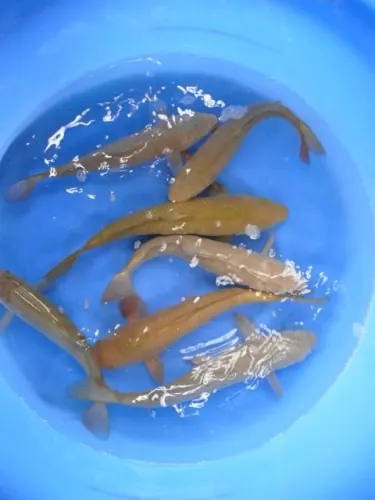

Sub-types and related Mujimono varieties
Chagoi is one of several solid-color Mujimono varieties, which also include Soragoi (gray-blue), Benigoi (red), Kigoi (yellow), Karashigoi (mustard-yellow), and Karasugoi (jet black)[1][2]. The JNPA notes that Karashigoi in particular can exceed one meter (about 3.3 ft) in length and perform notably well at koi shows, a trait shared informally with other large Mujimono such as Chagoi[2]. A record kept at the Ojiya Nishikigoi no Sato facility in Niigata documented a Chagoi individual (referred to by the kanji for its variety) at around 92 cm in length and 12.5 kg at 20 years of age, illustrating the large size this muji type can reach[10].Scale forms: Doitsu and Ginrin Chagoi
Doitsu-chagoi is a scale-reduced form in which almost no scales are present on the body, exposing the skin, while retaining the appearance characteristics of Chagoi[7]. ZNA notes that Doitsu Muji and Ginrin Muji versions of Mujimono varieties are judged within the Mujimono class at ZNA shows[1].Ginrin-chagoi has shiny golden or silver scales combined with the appearance characteristics of standard Chagoi, according to the JNPA[8]. Ginrin Chagoi individuals are also traded commercially; for example, Kodama Koi Farm, a koi dealer, has listed Ginrin Chagoi stock from a Japanese breeder[12].Classification at shows
Organizations differ somewhat in how Chagoi is grouped for competition. The Zen Nippon Airinkai (ZNA) 2021 classification used for the ZNA America Koi Show places Chagoi within category 15, Mujimono, alongside Soragoi, Karashi, Matsuba, Karasugoi, Kigoi, Midori Goi, and Aka Muji, including their Doitsu and Ginrin forms[4]. ZNA's own variety page similarly lists Chagoi under Mujimono[1]. By contrast, the AKJA glossary and ZNA's Kawarimono page both place Cha-goi within the Kawarimono grouping in some contexts, reflecting that mono-colored varieties are sometimes bundled with the broader miscellaneous Kawarimono class at certain shows[9][5]. See how koi varieties are classified for more on how these groupings can vary by organization and show.How Chagoi differs from similar varieties
Chagoi is distinguished from other Mujimono by its brown-to-bronze base color, compared with the gray-blue tone of Soragoi, the yellow of Kigoi, and the mustard-yellow of Karashigoi, all of which share the same unpatterned body plan within the Mujimono group[1][2]. It differs from the Ochiba Shigure, a Kawarimono variety with a Kohaku-style brown pattern over a gray-blue base, since Chagoi itself carries no secondary pattern[3]. Chagoi also lacks the black ink-brushstroke markings (sumi) that define Showa Sanshoku or the Utsurimono varieties[11].Keeping notes
Chagoi is frequently noted for a docile and friendly temperament, often described as approaching keepers at the pond edge, and for reaching a large adult size[3]. A specimen documented at the Ojiya Nishikigoi no Sato facility reached roughly 92 cm and 12.5 kg at 20 years old, indicating the substantial size Chagoi can attain over a long lifespan[10]. General guidance on koi appreciation from the same Niigata facility states that the beauty of nishikigoi is judged first on body shape, then on color and pattern balance, criteria that apply to Chagoi as to other varieties[10].Images
Common questions
What color is a Chagoi koi?
Chagoi ranges from pale olive-drab green or brown to copper, bronze, or darker subdued orange shades[3].
Is Chagoi a Mujimono or Kawarimono variety?
Do Chagoi grow larger than other koi?
Is there a scaleless or sparkling-scale Chagoi?
Why are Chagoi considered good luck?
Chagoi is widely described as a sign of good luck among koi keepers, linked to its docile, friendly personality[3].
Related koi topics
References
- ^ MUJIMONO | Zen Nippon Airinkai. Zen Nippon Airinkai. zna.jp/en/keep-nishikigoi/varieties-of-nishikigoi/mujimono/. Retrieved November 2026.
- ^ Muji - Variety - All Japan Nishikigoi Promotion Association. All Japan Nishikigoi Promotion Association. jnpa.info/en/nishikigoi/varieties/type/muji/. Retrieved November 2026.
- ^ Koi (Wikipedia). Wikipedia. en.wikipedia.org/wiki/Nishikigoi. Retrieved November 2026.
- ^ Koi classification (ZNA 2021), NMZNA 2026 show documents. nmzna.net. nmzna.net/2026%20Show%20Docs/NMZNA%202026%20Koi%20Classification%20…. Retrieved November 2026.
- ^ KAWARIMONO | Zen Nippon Airinkai. Zen Nippon Airinkai. zna.jp/en/keep-nishikigoi/varieties-of-nishikigoi/kawarimono/. Retrieved November 2026.
- ^ JAS 0020 Nishikigoi. Vocabulary (MAFF) — Ministry of Agriculture, Forestry and Fisheries (Japan). maff.go.jp/j/jas/jas_standard/attach/pdf/index-536.pdf. Retrieved November 2026.
- ^ Doitsugoi - Variety - All Japan Nishikigoi Promotion Association. All Japan Nishikigoi Promotion Association. jnpa.info/en/nishikigoi/varieties/type/doitsugoi/. Retrieved November 2026.
- ^ B-ginrin - Variety - All Japan Nishikigoi Promotion Association. All Japan Nishikigoi Promotion Association. jnpa.info/en/nishikigoi/varieties/type/b-ginrin/. Retrieved November 2026.
- ^ Glossary – American Koi Judges Association (AKJA). American Koi Judges Association. akjajudges.com/glossary/. Retrieved November 2026.
- ^ 小千谷市 錦鯉の里-つちかわれた伝統と地場産業を明日へ伝える総合産業会館サンプラザ. Ojiya Nishikigoi no Sato. nishikigoinosato.jp/appreciation.html. Retrieved November 2026.
- ^ Koi in Art & Literature: Dive into Their Enduring Presence. Kodama Koi Farm (koi dealer). kodamakoifarm.com/koi-in-art-literature/. Retrieved November 2026.
- ^ Kawarimono Archives - Kodama Koi Farm. Kodama Koi Farm (koi dealer). kodamakoifarm.com/variety/kawarimono/. Retrieved November 2026.