
Karashigoi
Key facts: Karashigoi (からし鯉) is a mustard yellow, non-metallic single-colored (muji) nishikigoi variety, classified alongside Chagoi, Soragoi, and Kigoi in the Mujimono group.[1][2]
Colors:
Karashigoi is a solid, mustard-colored koi belonging to the broader Mujimono (無地) classification, which covers single-color varieties without pattern. According to the All Japan Nishikigoi Promotion Association (JNPA), typical Mujimono varieties include the yellow-bodied Karashigoi, the bright red Aka-muji, the brown Chagoi, and the pure white Shiro-muji.[1]The JNPA notes that Karashigoi are often found in larger sizes, with individuals exceeding one meter in length, and that their performance at koi shows is remarkable.[1]- karashi (mustard)
Name and classification
Karashigoi takes its name from its mustard-yellow body color; a fish kept at Ojiya Nishikigoi no Sato and nicknamed for its “karashi” (mustard) hue illustrates the color association used locally.[7] The variety is treated as part of the Mujimono group by the JNPA, which also includes Aka-muji, Chagoi, and Shiro-muji.[1] The Zen Nippon Airinkai (ZNA) likewise lists Karashigoi among its “mono-colored” group within the Kawarimono class in its variety guide, alongside Kigoi, Aka-muji, Aka Hajiro, Chagoi, and Soragoi.[3]Judging points
- Evenly colored body, including coloring to the tips of the pectoral fins, is highly valued in Mujimono varieties including Karashigoi.[1]
- Good body shape (体形) is emphasized alongside color evenness for this group.[1]
- Large body size is notable and associated with strong show performance for Karashigoi specifically.[1]
- General nishikigoi appreciation criteria of body shape, color, and pattern balance apply, with body shape considered the most important point common to all varieties.[7]
Appearance and standard definition
The JNPA describes Mujimono generally as having no imprints (patterns) across the body, and states that in this category, koi that are evenly colored all the way to the tips of the pectoral fins, combined with a good body shape, are highly valued.[1]The Japanese Agricultural Standard (JAS) for nishikigoi vocabulary defines the general category Muji (無地) simply as koi with no imprint (斑紋) on the body, without enumerating specific body colors such as mustard yellow as a distinct standardized term.[4] This means Karashigoi, while recognized as a named variety by breed organizations such as the JNPA and ZNA, falls under the broader JAS “Muji” definition rather than having its own numbered JAS entry.[4][1]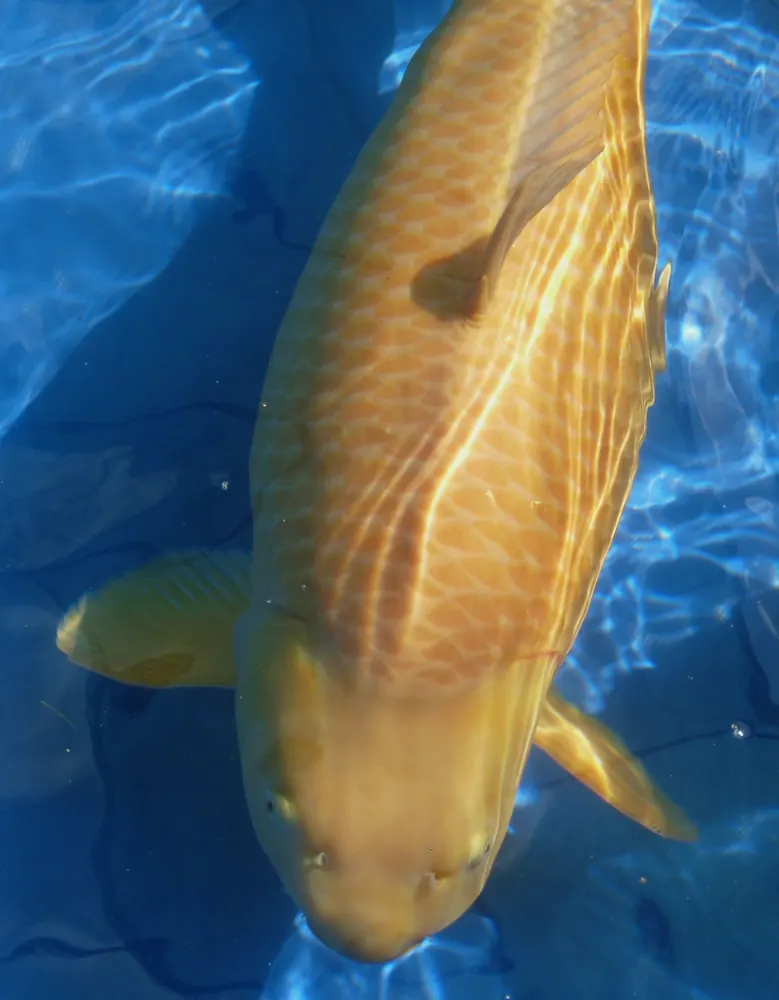

Related single-colored varieties
Within the Mujimono/mono-colored group, Karashigoi is listed alongside other solid-colored varieties. The JNPA names Aka-muji (red), Chagoi (brown), and Shiro-muji (white) as companion varieties sharing the “no pattern” appearance characteristic.[1] The ZNA's mono-colored list under Kawarimono similarly groups Ki-goi, Aka-muji, Aka Hajiro, Karashigoi, Chagoi, and Soragoi together.[3]The JNPA also documents related “akame” forms—koi with red pupils—for Aka-muji, Shiro-muji, and Kigoi, though an akame form specific to Karashigoi is not listed in available JNPA variety descriptions.[1]Scale forms: Doitsu and Ginrin Karashigoi
Scaleless and reduced-scale forms exist. The JNPA describes Doitsu-karashigoi as having almost no scales on the whole body with the skin exposed, while retaining the appearance characteristics of Karashigoi.[5] A sparkling-scaled form is also recognized: Ginrin-karashigoi is described by the JNPA as having shining golden or silver scales combined with the appearance characteristics of Karashigoi.[6]Classification at shows
Show classification places Karashigoi within the Mujimono class. The 2021 ZNA classification document used for the ZNA America Koi Show lists class 15, MUJIMONO, as including Chagoi, Soragoi, Karashi, Matsuba, Ginrin Muji, Karasugoi, Kigoi, Midori Goi, Aka Muji, and their Doitsu and Ginrin forms.[2] This document also notes that classification can be adjusted by individual districts or chapters for their local shows.[2]By contrast, ZNA's own published variety guide places Karashigoi under the Kawarimono class's “mono-colored” subgroup rather than a separate Mujimono class, reflecting some inconsistency between ZNA's general variety overview and the specific show classification document.[3][2]How it differs from similar varieties
Karashigoi is distinguished from other Mujimono by its mustard-yellow ground color, as opposed to the bright red of Aka-muji, the austere brown of Chagoi, or the pure white of Shiro-muji, all described by the JNPA as sharing the single-color, no-pattern body form.[1] Within the Kawarimono mono-colored listing, ZNA separately names Ki-goi as a distinct yellow variety alongside Karashigoi, implying the two are regarded as separate entries despite both being yellow single-colored koi; the sources do not state how the two colors are distinguished in practice.[3]Size and show performance
The JNPA notes that it is not unusual for Karashigoi to exceed one meter in length and that their performance at koi shows is remarkable, suggesting the variety is valued partly for large-bodied specimens.[1]Images
Common questions
What color is a Karashigoi?
Karashigoi is a mustard-yellow, single-colored (muji) koi, grouped by the JNPA with other solid-colored varieties such as Chagoi and Shiro-muji.[1]
How is Karashigoi classified at shows?
Related koi topics
References
- ^ Muji - Variety - All Japan Nishikigoi Promotion Association. All Japan Nishikigoi Promotion Association. jnpa.info/en/nishikigoi/varieties/type/muji/. Retrieved November 2026.
- ^ Koi classification (ZNA 2021), NMZNA 2026 show documents. nmzna.net. nmzna.net/2026%20Show%20Docs/NMZNA%202026%20Koi%20Classification%20…. Retrieved November 2026.
- ^ KAWARIMONO | Zen Nippon Airinkai. Zen Nippon Airinkai. zna.jp/en/keep-nishikigoi/varieties-of-nishikigoi/kawarimono/. Retrieved November 2026.
- ^ JAS 0020 Nishikigoi. Vocabulary (MAFF) — Ministry of Agriculture, Forestry and Fisheries (Japan). maff.go.jp/j/jas/jas_standard/attach/pdf/index-536.pdf. Retrieved November 2026.
- ^ Doitsugoi - Variety - All Japan Nishikigoi Promotion Association. All Japan Nishikigoi Promotion Association. jnpa.info/en/nishikigoi/varieties/type/doitsugoi/. Retrieved November 2026.
- ^ B-ginrin - Variety - All Japan Nishikigoi Promotion Association. All Japan Nishikigoi Promotion Association. jnpa.info/en/nishikigoi/varieties/type/b-ginrin/. Retrieved November 2026.
- ^ 小千谷市 錦鯉の里-つちかわれた伝統と地場産業を明日へ伝える総合産業会館サンプラザ. Ojiya Nishikigoi no Sato. nishikigoinosato.jp/appreciation.html. Retrieved November 2026.