
Mujimono
Key facts: Mujimono (無地) is the variety classification for non-metallic koi with a single, even body color and no pattern, encompassing fish such as Chagoi, Soragoi, Benigoi, Kigoi, Karasugoi and Karashigoi.[1][2]
Colors:
Mujimono (無地), often shortened to muji, is the Zen Nippon Airinkai (ZNA) and All Japan Nishikigoi Promotion Association (JNPA) classification used for single-colored, non-metallic koi that show no imprint pattern across the body.[1][2] The Japanese Agricultural Standard (JAS) for nishikigoi vocabulary defines the variety muji (無地) simply as a koi “with no imprint,” numbered entry 2022 in the standard.[3]Because the category is defined by the absence of pattern rather than by a specific color, it covers a wide range of ground colors, from the brown Chagoi and gray-blue Soragoi to the bright red Aka-muji (also called Benigoi), the yellow Kigoi, the jet-black Karasugoi and the large yellow-bodied Karashigoi.[2][1]- cha (brown)
- sora (gray-blue)
- hi (red)
- ki (yellow)
- sumi (black)
Name and classification
Mujimono groups together koi that are a single, even color with no contrasting pattern.[1] According to the All Japan Nishikigoi Promotion Association, “Muji is a general name for single-color Nishikigoi that have no patterns on their bodies.”[2] The term muji appears in judging glossaries as meaning “self-colored,” literally “nothing else.”[7]Mujimono is distinct from Hikari-mujimono, which is the equivalent classification for single-colored metallic koi such as Ogon and Platinum Ogon; the American Koi Judges Association glossary lists Hikari Mujimono separately as “the classification for single-colored metallic Koi.”[7]Judging points
- Evenly colored skin all the way to the tips of the pectoral fins is highly valued.[2]
- Good body shape is valued alongside even coloration.[2]
- The defining standard criterion is absence of any imprint pattern across the body.[3]
- Large Karashigoi, sometimes exceeding one meter, are noted for remarkable show performance.[2]
- Doitsu and Ginrin muji are judged within the Mujimono class rather than separately.[1]
Appearance and the JAS standard
The Japanese Agricultural Standard for nishikigoi vocabulary (JAS 0020) defines muji (無地), entry number 2022, as a koi variety that simply “has no imprint” (斑紋がないもの).[3] The same standard notes that a single individual can show the appearance characteristics of more than one defined variety, and which variety name is applied is left to the user of the standard — for example, a fish combining the characteristics of Kujaku and Doitsugoi may be classified as either.[3]The JNPA states that in the Muji category, koi that are evenly colored all the way to the tips of the pectoral fins and that have a good body shape are highly valued.[2]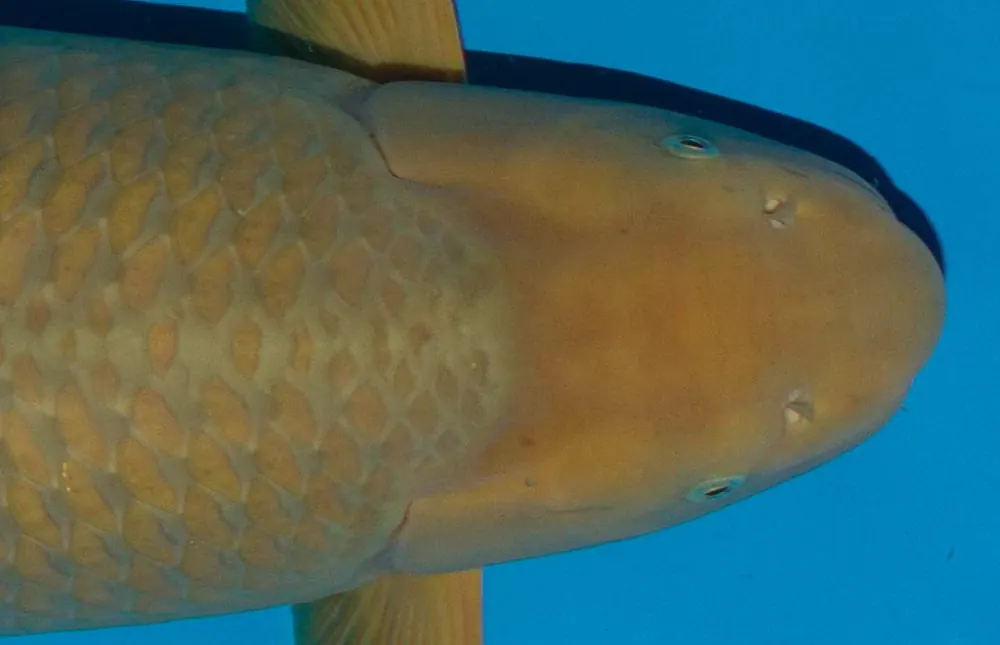
Sub-types within Mujimono
- Chagoi (茶鯉) — a brown-colored muji variety described by the JNPA as “austere brown.”[2] See Chagoi.Soragoi (空鯉) — a gray non-metallic muji variety listed by ZNA within Mujimono.[1] See Soragoi.Benigoi / Aka-muji — a bright red muji variety.[2] See Benigoi and Aka Muji.Kigoi (黄鯉) — a yellow-bodied muji variety.[1] See Kigoi.Karasugoi — described by the JNPA as having no imprints and a whole body that is jet black, with some individuals showing white tips on the pectoral fins.[2] See Karasugoi family.Karashigoi — a yellow-bodied muji variety that the JNPA notes can grow larger in size, “exceeding one meter in length,” with a performance at koi shows described as remarkable.[2] See Karashigoi.Shiro-muji — a pure white muji variety mentioned by the JNPA.[2]Aka-matsuba and Ki-matsuba — muji-bodied koi (red and yellow respectively) whose scales carry a pine-cone-like black pattern called matsuba-mon; the JNPA places Matsuba within the Muji category.[2] See also Matsuba.Akame variants — the JNPA also lists Akame-aka-muji, Akame-shiro-muji and Akame-kigoi, all distinguished by red-colored pupils alongside the usual appearance of their respective muji type.[2]
Scale forms: Doitsu and Ginrin Mujimono
Mujimono koi can occur in scaled, Doitsu (scaleless or partially scaled, German-derived) and Ginrin (sparkling-scale) forms. ZNA states that Doitsu Muji and Ginrin Muji should be entered in the Mujimono class at ZNA koi shows.[1]The JNPA lists several named Doitsu muji combinations, including Doitsu-aka-muji, Doitsu-shiro-muji, Doitsu-kigoi, Doitsu-chagoi and Doitsu-karashigoi, each described as having almost no scales with the skin exposed, combined with the body-color characteristics of the corresponding muji variety.[5]Similarly, the JNPA lists Ginrin-aka-muji, Ginrin-shiro-muji, Ginrin-kigoi, Ginrin-chagoi, Ginrin-soragoi, Ginrin-karashigoi, Ginrin-aka-matsuba and Ginrin-ki-matsuba, each combining shining golden or silver scales with the appearance of the base muji variety.[6] See also Doitsugoi (Doitsu koi) and Kinginrin (Ginrin).Classification at shows
At ZNA shows following the 2021 ZNA classification, Mujimono is class 15 and groups together Chagoi, Soragoi, Karashi(goi), Matsuba, Ginrin Muji, Karasugoi, Kigoi, Midori Goi, Aka Muji, and the Doitsu and Ginrin muji combinations.[4] This sits alongside, but separately from, class 16, Hikari Mujimono, which covers metallic single-colored koi such as Ogon, Platinum Ogon and Yamabuki.[4]Under the JAS vocabulary standard, muji is entry 2022, defined purely by the absence of imprint pattern, independent of the show-category subdivisions used by ZNA or the JNPA.[3]How Mujimono differs from similar classes
Mujimono is defined by having no pattern at all, which distinguishes it from Kawarimono, a broad non-metallic class for koi that do not fit other named varieties and that typically do show irregular markings — for example, black or white bodies with markings of various colors, according to the US importer Kodama Koi Farm.[8]Mujimono is also distinct from Hikari-mujimono, the metallic single-color class covering varieties such as Yamabuki Ogon and Platinum Ogon; both share the “single color, no pattern” rule but differ in whether the scales are metallic.[7][4]Judging notes
In the Muji category, the JNPA states that koi which are evenly colored all the way to the tips of the pectoral fins, and which have a good body shape, are highly valued.[2] The JNPA also notes that Karashigoi, which can grow larger in size, often exceeding one meter in length, give a remarkable performance at koi shows.[2]Images
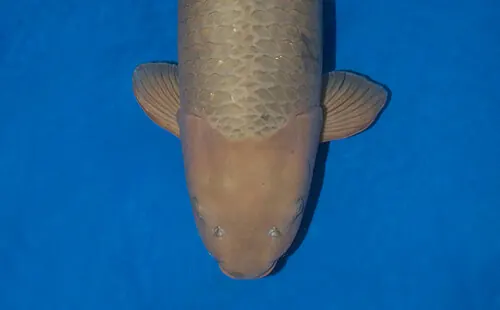
Entries in this section
- Chagoi — Chagoi (茶鯉) is a brown, tea-colored single-hued koi in the Mujimono group, prized for its calm, friendly behavior and large adult size.
- Soragoi — Soragoi (空鯉) is a gray-blue, non-metallic Mujimono koi prized for clean solid color and good skin quality, judged in the Mujimono class.
- Karashigoi — Karashigoi (からし鯉) is a mustard-yellow single-colored koi in the Mujimono group, noted for its large size and show performance.
- Kigoi — Kigoi (黄鯉) is a solid yellow non-metallic koi in the mujimono group, sometimes bred with a red-eyed (akame) form, shown under ZNA's Mujimono class.
- Benigoi and Aka Muji — Benigoi (紅鯉), also called Aka Muji (赤無地), is a solid red non-metallic koi classed as a Mujimono variety, with doitsu and ginrin forms recognized by Japanese b
Common questions
What does Mujimono mean?
What varieties are included in Mujimono?
How does the JAS standard define muji?
JAS 0020 defines muji (entry 2022) simply as a koi variety with no imprint (斑紋がないもの) on the body.[3]
Are there Doitsu and Ginrin versions of Mujimono koi?
Related koi topics
References
- ^ MUJIMONO | Zen Nippon Airinkai. Zen Nippon Airinkai. zna.jp/en/keep-nishikigoi/varieties-of-nishikigoi/mujimono/. Retrieved November 2026.
- ^ Muji - Variety - All Japan Nishikigoi Promotion Association. All Japan Nishikigoi Promotion Association. jnpa.info/en/nishikigoi/varieties/type/muji/. Retrieved November 2026.
- ^ JAS 0020 Nishikigoi. Vocabulary (MAFF) — Ministry of Agriculture, Forestry and Fisheries (Japan). maff.go.jp/j/jas/jas_standard/attach/pdf/index-536.pdf. Retrieved November 2026.
- ^ Koi classification (ZNA 2021), NMZNA 2026 show documents. nmzna.net. nmzna.net/2026%20Show%20Docs/NMZNA%202026%20Koi%20Classification%20…. Retrieved November 2026.
- ^ Doitsugoi - Variety - All Japan Nishikigoi Promotion Association. All Japan Nishikigoi Promotion Association. jnpa.info/en/nishikigoi/varieties/type/doitsugoi/. Retrieved November 2026.
- ^ B-ginrin - Variety - All Japan Nishikigoi Promotion Association. All Japan Nishikigoi Promotion Association. jnpa.info/en/nishikigoi/varieties/type/b-ginrin/. Retrieved November 2026.
- ^ Glossary – American Koi Judges Association (AKJA). American Koi Judges Association. akjajudges.com/glossary/. Retrieved November 2026.
- ^ Kawarimono Archives - Kodama Koi Farm. Kodama Koi Farm (koi dealer). kodamakoifarm.com/variety/kawarimono/. Retrieved November 2026.