
Kigoi
Key facts: Kigoi (黄鯉) is a solid, single-colored yellow nishikigoi classified among the non-metallic mujimono (無地) varieties, distinguished by an even yellow ground color with no imprinted pattern[1][2].
Colors:
Kigoi belongs to the mujimono (無地) group of nishikigoi, which covers single-colored koi without body patterns, such as Chagoi, Soragoi, Benigoi and Karashigoi[6][1]. According to the All Japan Nishikigoi Promotion Association, in the Muji category koi that are evenly colored all the way to the tips of the pectoral fins and have a good body shape are highly valued[6].The Japanese Agricultural Standard (JAS) for nishikigoi terminology defines muji (無地, muji) simply as koi with no imprints (斑紋) on the body, and uses a yellow koi (黄鯉) as its reference photograph for this entry[2].- ki (yellow)
Name and meaning
Kigoi is the common term for yellow-bodied, non-metallic koi within the mujimono classification[1][6]. The American Koi Judges Association glossary notes that ki means “yellow” and lists Kigoi alongside related yellow-marked varieties such as Ki Bekko, Ki Matsuba and Ki Utsuri, which combine yellow with other colors or patterns rather than being solid muji varieties[7].Judging points
History and origin
According to Zen Nippon Airinkai (ZNA), Aka Matsuba, Ki Matsuba and Kigoi were produced from Gunjo Asagi bloodlines, one of the old asagi-type lineages believed to be among the ancestors of modern nishikigoi[8]. ZNA notes that these three varieties, despite their Asagi ancestry, are shown in the Mujimono class rather than with Asagi[8].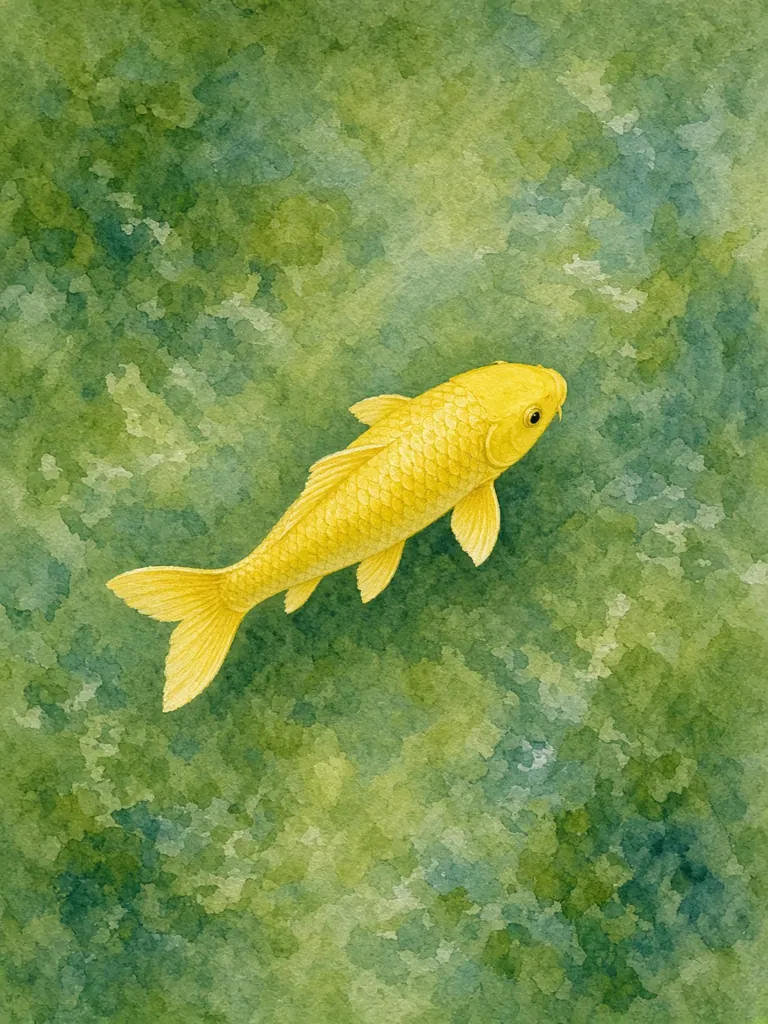
Appearance and the standard definition
Under the JAS vocabulary standard, muji (無地) is defined as koi with no imprints (斑紋, pattern markings differing locally from the ground color) across the body[2]. Kigoi fits this definition with a uniform yellow ground color and no contrasting pattern[2][1]. The JNPA states that within the Muji category generally, even coloration reaching to the tips of the pectoral fins and good body conformation are valued traits[6].Sub-types
- Akame-kigoi: a Kigoi with a red iris (akame, red eye), otherwise sharing the appearance characteristics of Kigoi, as described by the JNPA[6]. The AKJA glossary similarly notes that akame refers to an eye with a red iris, “most often seen in Ki-goi”[7].Ki Matsuba: a yellow koi with a black pine-cone-like scale pattern (matsuba-mon) along the back; the JNPA and ZNA both place this variety within or alongside the Muji/Mujimono groupings rather than treating it as plain Kigoi[6][9].
Scale forms: doitsu and ginrin
Doitsu-kigoi is described by the JNPA as having almost no scales over the body, with the skin exposed, while otherwise showing the appearance characteristics of Kigoi[4]. Ginrin-kigoi is described as having shining golden or silver scales combined with the appearance characteristics of Kigoi[5]. ZNA notes that Doitsu Muji and Ginrin Muji forms are shown in the Mujimono class at its shows[1].Classification at shows
ZNA's published classification for its International Koi Show places Kigoi within class 15, Mujimono, alongside Chagoi, Soragoi, Karashi, Matsuba, Karasugoi, Midori Goi and Aka Muji, including their Doitsu and Ginrin forms[3]. ZNA's own variety pages likewise list Kigoi under the Mujimono category of non-metallic, solid-colored koi[1]. Separately, ZNA's description of the Kawarimono class lists a “mono-colored” family that includes Ki-goi alongside Aka-muji, Aka Hajiro, Karashi-goi, Cha-goi and Sora-goi, reflecting that classification of some solid-colored varieties can vary by context[9].How it differs from similar varieties
Kigoi is distinguished from other mujimono by its yellow ground color, compared with the brown of Chagoi, the grayish blue of Soragoi and the red of Aka-muji (Benigoi and Aka Muji)[1][6]. It differs from Karashigoi, another yellow-toned muji variety, in that the JNPA describes Karashigoi separately as an “austere brown” yellow-bodied koi known for growing larger than one meter in length, whereas Kigoi is listed as its own distinct entry across the cited classifications[6][3]. Yellow patterned koi such as Ki Bekko and Ki Utsuri, which combine yellow with black markings, are classified separately from solid Kigoi, under Bekko and Utsurimono respectively, according to the AKJA glossary[7].Images
Common questions
What is Kigoi?
What is an Akame Kigoi?
Akame-kigoi is a Kigoi with a red iris (akame, red eye) while otherwise showing the usual appearance characteristics of Kigoi, according to the All Japan Nishikigoi Promotion Association[6].
How is Kigoi classified at koi shows?
Are there doitsu or ginrin Kigoi?
How is Kigoi related to Asagi?
According to ZNA, Kigoi (along with Aka Matsuba and Ki Matsuba) was produced from Gunjo Asagi bloodlines, though it is shown in the Mujimono class rather than with Asagi[8].
Related koi topics
References
- ^ MUJIMONO | Zen Nippon Airinkai. Zen Nippon Airinkai. zna.jp/en/keep-nishikigoi/varieties-of-nishikigoi/mujimono/. Retrieved November 2026.
- ^ JAS 0020 Nishikigoi. Vocabulary (MAFF) — Ministry of Agriculture, Forestry and Fisheries (Japan). maff.go.jp/j/jas/jas_standard/attach/pdf/index-536.pdf. Retrieved November 2026.
- ^ Koi classification (ZNA 2021), NMZNA 2026 show documents. nmzna.net. nmzna.net/2026%20Show%20Docs/NMZNA%202026%20Koi%20Classification%20…. Retrieved November 2026.
- ^ Doitsugoi - Variety - All Japan Nishikigoi Promotion Association. All Japan Nishikigoi Promotion Association. jnpa.info/en/nishikigoi/varieties/type/doitsugoi/. Retrieved November 2026.
- ^ B-ginrin - Variety - All Japan Nishikigoi Promotion Association. All Japan Nishikigoi Promotion Association. jnpa.info/en/nishikigoi/varieties/type/b-ginrin/. Retrieved November 2026.
- ^ Muji - Variety - All Japan Nishikigoi Promotion Association. All Japan Nishikigoi Promotion Association. jnpa.info/en/nishikigoi/varieties/type/muji/. Retrieved November 2026.
- ^ Glossary – American Koi Judges Association (AKJA). American Koi Judges Association. akjajudges.com/glossary/. Retrieved November 2026.
- ^ ASAGI | Zen Nippon Airinkai. Zen Nippon Airinkai. zna.jp/en/keep-nishikigoi/varieties-of-nishikigoi/asagi/. Retrieved November 2026.
- ^ KAWARIMONO | Zen Nippon Airinkai. Zen Nippon Airinkai. zna.jp/en/keep-nishikigoi/varieties-of-nishikigoi/kawarimono/. Retrieved November 2026.