
Benigoi and Aka Muji
Key facts: Benigoi (紅鯉), commonly called Aka Muji (赤無地), is a solid-red, non-metallic koi with no body pattern, classified by the Zen Nippon Airinkai as part of the Mujimono group[1], though Wikipedia notes it is sometimes shown in the Kawarimono category as Benigoi or Hiaka[2].
Colors:
Benigoi, more formally termed Aka Muji in most association glossaries, is a plain red koi lacking any secondary pattern[3]. The All Japan Nishikigoi Promotion Association describes Muji (無地) as a general name for single-color nishikigoi with no patterns on their bodies, including the bright red Aka-muji alongside the yellow Karashigoi, brown Chagoi, and white Shiro-muji[8].The variety is notable because it frequently arises as a byproduct of Kohaku breeding: fry with an entirely red body and no white ground are culled from Kohaku spawns, and historically most were discarded[2][9]. According to Wikipedia, this plain-red type was formerly considered a breeding fault, but interest in keeping it as a standalone variety has grown since the early 1990s[2].- hi (red)
Name and classification terms
Sources use several overlapping names for this fish. The American Koi Judges Association defines Aka-muji simply as “a non-metallic red koi,” placed within Kawarimono in its glossary[3]. Wikipedia states that an Akamuji is a plain red fish that occurs normally when breeding Kohaku, and that in exhibition such fish are usually shown under the Kawarimono category, as Benigoi (紅鯉) or as Hiaka (緋赤)[2]. The Zen Nippon Airinkai (ZNA), however, lists Benigoi directly within its Mujimono (solid-color) category alongside Chagoi, Soragoi, Kigoi, Karasugoi, and Karashigoi[1], illustrating a disagreement between sources on which show class the fish belongs to.Judging points
Appearance and the JAS standard
The Japanese Agricultural Standard (JAS) for nishikigoi vocabulary defines muji (無地) as a koi with no imprint (斑紋) on its body — that is, no localized markings distinct from the ground color[5]. The All Japan Nishikigoi Promotion Association similarly states that Muji has no imprints across the body, and specifically names Aka-muji as the bright red representative of this group[8]. In judging, koi that are evenly colored all the way to the tips of the pectoral fins and that show good body shape are highly valued within the Muji category[8].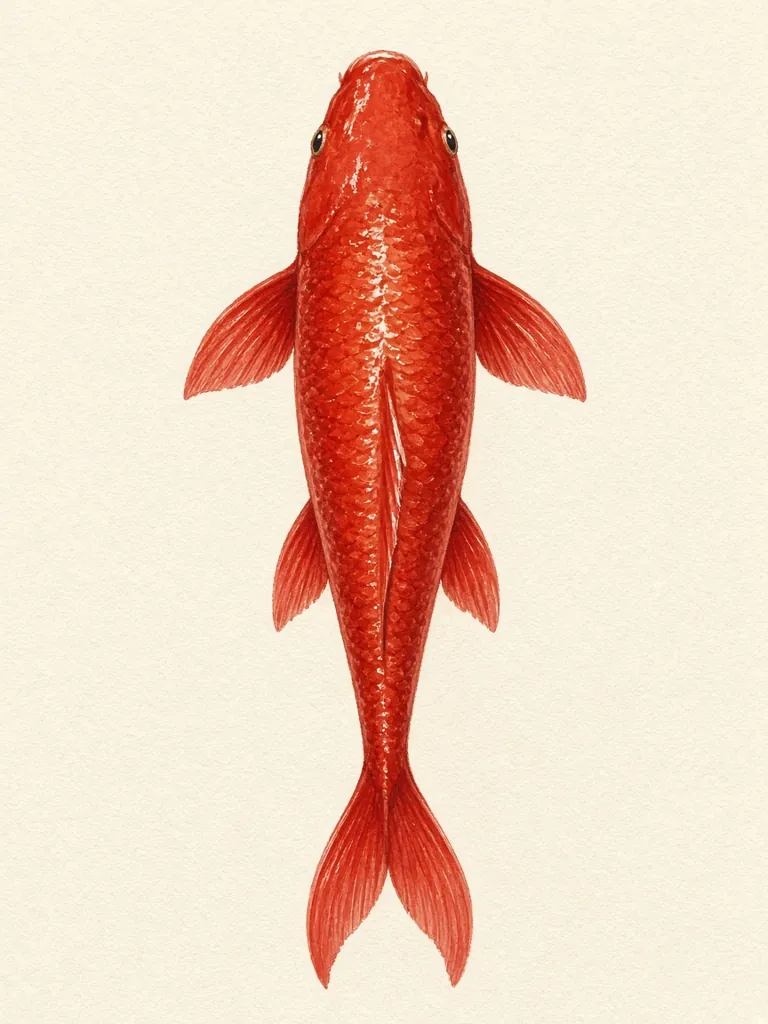
Sub-types and related solid-red forms
- Akame-aka-muji: an Aka-muji with a red iris (akame), otherwise sharing the appearance of standard Aka-muji[8].Aka Hajiro: a red koi with white tips on the pectoral and caudal fins, distinguishing it from a fully solid Aka-muji[3][2].Aka Matsuba: a related but distinct variety with a red body overlaid by a black pinecone-like matsuba pattern on the back, which disqualifies it from being classed as true Muji since it carries a pattern[8][3].
Scale forms: doitsu and ginrin
Non-standard scale forms of Aka-muji are recognized by Japanese breed descriptions. A Doitsu-aka-muji has almost no scales across the body, with skin exposed, while retaining the appearance characteristics of Aka-muji[6]. A Ginrin-aka-muji instead carries shining golden or silver scales while keeping the same red, solid-color appearance[7]. The ZNA notes that Doitsu Muji and Ginrin Muji fish are placed in the Mujimono class at ZNA koi shows, rather than in the separate Doitsugoi or Kinginrin classes[1].Classification at shows
At ZNA-affiliated shows, the Mujimono class (class 15 in the 2021 ZNA classification used for the ZNA America Koi Show) explicitly includes Chagoi, Soragoi, Karashi, Matsuba, Ginrin Muji, Karasugoi, Kigoi, Midori Goi, Aka Muji, and their doitsu and ginrin forms[4]. Separately, the ZNA’s page on Kawarimono lists Aka-muji and Aka Hajiro under a “Mono-colored” subgroup of the Kawarimono class[10], which differs from the ZNA’s own Mujimono page placing Benigoi in Mujimono[1]. This inconsistency across ZNA’s own published pages reflects the fact that, as the ZNA notes on its Kawarimono page, there are over a hundred nishikigoi varieties when divided by pattern and color in detail, and minority varieties are often grouped flexibly for show purposes[10].Under the JAS vocabulary standard, muji (無地, variety code 2022) is defined purely as “having no imprint,” with the standard noting that an individual fish may have appearance characteristics of more than one variety, leaving classification at exhibitions to the discretion of the user of the standard[5].Distinguishing Benigoi from similar varieties
Because Aka-muji arises from Kohaku breeding, it is directly related to, but distinct from, a Kohaku that lacks white ground entirely; the ZNA’s Kohaku page describes such an all-red culled fish as “Aka-muji (Aka-bo),” noting its skin ground is only red and it is usually removed at first culling before being placed in the Mujimono group[9]. This differs from a true Kigoi, which is yellow rather than red, and from Chagoi, described as an austere brown muji variety[8]. It also differs from Hajiro-type fish, which the ZNA’s Karasu-goi family groups separately as black-bodied koi with white fin tips, unrelated in ground color to red Aka-muji[10].Images
Common questions
Is Benigoi the same as Aka Muji?
Is Benigoi shown as Mujimono or Kawarimono?
How does Aka Hajiro differ from Benigoi?
Are there doitsu or ginrin forms of Benigoi?
What is judged in the Muji category?
The JNPA states that koi evenly colored to the tips of the pectoral fins, with good body shape, are highly valued in the Muji category[8].
Related koi topics
References
- ^ MUJIMONO | Zen Nippon Airinkai. Zen Nippon Airinkai. zna.jp/en/keep-nishikigoi/varieties-of-nishikigoi/mujimono/. Retrieved November 2026.
- ^ Kōhaku (fish) (Wikipedia). Wikipedia. en.wikipedia.org/wiki/Kohaku_(fish). Retrieved November 2026.
- ^ Glossary – American Koi Judges Association (AKJA). American Koi Judges Association. akjajudges.com/glossary/. Retrieved November 2026.
- ^ Koi classification (ZNA 2021), NMZNA 2026 show documents. nmzna.net. nmzna.net/2026%20Show%20Docs/NMZNA%202026%20Koi%20Classification%20…. Retrieved November 2026.
- ^ JAS 0020 Nishikigoi. Vocabulary (MAFF) — Ministry of Agriculture, Forestry and Fisheries (Japan). maff.go.jp/j/jas/jas_standard/attach/pdf/index-536.pdf. Retrieved November 2026.
- ^ Doitsugoi - Variety - All Japan Nishikigoi Promotion Association. All Japan Nishikigoi Promotion Association. jnpa.info/en/nishikigoi/varieties/type/doitsugoi/. Retrieved November 2026.
- ^ B-ginrin - Variety - All Japan Nishikigoi Promotion Association. All Japan Nishikigoi Promotion Association. jnpa.info/en/nishikigoi/varieties/type/b-ginrin/. Retrieved November 2026.
- ^ Muji - Variety - All Japan Nishikigoi Promotion Association. All Japan Nishikigoi Promotion Association. jnpa.info/en/nishikigoi/varieties/type/muji/. Retrieved November 2026.
- ^ KOHAKU | Zen Nippon Airinkai. Zen Nippon Airinkai. zna.jp/en/keep-nishikigoi/varieties-of-nishikigoi/kohaku/. Retrieved November 2026.
- ^ KAWARIMONO | Zen Nippon Airinkai. Zen Nippon Airinkai. zna.jp/en/keep-nishikigoi/varieties-of-nishikigoi/kawarimono/. Retrieved November 2026.