
Doitsugoi (Doitsu koi)
Key facts: Doitsugoi (ドイツ鯉), or Doitsu koi, are koi with almost no scales on the body, produced by crossbreeding Japanese nishikigoi with scaleless carp imported from Germany[1]. The trait can be combined with nearly any pattern variety, from Kohaku to Showa Sanshoku[1].
Colors:
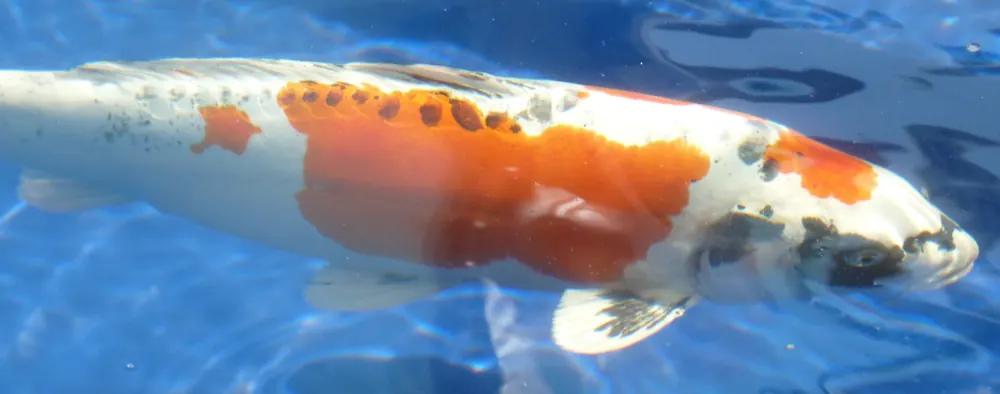
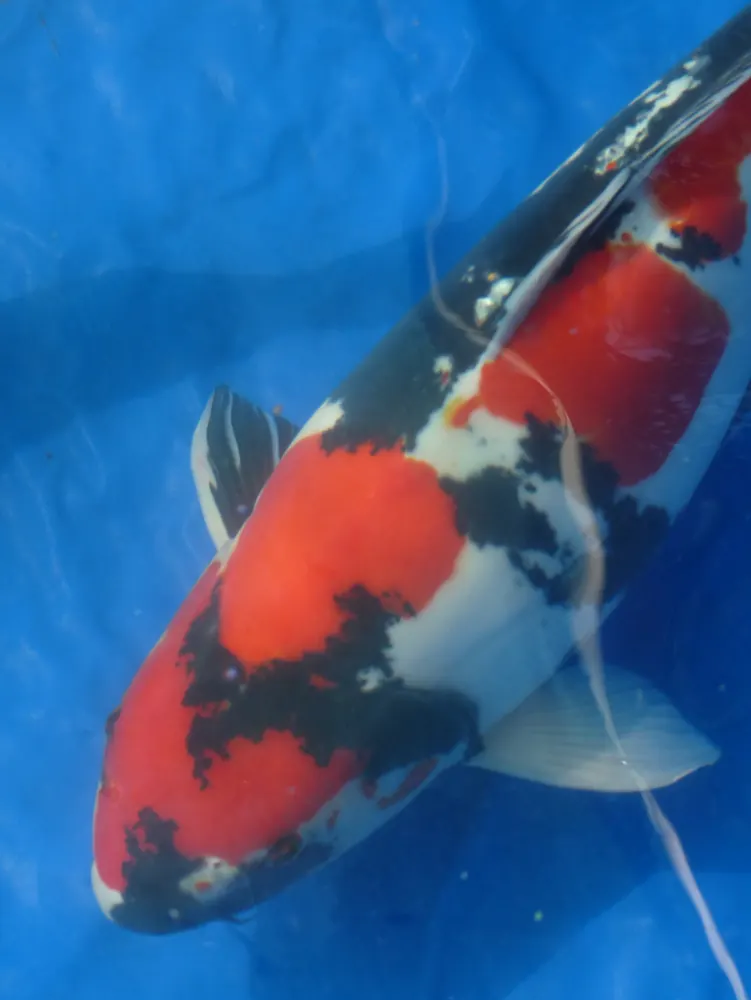
Doitsugoi (ドイツ鯉) is a scale-type group rather than a single pattern variety: it describes koi that are largely or entirely without scales, with the skin exposed except for rows of scales that may remain along the back and sides[1]. The Japanese Agricultural Standard (JAS) defines doitsugoi simply as koi with almost no scales over the whole body and exposed skin[3]. Because the scale-reduction trait is strongly inherited, it has been bred into most established color varieties, producing names such as Doitsu Kohaku, Doitsu Sanke, Doitsu Showa, and Doitsu Shiro Utsuri[1][3].The group traces to German food carp imported into Japan in the early twentieth century, which lacked the full scale covering of native Japanese carp and were valued for disease resistance and growth rate[8]. According to the dealer Kodama Koi Farm, a breeder crossed these scaleless carp with Asagi to begin the development of Doitsu Kohaku[8][5].- hi (red)
- shiroji (white ground)
- sumi (black)
Name and meaning
The Japanese word doitsu (ドイツ) is a phonetic rendering of "Deutsch," referring to Germany, and reflects the German origin of the scaleless carp used to create the group[9][5]. In koi terminology Doitsu is used both as a prefix for named varieties (e.g., Doitsu Kohaku) and as a standalone descriptive class for the scale pattern itself[7].Judging points
- placeholder
History and origin
Scaleless and mirror-scaled carp (German: Spiegelkarpfen and Lederkarpfen) were developed in Europe as food fish; a leather carp variety is reported to have been bred in Austria in 1782[6]. In 1904, mirror carp and leather carp were sent from Munich, Germany, to Japan, where both are referred to collectively as Doitsugoi[6][8]. According to Kodama Koi Farm, the breeder Kichigoro Akiyama observed the hardiness of the German carp and crossed it with the Japanese Asagi variety, work that led to the Doitsu Kohaku and, in 1906, to the related variety Shusui, created by crossing a female leather carp with a male Asagi[6][8][5]. Because there is no record of carp, including colored carp, being introduced to Japan before the 1904 mirror carp import, this event marks an early documented point in the lineage now called Doitsugoi[6].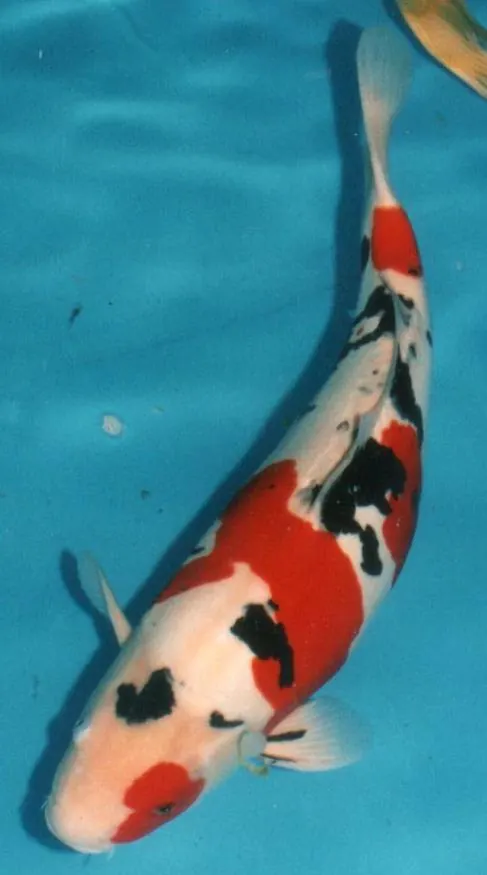

Appearance and the JAS standard
The JAS vocabulary standard for nishikigoi defines doitsugoi (ドイツ鯉, no. 2012/2011 depending on edition) as koi with almost no scales over the entire body, with the skin exposed, noting that the trait originated from a German food-carp variety imported to Japan and crossed with numerous nishikigoi varieties, which, due to strong genetic inheritance of the appearance trait, has produced many named Doitsu varieties[3][4]. The All Japan Nishikigoi Promotion Association (JNPA) gives a similar description: except for the back and both sides, the fish has almost no scales and the skin is exposed, and compared with fully scaled koi (wagoi), Doitsugoi show brighter, more vivid colors[1]. The JNPA states that a good Doitsugoi has a clear boundary, called kiwa, between the skin color and the pattern[1].Scale forms: leather, mirror and armor types
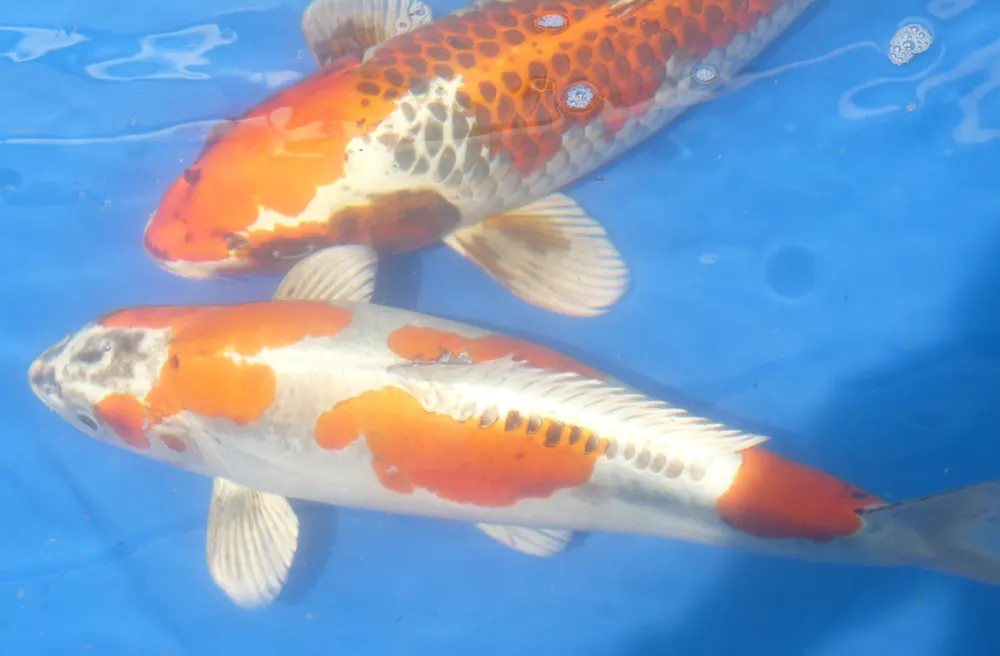
According to Wikipedia's koi article, four main Doitsu scale patterns exist. The most common has a row of scales running along each side of the dorsal fin; a second type runs a row of scales from the head-shoulder junction along the full body length; a third type, also called "mirror koi," adds a line of often large scales along the lateral line; and the rarest, "armor koi," is nearly or completely covered with large plate-like scales, also called Kagami-goi (鏡鯉) or mirror carp[6]. The American Koi Judges Association glossary similarly defines Doitsu as referring to koi with large mirror scales along the dorsal and lateral lines only, or completely scaleless leather carp, both originally imported from Germany and bred into Japanese koi[7]. The glossary also lists a-ra-goi (or a-ra-go-ke) as a term for Doitsu whose mirror scales are scattered unevenly over the body[7].Named Doitsu sub-types
- Doitsu-kohaku, with the appearance characteristics of Kohaku[1]Doitsu-taisho-sanshoku and Doitsu-showa-sanshoku, following Taisho Sanshoku and Showa Sanshoku[1]Doitsu-shiroutsuri and Doitsu-hiutsuri/kiutsuri, following the Utsurimono group[1]Doitsu-goshiki, Doitsu-ochiba-shigure, and Doitsu-midorigoi, following Goshiki, Ochiba Shigure, and Midorigoi[1]Doitsu-ai-goromo and Doitsu-budo-goromo, following the Koromo group[1]Doitsu-shiro-bekko and Doitsu-aka-bekko, following Bekko[1]Doitsu-aka-muji, Doitsu-shiro-muji, Doitsu-kigoi, Doitsu-chagoi, Doitsu-chautsuri, and Doitsu-karashigoi, following various muji (single-color) varieties such as Kigoi, Chagoi, and Karashigoi[1]
Classification at shows
Doitsu varieties are generally judged within the class of their base color pattern rather than as a separate category. Under the ZNA classification used for the 2026 ZNA America show, Doitsu Kohaku is grouped under Kohaku, Doitsu Sanke under Taisho Sanshoku, Doitsu Showa under Showa Sanshoku, and Doitsu Utsuri under Utsurimono; Doitsu Bekko falls under Bekko, Doitsu Hariwake and Kujaku Doitsu under Hikari Moyomono, Doitsu Kin Showa under Hikari Utsurimono, Doitsu Ogon and Platinum Doitsu under Hikari Mujimono, and Doitsu-plus-Muji combinations under Mujimono[2]. The JAS vocabulary standard treats doitsugoi (no. 2012) as one of the defined appearance-characteristic terms used to classify nishikigoi varieties, alongside terms such as kumonryu and shusui, both of which it also notes possess the doitsugoi appearance trait[3].Differences from similar varieties
Doitsu is a scale-type trait, not a color pattern, so it is distinguished from color varieties by its skin and scale arrangement rather than its hi, sumi, or shiroji pattern[3][7]. It differs from fully scaled koi, called wagoi in Japan, which are covered in regular scales across nearly the whole body[1]. Within the Doitsu group itself, leather-type fish are nearly scaleless, mirror-type fish carry a line of enlarged scales along the lateral line, and armor-type fish (Kagami-goi) are covered in large plate-like scales, so the amount of visible scaling can vary considerably between individuals described as Doitsu[6][7].Quality points and appreciation
According to Kodama Koi Farm, appreciation of Doitsu koi involves two main considerations: the quality of the scale layout and the excellence of the underlying color variety[5]. Because Doitsu fish carry fewer scales, the placement of any remaining scales along the back and lateral lines becomes more visually significant, and a single irregular scale, called muda-goke, can detract from the fish's overall appearance[5]. The source states that some breeders now favor breeding Doitsu with as few scales as possible, since achieving a perfectly regular scale layout is considered more difficult than reducing scale count further[5]. After scale quality is assessed, the fish should also be judged against the standards of its base variety; for example, a Doitsu Kohaku should be evaluated for the quality and balance of its hi and shiroji as though it were a regularly scaled Kohaku[5]. The JNPA likewise notes that a well-formed Doitsugoi shows a clear kiwa, or boundary, between skin color and pattern color[1].Images
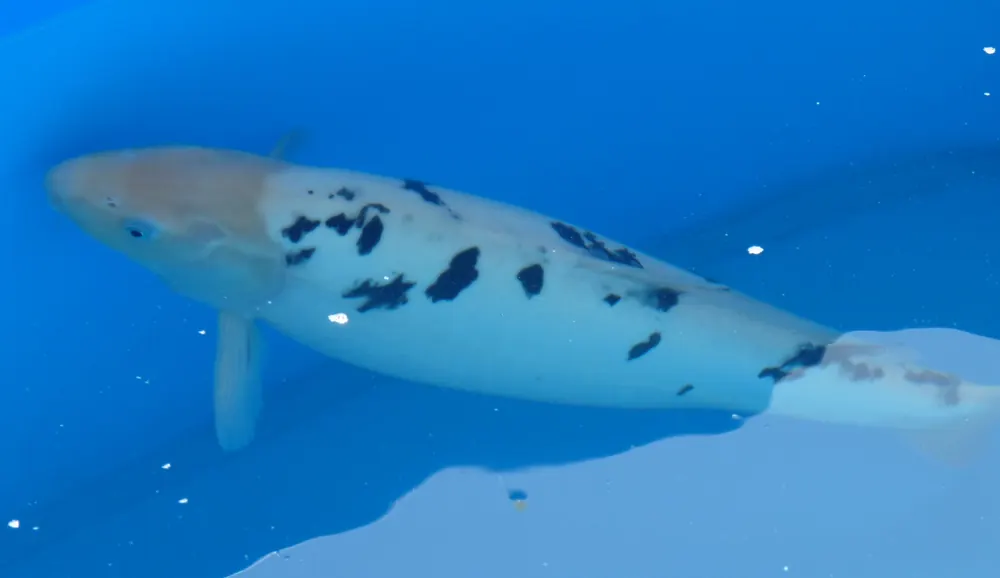

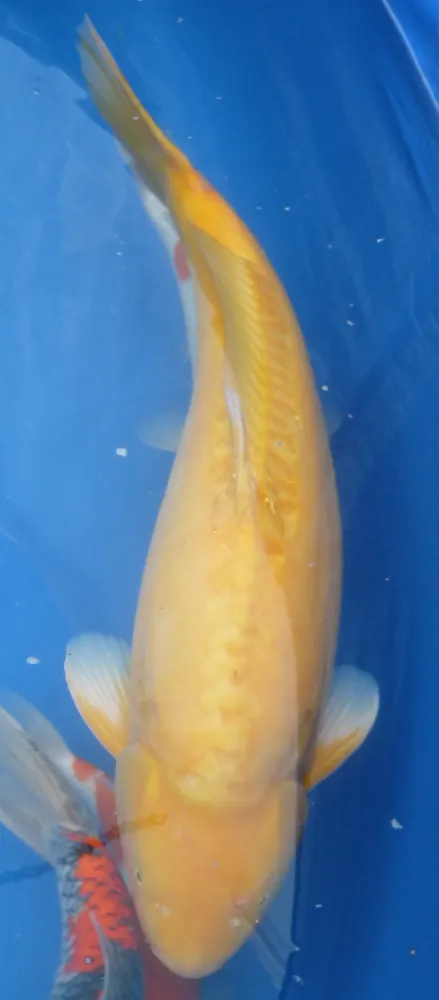

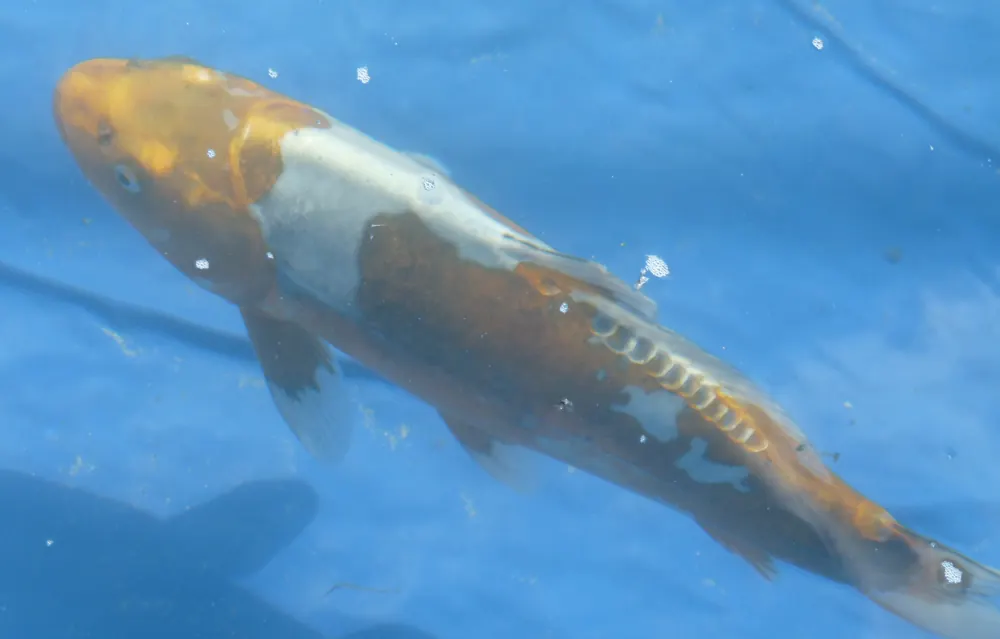




Common questions
What does "Doitsu" mean on a koi variety name?
Is Doitsu a separate variety from Kohaku, Sanke, and Showa?
What is the difference between leather, mirror, and armor Doitsu koi?
How are Doitsu koi judged at shows?
Doitsu fish are generally shown within their base color-pattern class (for example, Doitsu Sanke under Taisho Sanshoku) rather than as a separate class, according to ZNA show classification documents[2]; appreciation also considers scale layout quality and the strength of the underlying color variety[5].
Related koi topics
References
- ^ Doitsugoi - Variety - All Japan Nishikigoi Promotion Association. All Japan Nishikigoi Promotion Association. jnpa.info/en/nishikigoi/varieties/type/doitsugoi/. Retrieved November 2026.
- ^ Koi classification (ZNA 2021), NMZNA 2026 show documents. nmzna.net. nmzna.net/2026%20Show%20Docs/NMZNA%202026%20Koi%20Classification%20…. Retrieved November 2026.
- ^ JAS 0020 Nishikigoi. Vocabulary (MAFF) — Ministry of Agriculture, Forestry and Fisheries (Japan). maff.go.jp/j/jas/jas_standard/attach/pdf/index-536.pdf. Retrieved November 2026.
- ^ JAS 0020 enactment notice, 2022 (MAFF). Ministry of Agriculture, Forestry and Fisheries (Japan). maff.go.jp/j/jas/jas_kikaku/attach/pdf/kokujikaisei-50.pdf. Retrieved November 2026.
- ^ Doitsu Variety - The beauty of Scaleless Koi, Unique Koi Varieties. Kodama Koi Farm (koi dealer). kodamakoifarm.com/doitsu-variety-beauty-no-scales/. Retrieved November 2026.
- ^ Koi (Wikipedia). Wikipedia. en.wikipedia.org/wiki/Shusui. Retrieved November 2026.
- ^ Glossary – American Koi Judges Association (AKJA). American Koi Judges Association. akjajudges.com/glossary/. Retrieved November 2026.
- ^ Doitsu - Koi For Sale - Kodama Koi Farm. Kodama Koi Farm (koi dealer). kodamakoifarm.com/variety/doitsu/. Retrieved November 2026.
- ^ Names of Germany (Wikipedia). Wikipedia. en.wikipedia.org/wiki/Doitsu. Retrieved November 2026.