
Shusui
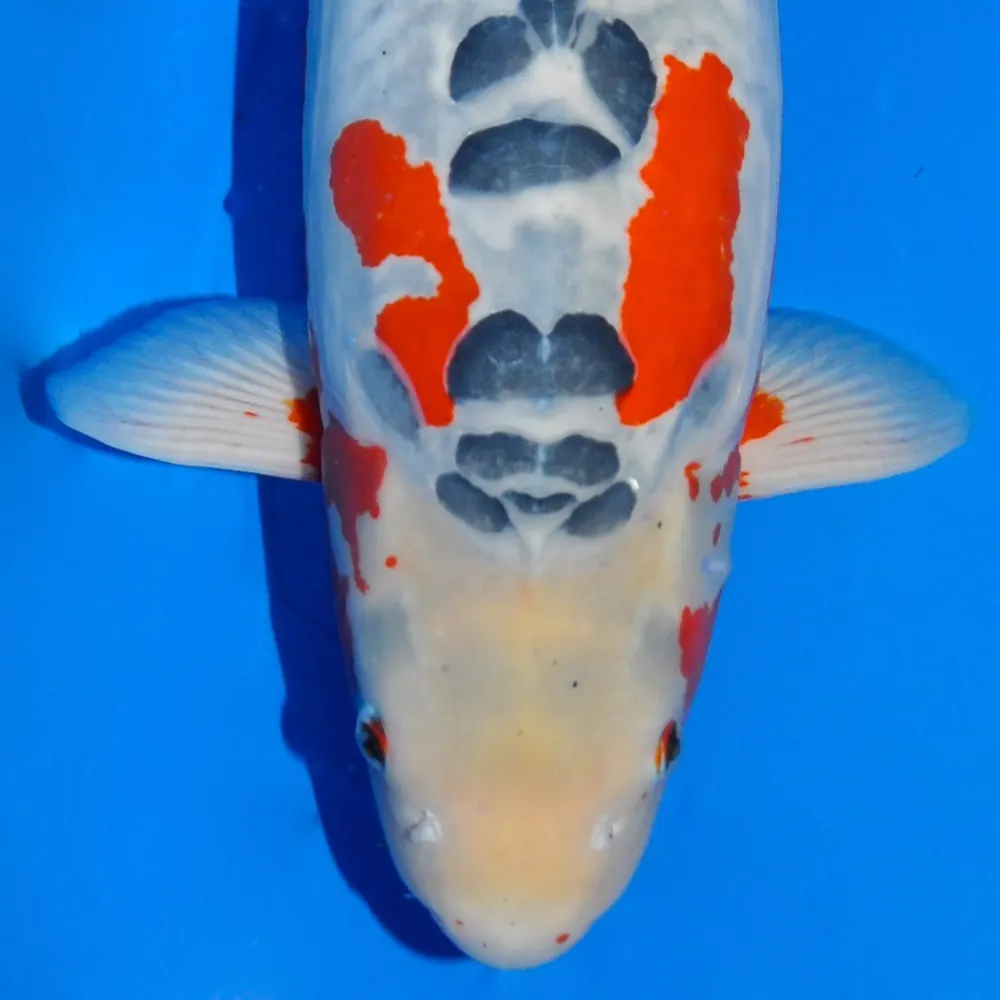
Key facts: Shusui (秋翠) is a Doitsu-goi (scaleless) version of Asagi, created by crossing a German mirror or leather carp with a Japanese Asagi, giving it a pale blue back, red or orange markings, and a single line of large mirror scales along the dorsal ridge.[1][2][3]
Colors:
Shusui is a nishikigoi (錦鯉) variety recognized as its own class by major Japanese and international organizations.[4][8] It was the first variety to show the characteristics of Doitsugoi (ドイツ鯉), the reduced-scale “German carp” lineage, and remains one of only two blue koi varieties.[6][2]The Japan Nishikigoi Promotion Association (JNPA) states that Shusui is produced by crossing Asagi with Doitsugoi, and that it was first produced in Tokyo by Kichigoro Akiyama, who named it using one kanji character from his own name together with a reference to the koi's blue body color.[2] The Ministry of Agriculture, Forestry and Fisheries' JAS standard defines Shusui (秋翠) formally as an Asagi that possesses the appearance characteristics of Doitsugoi.[5]- ai (indigo blue)
- hi (red)
- shiroji (white ground)
Name and meaning
According to Wikipedia, Shūsui (秋翠) means “autumn green.”[3] The American Koi Judges Association (AKJA) glossary translates the name as “autumn water.”[7] The JNPA instead states the name references one kanji from creator Kichigoro Akiyama's name combined with the koi's blue body color.[2] These sources disagree on the precise derivation of the name, and no single explanation is confirmed across all of them.Judging points
History and origin
Sources vary on the exact date and the breeder's given name. The Zen Nippon Airinkai (ZNA) states that Doitsu-goi (German carp) were first imported to Japan in 1904, and that Kichigoro Akiyama, a teacher at what is now the Tokyo Fisheries College, cross-bred them with Japanese Asagi Sanshoku to produce the new variety, with excellent specimens appearing from around 1928.[1] Wikipedia instead dates the creation to 1906 or, in another passage, to 1910, by Tokyo-based breeder Kichigoro Akiyama (also rendered Yoshigoro Akiyama), crossing a female leather carp imported from Germany with a male Japanese Asagi or spotted carp.[3][9] According to Wikipedia, the leather carp was a low-scaled variety originally bred in Austria in 1782 and sent to Japan from Munich, Germany in 1904 along with the mirror carp, also low-scaled; both are called Doitsugoi in Japan.[3]Kodama Koi Farm, a US-based koi dealer, describes Shusui as the first Doitsu variety of koi, bred in the early 1900s by mixing Doitsugoi, described as a “German scale fish,” with Asagi.[6] The origin of the word Doitsu itself traces to the Japanese phonetic rendering of the Dutch word for “German.”[10]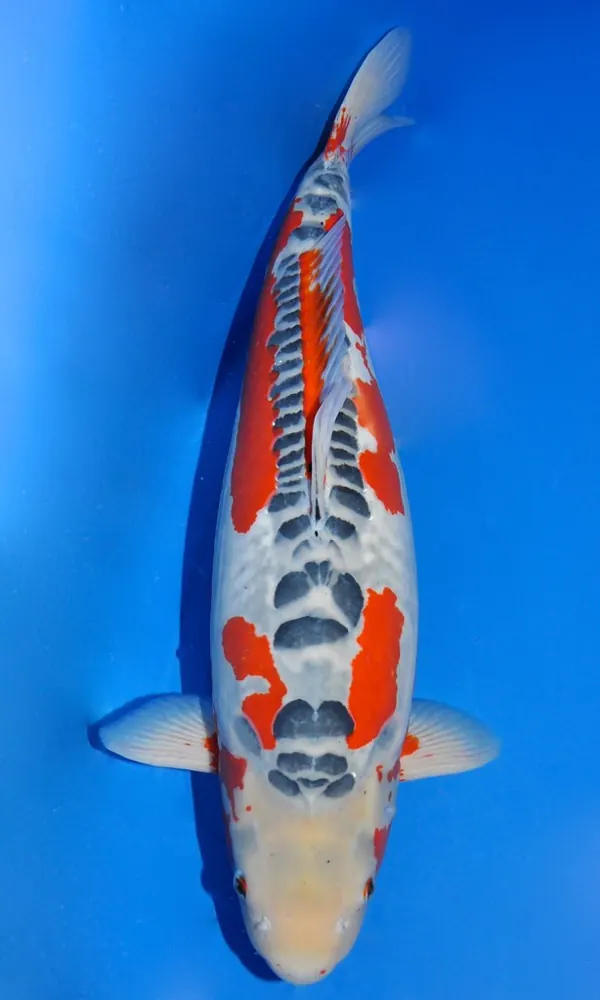
Appearance and the JAS standard
The JAS 0020 Nishikigoi vocabulary standard, issued by Japan's Ministry of Agriculture, Forestry and Fisheries, defines Shusui (秋翠) as an Asagi that possesses the appearance characteristics of Doitsugoi.[5] The JNPA elaborates that Shusui displays an “asagi” pattern on the white part of the body along with the doitsugoi (reduced-scale) appearance.[2]According to Wikipedia, the fish has no scales except for a single line of large mirror scales running dorsally from head to tail, and the most common form shows a pale sky-blue/gray color above the lateral line with red or orange (very rarely bright yellow) below the lateral line and on the cheeks.[3] Kodama Koi Farm similarly notes that judges look for a symmetrical pattern of scales, since Shusui lack scales across most of the body except down the middle of the back along the dorsal fin, and that this scale absence lets the blue ground color show through.[6]Hana, Hi and Ki Shusui
- Hana Shusui — ZNA describes this as having hi markings between the lateral and dorsal lines, arranged symmetrically on both sides of the body;[1] the AKJA glossary similarly calls it a “flowery” form of Shusui.[7]Hi Shusui — According to ZNA, the body is largely covered by hi;[1] AKJA describes it as a Shusui whose red pattern spreads up from the belly and covers the back.[7]Ki Shusui — ZNA defines this as a yellow Shusui, noting that if there is no blue ground at all and the scales on the back are black, the fish should instead be classified as Ki Matsuba Doitsu.[1] AKJA describes Ki Shusui as a yellow Shusui with a greenish dorsal and calls it a very rare variety.[7]Pearl Shusui — ZNA describes this as Shusui with ginrin on the scales of the back;[1] AKJA similarly defines Pearl Shusui as a Shusui with silver scales.[7]
Scale forms and related crosses
Because Shusui is itself a Doitsu (reduced-scale) form, ginrin-type Shusui are referred to as Pearl Shusui or, per AKJA, Kinsui for a metallic/gold-lustered form classified under Hikari Moyomono.[1][7] ZNA's Hikari-Moyomono listing confirms Kinsui and Ginsui as metallic Shusui.[11]The AKJA glossary also lists several cross-variety names involving Shusui: Goshiki Shusui, described as a Doitsu, non-metallic blue Goshiki;[7] Sanke Shusui, a Doitsu Sanke whose pattern is underlaid with the blue back of Shusui;[7] and Showa Shusui, a koi with the sumi and pattern of a Showa combined with the underlying blue of Shusui.[7] AKJA also defines “shusui bire” as the hi equivalent of motoguro, meaning hi at the base of the pectoral fins of Shusui.[7]Classification at shows
The 2021 ZNA classification used for the ZNA America Koi Show lists Shusui as its own numbered class (class 8), encompassing Shusui, Hi Shusui, Hana Shusui, and Ki Shusui.[4] The AKJA instead groups Asagi and Shusui together under a single combined classification, “Asagi/Shusui.”[8] The ZNA SoCal Koi Show's exhibitor registration packet likewise benches koi under a combined “Asagi/Shusui” group (including hi and ki forms) within its Group B classes.[12] The JNPA-affiliated Shinkokai USA lists Shusui and Asagi as separate named varieties in its own variety list, without stating whether they are combined for judging.[13] Results from the 49th Sydney Koi Show show Shusui benched as its own class (separate from Asagi) across multiple size categories.[14]How Shusui differs from similar varieties and judging notes
Because Shusui is the Doitsu counterpart of Asagi, the two varieties share the same pale-blue-and-red color scheme, but Shusui lacks the full scale covering of Asagi, showing instead a single dorsal row of large mirror scales (called onigoke in Japanese, per the JNPA).[2][3] The JNPA states that the blue pattern on the body and the alignment of these large dorsal scales are important evaluation points, and that the scales should be well aligned and of uniform size.[2]Kodama Koi Farm, a US importer, notes that hi marks on the cheeks, head, body and fins are considered desirable on this variety.[6] The AKJA glossary defines ago hi as the hi markings specifically on the cheeks of Asagi or Shusui, a term used in judging these varieties.[7]Images
Common questions
What does the name Shusui mean?
How is Shusui different from Asagi?
What are Hana, Hi and Ki Shusui?
Related koi topics
References
- ^ SHUSUI | Zen Nippon Airinkai. Zen Nippon Airinkai. zna.jp/en/keep-nishikigoi/varieties-of-nishikigoi/shusui/. Retrieved November 2026.
- ^ Shusui - Variety - All Japan Nishikigoi Promotion Association. All Japan Nishikigoi Promotion Association. jnpa.info/en/nishikigoi/varieties/type/shusui/. Retrieved November 2026.
- ^ Koi (Wikipedia). Wikipedia. en.wikipedia.org/wiki/Shusui. Retrieved November 2026.
- ^ Koi classification (ZNA 2021), NMZNA 2026 show documents. nmzna.net. nmzna.net/2026%20Show%20Docs/NMZNA%202026%20Koi%20Classification%20…. Retrieved November 2026.
- ^ JAS 0020 Nishikigoi. Vocabulary (MAFF) — Ministry of Agriculture, Forestry and Fisheries (Japan). maff.go.jp/j/jas/jas_standard/attach/pdf/index-536.pdf. Retrieved November 2026.
- ^ Shusui - Koi For Sale - Kodama Koi Farm. Kodama Koi Farm (koi dealer). kodamakoifarm.com/variety/shusui/. Retrieved November 2026.
- ^ Glossary – American Koi Judges Association (AKJA). American Koi Judges Association. akjajudges.com/glossary/. Retrieved November 2026.
- ^ AKJA Classifications – American Koi Judges Association (AKJA). American Koi Judges Association. akjajudges.com/akja_classifications/. Retrieved November 2026.
- ^ Koi (Wikipedia). Wikipedia. en.wikipedia.org/wiki/Utsurimono. Retrieved November 2026.
- ^ Names of Germany (Wikipedia). Wikipedia. en.wikipedia.org/wiki/Doitsu. Retrieved November 2026.
- ^ HIKARI-MOYOMONO | Zen Nippon Airinkai. Zen Nippon Airinkai. zna.jp/en/keep-nishikigoi/varieties-of-nishikigoi/hikari-moyomono/. Retrieved November 2026.
- ^ ZNA SoCal 50th Annual Koi Show exhibitor registration packet (2026). znasocal.org. znasocal.org/wp-content/uploads/2026/02/2026-entrant-registration-1…. Retrieved November 2026.
- ^ Variety - Shinkokai USA Official Website. Shinkokai USA (JNPA). shinkokaiusa.com/variety. Retrieved November 2026.
- ^ 49th Sydney Koi Show 2026 results (Sydney Koi Show). Sydney Koi Show. sydneykoishow.com/admin/photoresultsnew.toy?eid=206700. Retrieved November 2026.