
Hikari-mujimono
Key facts: Hikari-mujimono (光無地もの) is the Nishikigoi classification for koi whose entire body is a single, uniform color with a metallic luster and no pattern[1][2].
Colors:
Hikari-mujimono, sometimes romanized Hikari-muji, is a general name for metallic koi that show no contrasting pattern, with color possibilities including yellow-gold (Yamabuki), silver (Platinum), orange-gold (Orenji) and others[1]. The Japan Agricultural Standard (JAS) definition for hikari-muji (光り無地, JAS No. 2017) states that the fish has no imprints and the whole body shines[3][2]. According to the Ministry of Agriculture, Forestry and Fisheries standard, customary named varieties within hikari-muji include Orenji Ogon and Platinum Ogon, among others[3].The group is closely tied to the broader Ogon (黄金) lineage. Ōgon is described by Wikipedia as a metallic koi of one color only, created by Sawata Aoki, with origin dates given variously; one account states the variety was created in 1946 from wild carp caught in 1921[7], while the Zen Nippon Airinkai (ZNA) account describes Aoki beginning selective breeding in 1921 and achieving a recognized Ogon variety in 1947[1]. The koi dealer Kodama Koi Farm also states that Sawata Aoki succeeded in creating Ogon in 1947[8].- kin (gold)
- orenji (orange)
- gin (silver)
Name and Classification
In koi terminology, muji (無地) means self-colored, or literally “nothing else,” and hikari means metallic, so hikari-mujimono denotes metallic koi with no additional pattern, according to a glossary published by the American Koi Judges Association (AKJA)[10]. The AKJA glossary defines ogon simply as a single-colored metallic koi within the Hikari Mujimono class[10].Judging points
History
According to ZNA, in 1921 Sawato Aoki of Takezawa, Niigata, began using a koi with some golden color on its back as a breeding parent. By the fourth or fifth generation he had produced dull-metallic forms such as Kin Kabuto, Gin Kabuto and Sakin, before crossing them with a female koi named ‘Shiro Fuji’ to finally produce the first Ogon koi[1]. After further work by Aoki and his son, Ogon became a recognized Nishikigoi variety in 1947, and these golden koi were initially greatly prized and commanded very high prices[1].Kodama Koi Farm, a koi dealer, recounts that during the Taisho period (1912–1926) children found a black carp with a slight shimmer on its back, which prompted Sawata Aoki to attempt breeding a koi that shone gold all over; he succeeded in 1947[8]. Wikipedia separately dates the creation of Ōgon to 1946, from wild carp Aoki had caught in 1921[7].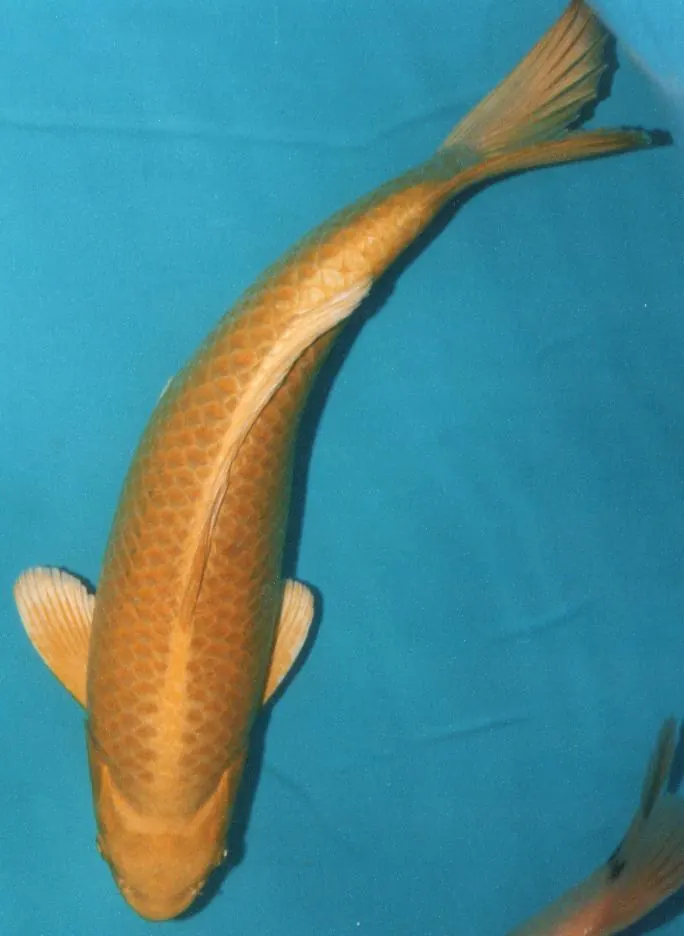

Appearance and the JAS Standard
The Japan Agricultural Standard for Nishikigoi vocabulary (JAS 0020) defines hikari-muji (光り無地) as koi with no imprints (pattern) where the whole body shines[3]. The standard notes that customary hikari-muji varieties include Orenji Ogon (オレンジ黄金), Platinum Ogon (プラチナ黄金) and Matsuba Ogon (松葉黄金)[3]. The All Japan Nishikigoi Promotion Association (JNPA) similarly describes Hikari-muji as a general name for Nishikigoi with no patterns and a single metallic color over the whole body, adding that a good Hikari-muji shows high luster with even, uniform color spread over the entire body[2]. Kodama Koi Farm states that a prize-winning Ogon ideally is a bright metallic koi without blemishes, with an even pattern of scales and no markings on the face[8].Sub-types
- Yamabuki Ogon — whole body shines bright reddish yellow (Yamabuki color), with no imprints, according to JNPA[2]; the AKJA glossary likewise defines Yamabuki Ogon as metallic solid yellow[10]. See Yamabuki Ogon.Platinum Ogon — whole body shines white or light gray (Platinum color), per JNPA[2], also called Purachina or Shirogane by AKJA[10]. See Platinum Ogon.Nezu Ogon — shines silver-gray, described by JNPA as having no imprints[2]; AKJA describes Nezu Ogon as a silver-gray koi with a dull metallic luster[10].Mukashi Ogon — shines in a turmeric or dark gold color, with part of the scales, fins and head black, per JNPA[2]; Kodama Koi Farm has listed Mukashi Ogon among koi offered for sale[8].Tora Ogon — an Ogon with black markings, per the AKJA glossary[10].Kin Kabuto / Gin Kabuto — JNPA describes Kin Kabuto as having a shiny gold-brown body with gold-colored head markings resembling elk horns, and Gin Kabuto as the silver equivalent[2]; these were early forms produced by Aoki according to ZNA[1].
Orenji Ogon and Mizuho Ogon
Orenji Ogon (Orange Ogon) is defined by JNPA as having no imprints with the whole body shining reddish yellow, described in Japan as Orange-color[2]. The AKJA glossary similarly defines Orenji Ogon as a deep orange metallic koi within the Hikari Mujimono class[10]. A doitsu form, Doitsu-orange-ogon, has almost no scales with the skin exposed and the same appearance characteristics as Orenji Ogon[2].Mizuho Ogon is described by JNPA as having almost no scales over the whole body, with skin that shines orange exposed, while part of the scales shine black[2]. This places Mizuho Ogon as a scaleless, doitsu-like variant distinct from scaled Orenji Ogon, according to the same source[2].Kin Matsuba and Gin Matsuba
Nishikigoi with matsuba-mon, a pattern in which each scale is colored black in a pinecone-like shape, are called Matsuba-kei; those that also shine are called Kin-matsuba and Gin-matsuba, according to JNPA[2]. JNPA defines Ki-matsuba-ogon (also called Kin-matsuba in Japan) as shining in turmeric or dark gold with a matsuba pattern across the entire back, and Gin-matsuba as shining silvery white with the same matsuba pattern[2]. A doitsu form, Doitsu-gin-matsuba, has almost no scales over the whole body with the skin exposed[2]. The AKJA glossary defines Gin Matsuba as a metallic silver koi with a black pinecone pattern in the scales, classifying it under Hikari Utsurimono rather than Hikari Mujimono in its scheme, while describing Matsuba Ogon as another name for Kin Matsuba under Hikari Mujimono[10]. Aka-matsuba-ogon, shining red or vermilion with the matsuba pattern across the back, is also listed by JNPA[2]. See also Kin Matsuba and Gin Matsuba and Matsuba.Scale Forms: Doitsu and Ginrin
Doitsu versions exist across the hikari-mujimono group. JNPA describes Doitsu-mukashi-ogon, Doitsu-yamabuki-ogon, Doitsu-platinum-ogon and Doitsu-nezu-ogon as each having almost no scales over the whole body with the skin exposed, while retaining the appearance characteristics of their scaled counterparts[2]. See Doitsugoi (Doitsu koi).Ginrin forms are also recognized. JNPA states that Ginrin-yamabuki-ogon and Ginrin-platinum-ogon have shining golden or silver scales with the appearance characteristics of their non-ginrin counterparts[6]. Kodama Koi Farm has sold Ginrin Ogon and Ginrin Platinum as named stock items[8][11]. See Kinginrin (Ginrin).Classification at Shows
The ZNA 2021 classification used for the NMZNA 2026 koi show places Hikari Mujimono as group 16, including Ogon, Platinum Ogon, Yamabuki, Orange Ogon, Doitsu Ogon, Platinum Doitsu, Kin Matsuba, Gin Matsuba, Mizuho Ogon and Ginrin Hikari-muji[4]. Entry rules for the 59th ZNA International Koi Show similarly list Hikari Mujimono as class 16, noting it includes Ginrin and Matsuba, with specific example varieties Kin Matsuba and Gin Matsuba[5]. The ZNA SoCal show registration packet defines Hikari Mujimono as a bench group covering “Single-color metallic incl Ginrin & Matsuba”[12]. Results from the 49th Sydney Koi Show record a class titled “Hikari Muji (Ogon)” with placings and a Variety Champion award, showing the term is used interchangeably with Ogon in some show programs[13].How Hikari-mujimono Differs from Related Varieties
Hikari-mujimono is distinguished from Hikari-moyomono, which ZNA defines as a metallic-bodied koi with two or more colors, excluding the Utsuri family, with named examples such as Platinum Kohaku, Yamato Nishiki and Hariwake Ogon[9]. JNPA likewise defines Hikari-moyo as having metallic luster and pattern on the whole body, in contrast to Hikari-muji and Hikari-utsuri, which are the other two shining subgroups[14]. It is also distinguished from non-metallic single-color koi, termed Mujimono in the ZNA and JNPA classification schemes, such as Chagoi and Kigoi, which lack the metallic shine[4]. See Hikari-moyomono, Mujimono, and Kawarimono for related catch-all groups.Keeping Notes
Kodama Koi Farm, a koi dealer, describes Ogon as friendly koi that can be hand fed and that grow well[8]. The same dealer states that Ogon are bred in huge numbers, making show competition within the variety fierce[8]. Platinum koi, also from the Hikari Muji group according to Kodama Koi Farm, can grow to jumbo size, and when they exceed roughly 80 cm (about 31 in) a net-like skin pattern called fukurin becomes visible, which the dealer describes as central to the attractiveness of hikarimono[11]. The AKJA glossary defines fukurin generally as the area of skin around the smaller scales of good metallic koi, noting that smaller scales are associated with greater luster[10].Images
Entries in this section
- Yamabuki Ogon — Yamabuki Ogon is a metallic single-colored koi variety with a bright golden-yellow body, classified under Hikari-mujimono alongside Platinum Ogon.
- Platinum Ogon — Platinum Ogon (プラチナ黄金) is a solid white-silver metallic koi of the Hikari-mujimono group, also called Purachina or Shirogane.
- Kin Matsuba and Gin Matsuba — Kin Matsuba and Gin Matsuba are metallic koi with a black pine-cone (matsuba) pattern on each scale, classed under Hikari-mujimono at Japanese and ZNA shows.
- Ghost koi — Ghost koi are a metallic hybrid of Ogon koi and wild carp developed in the 1980s, popular in the UK but not universally classed as true nishikigoi.
Common questions
What does Hikari-mujimono mean?
Is Ogon the same as Hikari-mujimono?
What colors are included in Hikari-mujimono?
How does Hikari-mujimono differ from Hikari-moyomono?
Related koi topics
References
- ^ HIKARI-MUJIMONO | Zen Nippon Airinkai. Zen Nippon Airinkai. zna.jp/en/keep-nishikigoi/varieties-of-nishikigoi/hikari-mujimono/. Retrieved November 2026.
- ^ Hikari-muji - Variety - All Japan Nishikigoi Promotion Association. All Japan Nishikigoi Promotion Association. jnpa.info/en/nishikigoi/varieties/type/hikari-muji/. Retrieved November 2026.
- ^ JAS 0020 Nishikigoi. Vocabulary (MAFF) — Ministry of Agriculture, Forestry and Fisheries (Japan). maff.go.jp/j/jas/jas_standard/attach/pdf/index-536.pdf. Retrieved November 2026.
- ^ Koi classification (ZNA 2021), NMZNA 2026 show documents. nmzna.net. nmzna.net/2026%20Show%20Docs/NMZNA%202026%20Koi%20Classification%20…. Retrieved November 2026.
- ^ 59th ZNA International Koi Show entry rules (ZNA). Zen Nippon Airinkai. zna.jp/wp-content/uploads/2023/07/59th-zna-koishow.pdf. Retrieved November 2026.
- ^ B-ginrin - Variety - All Japan Nishikigoi Promotion Association. All Japan Nishikigoi Promotion Association. jnpa.info/en/nishikigoi/varieties/type/b-ginrin/. Retrieved November 2026.
- ^ Koi (Wikipedia). Wikipedia. en.wikipedia.org/wiki/Koi. Retrieved November 2026.
- ^ Ogon - Koi For Sale and History - Kodama Koi Farm. Kodama Koi Farm (koi dealer). kodamakoifarm.com/variety/ogon/. Retrieved November 2026.
- ^ HIKARI-MOYOMONO | Zen Nippon Airinkai. Zen Nippon Airinkai. zna.jp/en/keep-nishikigoi/varieties-of-nishikigoi/hikari-moyomono/. Retrieved November 2026.
- ^ Glossary – American Koi Judges Association (AKJA). American Koi Judges Association. akjajudges.com/glossary/. Retrieved November 2026.
- ^ Platinum - Koi For Sale - Kodama Koi Farm. Kodama Koi Farm (koi dealer). kodamakoifarm.com/variety/platinum/. Retrieved November 2026.
- ^ ZNA SoCal 50th Annual Koi Show exhibitor registration packet (2026). znasocal.org. znasocal.org/wp-content/uploads/2026/02/2026-entrant-registration-1…. Retrieved November 2026.
- ^ 49th Sydney Koi Show 2026 results (Sydney Koi Show). Sydney Koi Show. sydneykoishow.com/admin/photoresultsnew.toy?eid=206700. Retrieved November 2026.
- ^ Hikari-moyo - Variety - All Japan Nishikigoi Promotion Association. All Japan Nishikigoi Promotion Association. jnpa.info/en/nishikigoi/varieties/type/hikari-moyo/. Retrieved November 2026.