
Ghost koi
Key facts: Ghost koi are a hybrid of Ōgon (黄金) koi and wild carp developed in the 1980s, distinguished by metallic scales, that became very popular in the United Kingdom[1]. Some sources consider them not to be true nishikigoi[1].
Colors:
Ghost koi (人面魚, じんめんぎょ) are described in secondary sources as a hybrid of Ōgon koi and wild carp with metallic scales, developed in the 1980s[1]. According to Wikipedia, ghost koi became very popular in the United Kingdom[1]. Because they arise from crossing nishikigoi with wild carp rather than from selective refinement within existing nishikigoi lines, butterfly koi and ghost koi are considered by some to be not true nishikigoi[1].Common carp (Cyprinus carpio) sources note that ghost carp is an artificial hybrid bred between common carp and Japanese Purachina koi, and that the wide variation in colors produced makes ghost carp a popular commercial fish[4]. Ghost koi are also listed among koi types kept in garden ponds alongside Nishikigoi and Butterfly Koi[5].- gin (silver)
- ki (yellow)
- kin (gold)
Name and meaning
Wikipedia gives the Japanese characters for ghost koi as 人面魚 (じんめんぎょ)[1]. The variety is not listed among the terms defined in the JAS 0020 Nishikigoi vocabulary standard, which covers varieties such as Kohaku, Taisho Sanshoku, Showa Sanshoku, Shiro Utsuri, Goshiki, Kujaku, Kumonryu, Doitsugoi, Koromo and Tancho[3].Judging points
- Sources state ghost koi are distinguished primarily by their metallic scales inherited from Ogon ancestry[1].
- Common carp sources note a wide range of resulting colors from the common carp × Purachina koi cross contributes to commercial variation rather than a fixed pattern standard[4].
- Ghost koi are not included among the named varieties in the ZNA or JAS classification systems used for judging, so no official variety-specific judging criteria are given in these sources[2][3].
History and origin
According to Wikipedia, ghost koi were developed in the 1980s and became very popular in the United Kingdom[1]. They are described as a hybrid of wild carp and Ogon koi, distinguished by their metallic scales[1]. This places their development after most historic nishikigoi varieties, which trace to color mutations recorded from around 1875 onward in Niigata, with the Ogon (single-colored metallic) variety itself noted as a relatively recent development compared with older varieties like Kohaku, Asagi and Ki Utsuri[1].The World Organisation for Animal Health describes “ghost (koi × common) carp” as a recognized strain in disease-surveillance guidance, alongside koi and common carp, indicating the hybrid is an established commercial category tracked for fish health purposes[6][7]. UK government guidance likewise lists “ghost carp” as one of the varieties of common carp susceptible to koi herpesvirus, alongside mirror carp, leather carp and koi carp[8].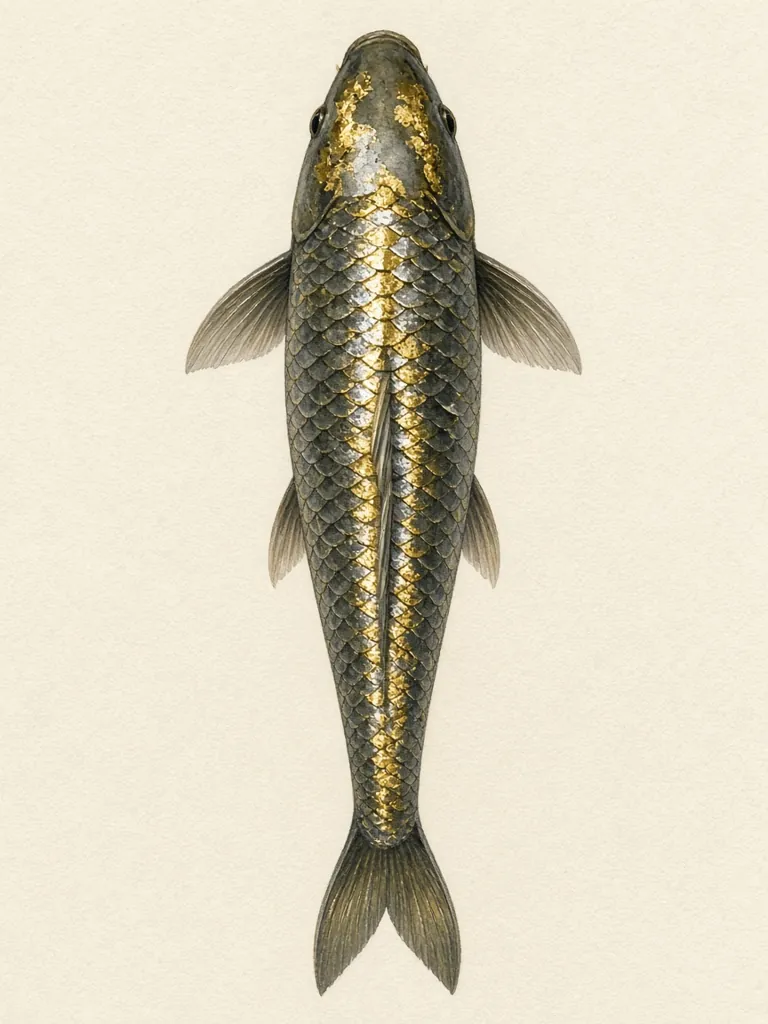
Appearance and the standard definition
Ghost koi are distinguished by metallic scales inherited from their Ogon parentage[1]. The Japanese Agricultural Standard (JAS 0020) vocabulary for nishikigoi defines a related metallic category, hikari-kawarigoi (光り変わり鯉), as koi not matching the other listed named varieties whose whole body shines metallically, a category that groups recently fixed or still-evolving metallic variants[3]. Ghost koi are not themselves named in the JAS 0020 variety list, which instead formally defines varieties such as Kohaku, Taisho Sanshoku, Showa Sanshoku, Shiro Utsuri, Goshiki, Kujaku, Kawarigoi, Kumonryu, Doitsugoi, Koromo and Tancho[3].Common carp sources describe ghost carp as bred between common carp and Japanese Purachina (platinum) koi, with the wide range of resulting colors contributing to its commercial popularity[4].Classification at shows
The ZNA classification used for the NMZNA/ZNA America Koi Show lists 17 numbered groups plus a Male category, covering varieties from Kohaku through Tancho, including Hikari Mujimono (metallic single-colored koi such as Ogon and Platinum Ogon) and Hikari Moyomono (metallic patterned koi such as Hariwake and Kujaku)[2]. Ghost koi are not named within this list of ZNA groups[2]. According to Wikipedia, Zen Nippon Airinkai recognizes more than 100 varieties of koi grouped into 16 classes based on coloration, patterning and scalation, and states that ghost koi and butterfly koi, both developed in the 1980s, are considered by some to be not true nishikigoi[1].Ghost koi compared with nishikigoi
Sources draw a consistent distinction between ghost koi and nishikigoi based on origin rather than appearance alone. Wikipedia describes nishikigoi varieties as having been bred from an original handful of color mutations arising from wild carp (nogoi/magoi) within Japan, such as Kohaku, Asagi and Ki Utsuri, with the Ogon variety developed more recently[1]. Ghost koi, by contrast, are explicitly described as a hybrid of Ogon koi and wild carp, and are grouped with butterfly koi as varieties “considered by some to be not true nishikigoi”[1].The common carp article frames this similarly, calling ghost carp an “artificial hybrid” between common carp and Japanese platinum koi, distinct from the long-established selective breeding lineage that produced classic nishikigoi varieties[4]. Fish-health documents from the World Organisation for Animal Health and the UK government use the compound term “koi or ghost (koi × common) carp” when describing susceptible populations, treating ghost carp as a hybrid class separate from koi carp for surveillance purposes, which further reflects that ghost koi are regarded administratively as a cross rather than a conventional nishikigoi variety[6][7][8].Keeping notes
Ghost koi are kept as pond fish in the same settings as Nishikigoi and Butterfly Koi, according to an overview of water garden fish[5]. As with other carp varieties, ponds with ghost koi require pumps and filtration to maintain oxygen levels, and in cold climates a small heater may be used to prevent the water from freezing solid[5]. Health authorities note that koi or ghost (koi × common) carp are among the varieties most susceptible to koi herpesvirus and should be preferentially selected for virus surveillance sampling[6][7]. UK government guidance states that koi herpesvirus can cause mortality rates of up to 100% in susceptible carp varieties, including ghost carp, and that outbreaks must be reported to the Fish Health Inspectorate[8].Images
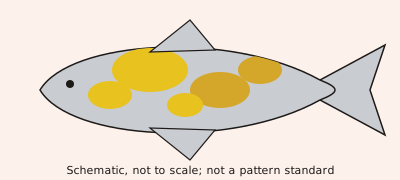
Common questions
Are ghost koi true nishikigoi?
Sources differ: Wikipedia states that ghost koi, like butterfly koi, are considered by some to be not true nishikigoi because they are a hybrid of Ogon koi and wild carp rather than a line bred purely within nishikigoi stock[1].
When were ghost koi developed?
According to Wikipedia, ghost koi were developed in the 1980s and became very popular in the United Kingdom[1].
What gives ghost koi their metallic look?
Their metallic scales come from their Ogon koi parentage, as Ogon is a single-colored metallic variety of nishikigoi crossed with wild carp to produce ghost koi[1].
Are ghost koi more susceptible to disease?
Health authorities list koi or ghost (koi × common) carp among the carp varieties preferentially sampled for koi herpesvirus surveillance because they are among the most susceptible[6][7], and UK government guidance notes mortality from koi herpesvirus can reach up to 100% in susceptible carp including ghost carp[8].
Related koi topics
References
- ^ Koi (Wikipedia). Wikipedia. en.wikipedia.org/wiki/Ghost_koi. Retrieved November 2026.
- ^ Koi classification (ZNA 2021), NMZNA 2026 show documents. nmzna.net. nmzna.net/2026%20Show%20Docs/NMZNA%202026%20Koi%20Classification%20…. Retrieved November 2026.
- ^ JAS 0020 Nishikigoi. Vocabulary (MAFF) — Ministry of Agriculture, Forestry and Fisheries (Japan). maff.go.jp/j/jas/jas_standard/attach/pdf/index-536.pdf. Retrieved November 2026.
- ^ Common carp (Wikipedia). Wikipedia. en.wikipedia.org/wiki/Common_carp. Retrieved November 2026.
- ^ Water garden (Wikipedia). Wikipedia. en.wikipedia.org/wiki/Water_garden. Retrieved November 2026.
- ^ Manual of Diagnostic Tests for Aquatic Animals, ch. 2.3.6 Koi herpesvirus disease (WOAH). World Organisation for Animal Health. woah.org/fileadmin/Home/eng/Health_standards/aahm/current/2.3.06_KH…. Retrieved November 2026.
- ^ Manual of Diagnostic Tests for Aquatic Animals, ch. 2.3.9 Spring viraemia of carp (WOAH). World Organisation for Animal Health. woah.org/fileadmin/Home/eng/Health_standards/aahm/current/2.3.09_SV…. Retrieved November 2026.
- ^ Koi Herpesvirus (KHV) - GOV.UK. UK Government. gov.uk/government/publications/koi-herpesvirus-khv/koi-herpesvirus-…. Retrieved November 2026.