
Showa Sanshoku
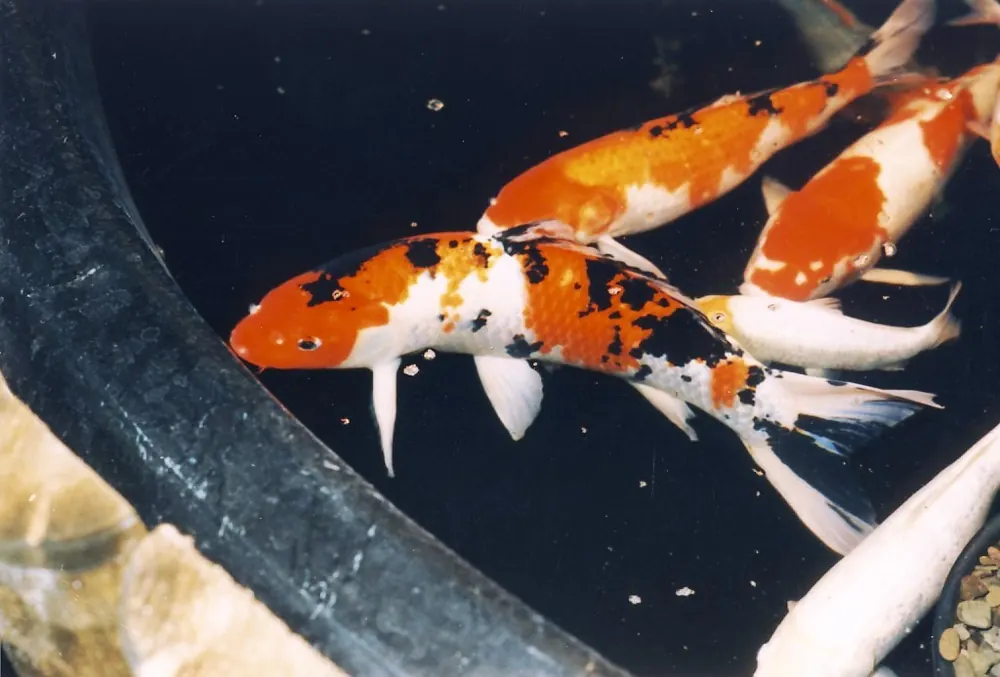
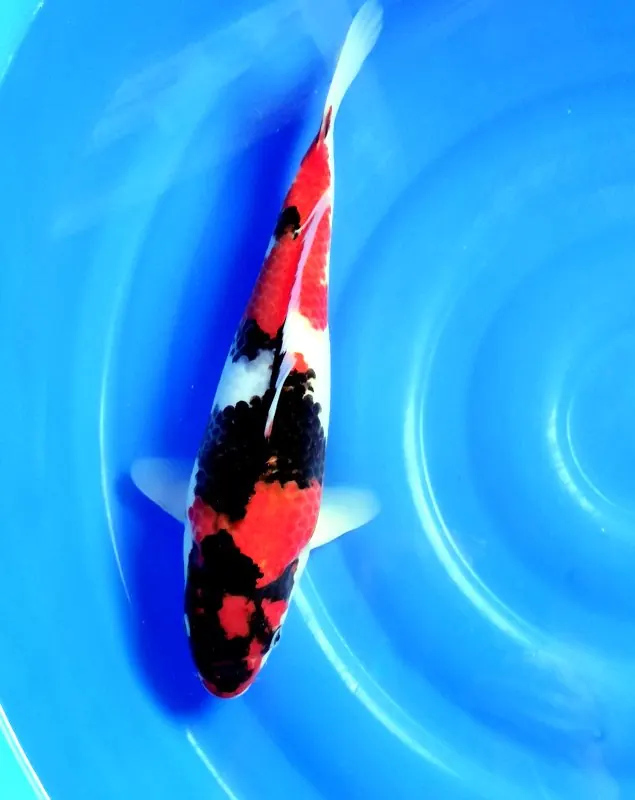
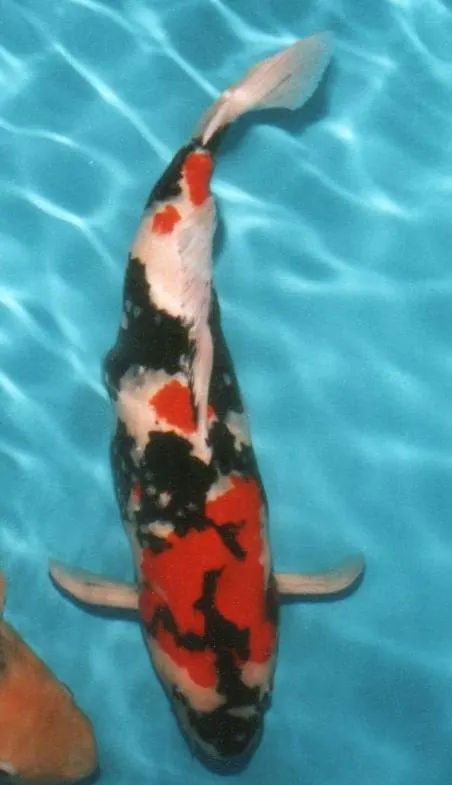
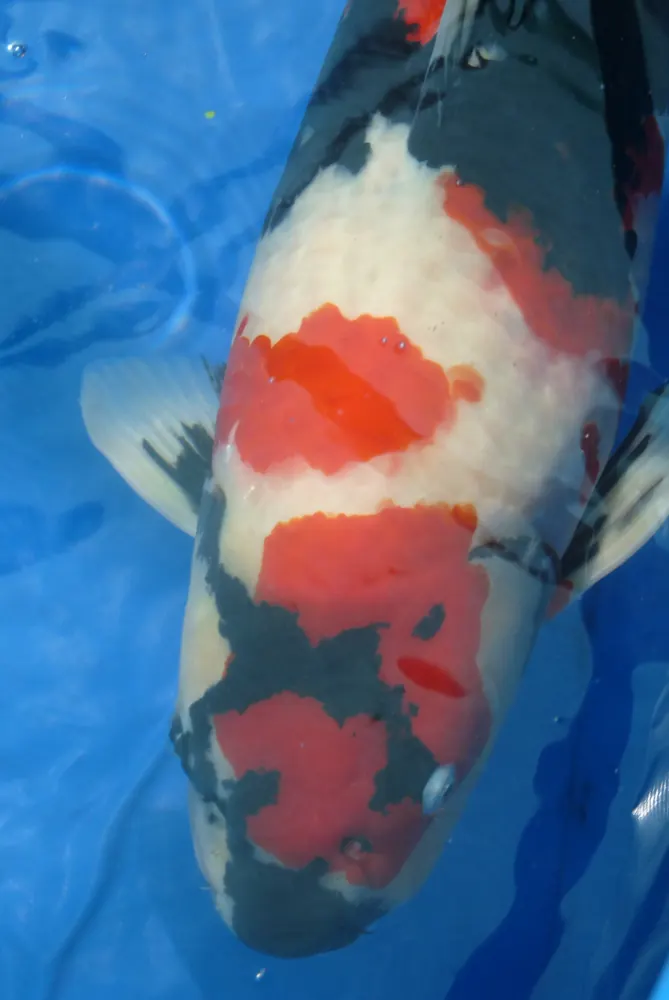
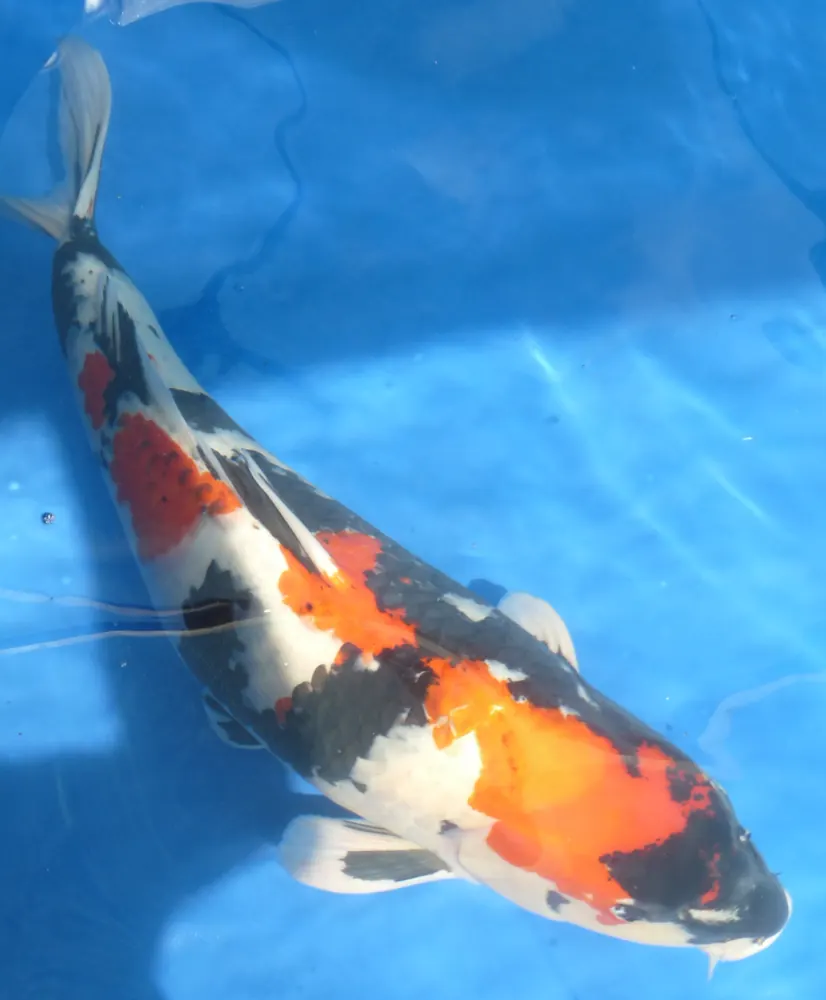
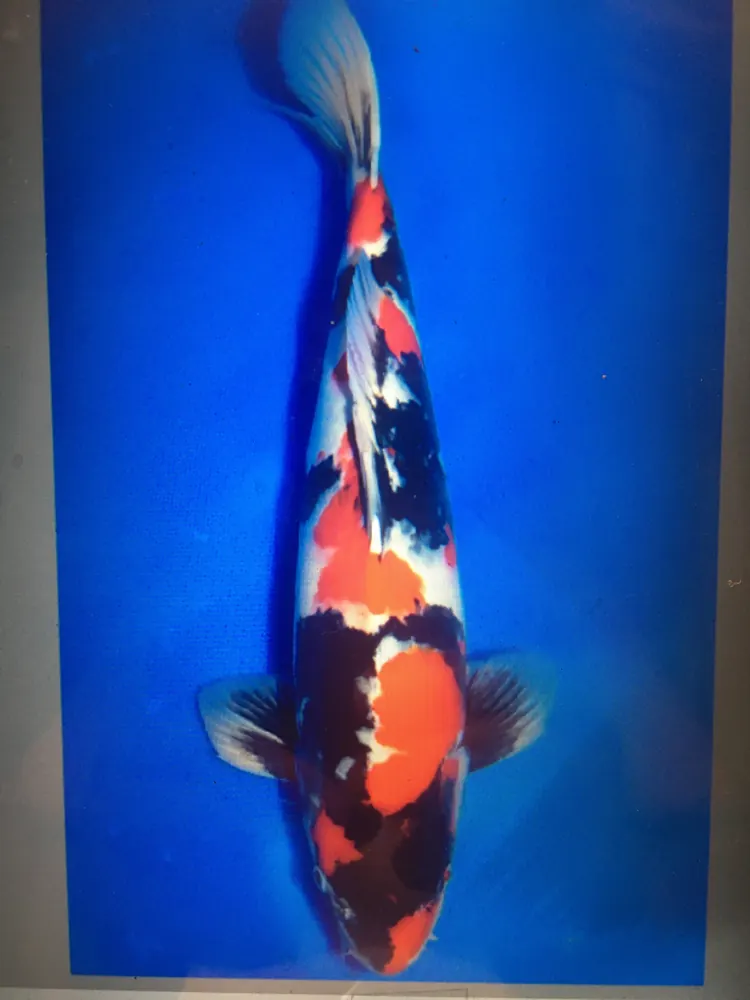
Key facts: Showa Sanshoku (昭和三色) is a koi variety with a black (sumi) base overlaid with red (hi) and white (shiroji) markings, distinguished from Taisho Sanshoku by sumi patterns that typically appear on the head and pectoral fin bases.[1][2]
Colors:
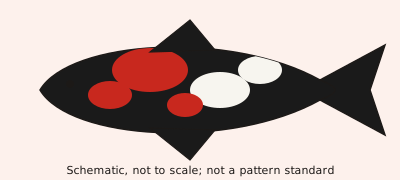
Showa Sanshoku, often shortened to Showa, is one of the Gosanke (御三家), the three most prominent koi varieties alongside Kohaku and Taisho Sanshoku (Sanke).[7][3] It has a black body with red and white markings across it, and is distinguished from Sanke chiefly by the presence of black on the head and by a continuous black background called utsurizumi.[1][2]According to Wikipedia, the first Showa Sanshoku was exhibited in 1927, during the reign of the Shōwa Emperor, and the variety is named for that era.[3][6] Kodama Koi Farm, a koi dealer, states it was created by Shigekichi Hoshino in Takesawa village from a lineage of Magoi (black carp).[7]- sumi (black)
- hi (red)
- shiroji (white ground)
Name and meaning
The Japanese Wikipedia entry gives the kanji 昭和三色 and describes the variety as having a black body with hi (緋) and white (白) markings, grouped together with Kohaku and Taisho Sanshoku as the “Gosanke” (御三家).[9] The name references the Shōwa era, during which the pattern was first stabilized and named.[3]Judging points
History and origin
According to Wikipedia, Showa were originally developed by Jukichi Hoshino around 1927 by pairing a Kohaku with a Ki Utsuri; these early fish had a grayish shiro, striped fins, dull sumi, and weak hi.[3] Breeders later crossed Showa with Asagi, which helped produce the black motoguro markings in the fins, though the hi remained weak and pale.[3]In 1964, Tomiji Kobayashi crossed a male Kohaku with a female Showa to produce a new style with a large crimson pattern and a brighter, un-netted white ground, though these “Kobayashi Showa” still had small size and poor body shape.[3] A later inazuma (lightning pattern) Showa bred by Minoru Mano represented a major improvement in body conformation and color quality and was used as a brood fish for many years afterward.[3] Kodama Koi Farm notes that before 1975, Showa were represented by the Kobayashi Showa lineage, which had abundant sumi but very little shiroji, with sumi and hi regularly overlapping to create an impression of power.[7]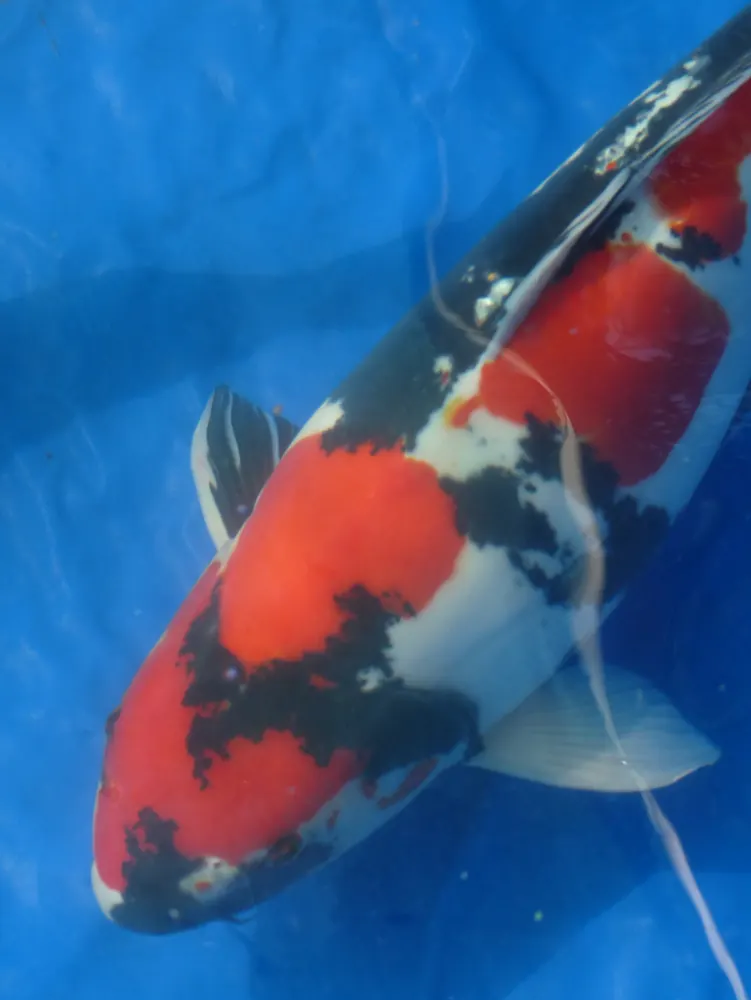

Appearance and the JAS standard
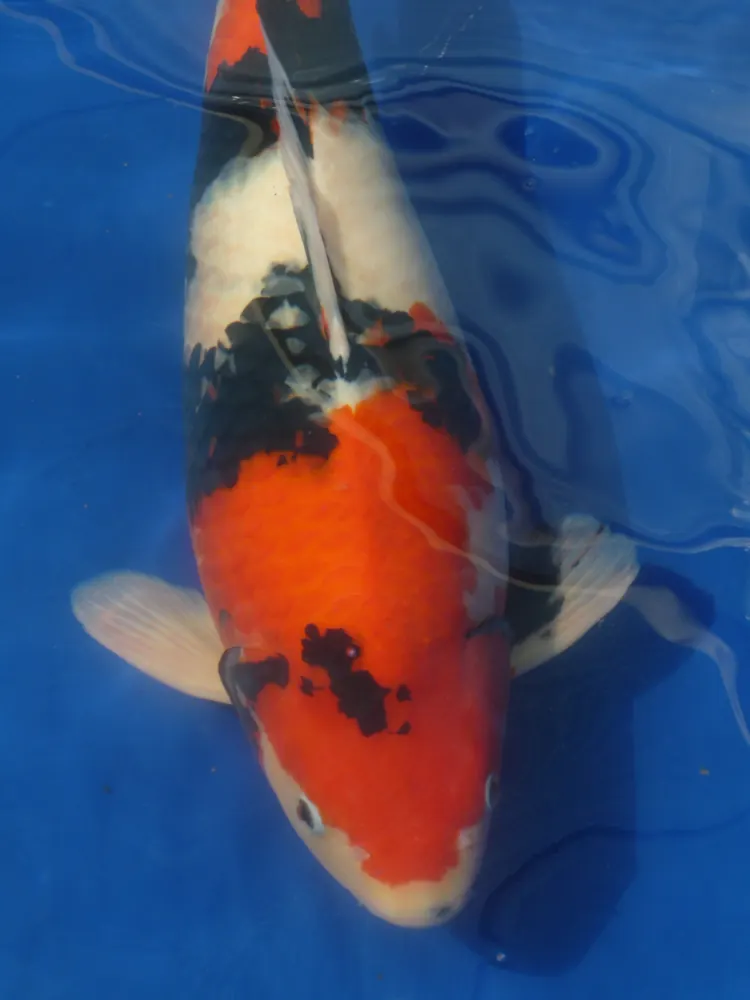
The Japan Agricultural Standard (JAS) entry 2003 for Showa Sanshoku states (translated) that Showa Sanshoku has a black body (black background/background color), with scarlet and white imprints across the body; in general the base of the pectoral fin is on a black background, but some individuals change from a white background to a black background in the course of growth, and some individuals have a continuous black background without the mottled “utsurizumi” shape.[5] The All Japan Nishikigoi Promotion Association (JNPA) similarly describes Showa Sanshoku as characterized by a continuous shape of utsurizumi derived from the black background, with the best examples showing an ink pattern rolling up from the belly to the back and an ink pattern splitting the face in half.[1]The Zen Nippon Airinkai (ZNA) states that Showa Sanshoku has a three-colored body of black, red, and white, and that unlike Taisho Sanshoku, sumi markings usually appear on the head.[2] Kodama Koi Farm describes the ideal as deep, jet-black sumi forming bold patterns, bright and well-defined hi, and clear, luminous shiroji extending from head to tail, with all three colors ideally present on the head.[7]Head and sumi patterns
ZNA lists typical sumi markings on the head: hachi-ware (men-ware) sumi, where a marking runs from the nose up over the shoulder, dividing the head; a v-shaped sumi marking on the head; and motoguro, a lump of sumi at the base of each pectoral fin.[2] Motoguro is usually considered a favorable sign for good sumi and overall pattern, though unusually large sumi spreading over the fins is sometimes seen as past its peak condition.[2] The American Koi Judges Association (AKJA) glossary defines menware as the traditional Showa head pattern in which the black pattern divides the red marking on the head, and moto guro as a sumi lump at the base of each pectoral fin, found in Showa Sanshoku and Utsurimono.[10] A ZNA terminology page likewise defines moto guro as a sumi lump at the base of each pectoral fin appearing in Showa Sanshoku and Utsurimono.[11]Kodama Koi Farm notes that sumi at the tail section is important: sumi or hi must end on pure white background at a line called the odome, and a lack of real shiroji after the odome is considered a major fault; sumi on the pectoral fins is also considered a major attribute, with beautiful pectoral fins described as extremely rare.[7]Kindai Showa and traditional Showa
ZNA states that Showa Sanshoku with more white parts, resembling Taisho Sanshoku, have also been produced and are called Kindai Showa, or Modern Showa.[2] The Japanese Wikipedia entry on Showa Sanshoku similarly notes that a form with less sumi and more visible white ground is called “Kindai Showa” (近代昭和).[9] The English Wikipedia entry states that the amount of shiroji on Showa Sanke has increased in modern times (Kindai Shōwa), to the point that it can be difficult to distinguish from Taisho Sanke.[3][6]Kodama Koi Farm, describing “Modern Showa,” says it has more vibrant and refined coloration with greater emphasis on balanced red and white, in contrast to “Traditional Showa,” which tends to have more extensive black patterns with simpler red and white detail.[7] This distinction is consistent with the shift described above from the heavily black Kobayashi-era lineage toward Showa developed with the separation of hi and sumi intended to harmonize into a brighter impression.[7]Sub-types and related forms
The AKJA glossary lists several named Showa pattern variants, including Hi Showa, a predominantly red Showa; Boke Showa, a form with blurred, grayish sumi; and Kanoko Showa, a Showa with dappled red markings.[10] Kage Showa, a Showa with a blurred, reticulated black “kage” pattern over the white, is classed by AKJA under Kawarimono.[10]Koromo Showa combines the Showa pattern with the Koromo trait of indigo- or black-tinted scale edges over the hi; JNPA describes it as having the appearance characteristics of Showa Sanshoku with a half-moon-shaped indigo-dyed scale tip on the scarlet imprints, and notes a Doitsu-koromo-showa form with almost no scales.[12] ZNA similarly describes Koromo Showa as produced by cross-breeding Ai Goromo and Showa Sanshoku.[8]Scale forms: Doitsu and Ginrin
A Doitsu (scaleless or German-scaled) form, Doitsu Showa, is recognized in ZNA show classification alongside standard Showa Sanshoku.[4] The JAS standard illustrates a Doitsu-kin-showa form (a metallic Showa with almost no scales) under the Hikari-utsuri category, and JNPA likewise describes Doitsu-kin-showa as having almost no scales with the skin exposed while retaining Kin-showa appearance characteristics.[13][5]Ginrin Showa, a form with sparkling, mirror-like deposits on the scales, is recognized as a class in ZNA show classification under Kinginrin.[4] The JAS standard defines A-ginrin and B-ginrin as scales shining gold or silver, applicable among others to Showa Sanshoku.[5]Metallic Showa (Hikari-utsurimono)
Metallic versions of Showa fall under the Hikari-utsurimono classification. ZNA lists Kin Showa as a metallic Showa Sanshoku and Gin Showa as a platinum metallic Showa Sanshoku within this group.[14] JNPA describes Kin-showa as having a black body with scarlet and white imprints across the body, with the whole body shining brightly and an utsuri-zumi pattern across the body, and notes a Doitsu-kin-showa variant with almost no scales.[13] The AKJA glossary defines Kin Showa as a metallic Showa with a gold luster.[10]Classification at shows
- ZNA show classification places Showa Sanshoku, along with Doitsu Showa, in its own class (class 3), separate from Utsurimono, Kinginrin and Koromo.[4]The JAS standard (variety entry 2003) defines Showa-sanshoku as having a black ground color with scarlet and white imprints, distinguishing it from the white-ground Kohaku (2001) and Taisho-sanshoku (2002) entries.[5]Kodama Koi Farm, a koi dealer, lists Showa Sanshoku as one of the Gosanke along with Kohaku and Taisho Sanke.[15][7]
Differences from similar varieties
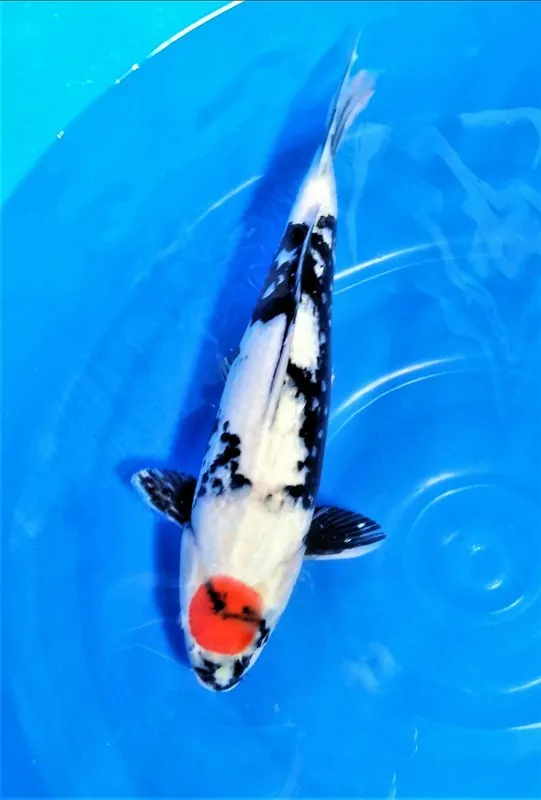
ZNA notes that Showa differs from Taisho Sanshoku (Sanke) chiefly in that sumi markings usually appear on the head in Showa, whereas Sanke generally lack black on the head.[2][7] Kodama Koi Farm adds that fry can be distinguished early: Showa fry are born with black coloring on their bodies, while Sanke fry are born pinkish.[7][16]Showa is also distinguished from Utsurimono. ZNA states that Utsurimono have Showa-typed sumi on a white, yellow, or red body but that, unlike Showa Sanshoku, Shiro Utsuri has no hi markings.[17] The JAS standard notes that Shiroutsuri (white-ground, black-background with white imprints) can resemble Bekko but is distinguishable by its black background.[5]Keeping and selection notes
Kodama Koi Farm, a koi dealer, notes that young Showa may show incomplete sumi development, with black deepening and red becoming richer as the fish matures, so evaluating a Showa’s eventual pattern requires understanding how its colors change with age.[15] ZNA notes that sumi in the related Utsurimono family is said not to settle until the fish reaches four or five years old, a pattern of late sumi development also relevant to Showa coloration.[17]Images
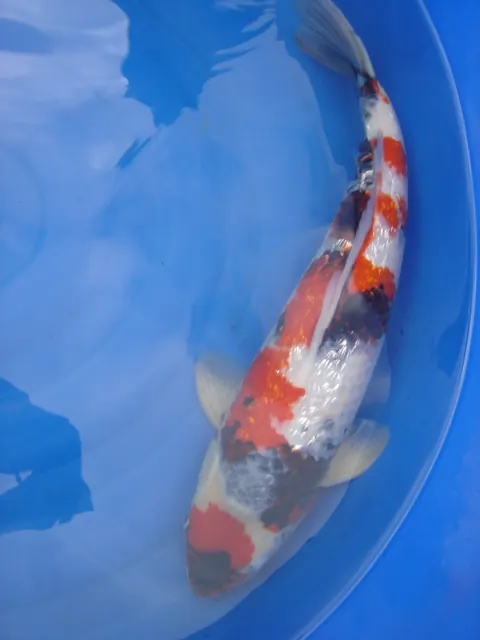

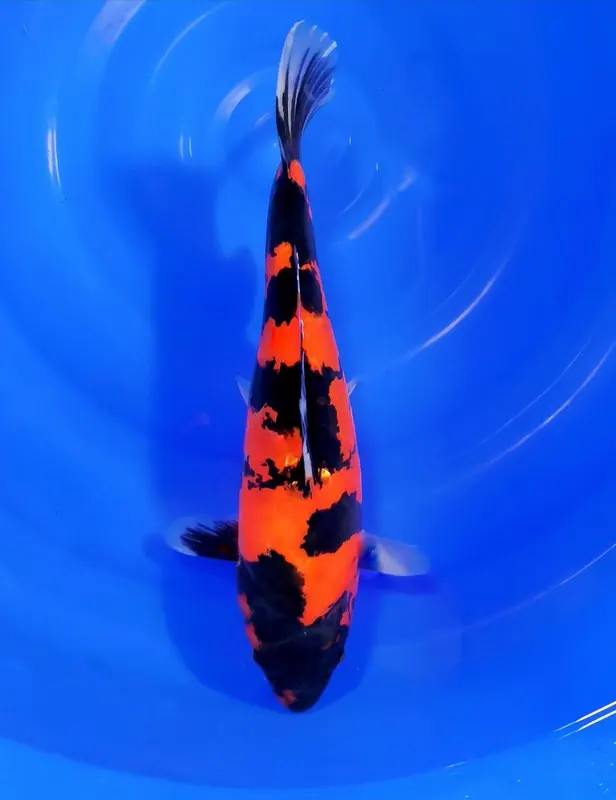

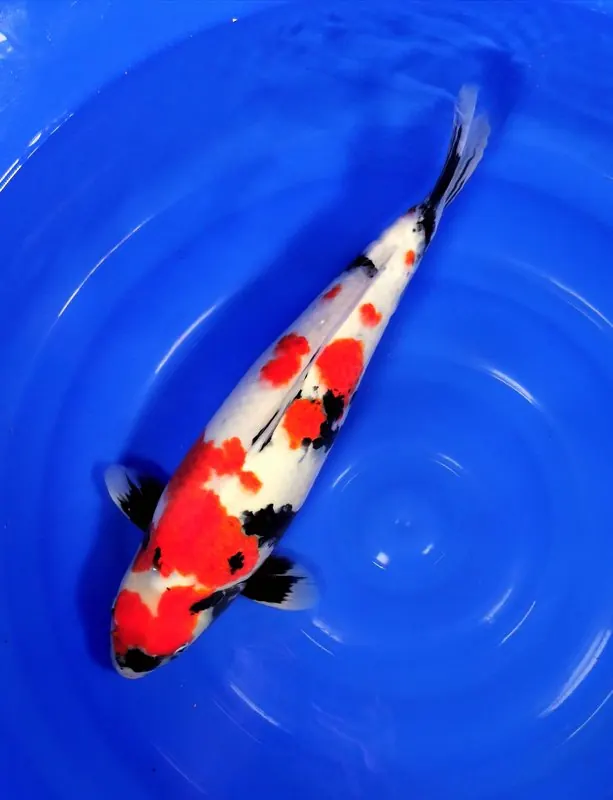









Common questions
How is Showa Sanshoku different from Taisho Sanke?
What is Kindai Showa?
What is motoguro?
When was Showa Sanshoku first fixed as a breed?
Related koi topics
References
- ^ Showa-sanshoku - Variety - All Japan Nishikigoi Promotion Association. All Japan Nishikigoi Promotion Association. jnpa.info/en/nishikigoi/varieties/type/showa-sanshoku/. Retrieved November 2026.
- ^ SHOWA SANSHOKU | Zen Nippon Airinkai. Zen Nippon Airinkai. zna.jp/en/keep-nishikigoi/varieties-of-nishikigoi/showa-sanshoku/. Retrieved November 2026.
- ^ Showa (fish) (Wikipedia). Wikipedia. en.wikipedia.org/wiki/Showa_(fish). Retrieved November 2026.
- ^ Koi classification (ZNA 2021), NMZNA 2026 show documents. nmzna.net. nmzna.net/2026%20Show%20Docs/NMZNA%202026%20Koi%20Classification%20…. Retrieved November 2026.
- ^ JAS 0020 Nishikigoi. Vocabulary (MAFF) — Ministry of Agriculture, Forestry and Fisheries (Japan). maff.go.jp/j/jas/jas_standard/attach/pdf/index-536.pdf. Retrieved November 2026.
- ^ Koi (Wikipedia). Wikipedia. en.wikipedia.org/wiki/Koi. Retrieved November 2026.
- ^ Showa - Koi for Sale and History - Kodama Koi Farm. Kodama Koi Farm (koi dealer). kodamakoifarm.com/variety/showa/. Retrieved November 2026.
- ^ KOROMO | Zen Nippon Airinkai. Zen Nippon Airinkai. zna.jp/en/keep-nishikigoi/varieties-of-nishikigoi/koromo/. Retrieved November 2026.
- ^ 昭和三色 (Wikipedia). Wikipedia (Japanese). ja.wikipedia.org/wiki/昭和三色. Retrieved November 2026.
- ^ Glossary – American Koi Judges Association (AKJA). American Koi Judges Association. akjajudges.com/glossary/. Retrieved November 2026.
- ^ NISHIKIGOI TERMINOLOGY 3 SUMI | Zen Nippon Airinkai. Zen Nippon Airinkai. zna.jp/en/keep-nishikigoi/nishikigoi-terminology/nishikigoi-termino…. Retrieved November 2026.
- ^ Koromo - Variety - All Japan Nishikigoi Promotion Association. All Japan Nishikigoi Promotion Association. jnpa.info/en/nishikigoi/varieties/type/koromo/. Retrieved November 2026.
- ^ Hikari-utsuri - Variety - All Japan Nishikigoi Promotion Association. All Japan Nishikigoi Promotion Association. jnpa.info/en/nishikigoi/varieties/type/hikari-utsuri/. Retrieved November 2026.
- ^ HIKARI-UTSURIMONO | Zen Nippon Airinkai. Zen Nippon Airinkai. zna.jp/en/keep-nishikigoi/varieties-of-nishikigoi/hikari-utsurimono/. Retrieved November 2026.
- ^ All About Gosanke Koi Fish Varieties "The Big Three!". Kodama Koi Farm (koi dealer). kodamakoifarm.com/gosanke-koi-fish/. Retrieved November 2026.
- ^ Taisho Sanke - Koi For Sale - Kodama Koi Farm. Kodama Koi Farm (koi dealer). kodamakoifarm.com/variety/taisho-sanke/. Retrieved November 2026.
- ^ UTSURI MONO | Zen Nippon Airinkai. Zen Nippon Airinkai. zna.jp/en/keep-nishikigoi/varieties-of-nishikigoi/utsuri-mono/. Retrieved November 2026.