
Kage Utsuri and Kage Showa
Key facts: Kage (影, “shadow”) describes koi — chiefly Kage Shiro Utsuri, Kage Hi Utsuri, Kage Ki Utsuri and Kage Showa — whose Utsuri- or Showa-type markings carry an additional mesh-like, reticulated black overlay on the colored areas[1][2].
Colors:
Kage (影) literally means “shadow” or “phantom,” and in koi terminology it refers to a blurred, reticulated black pattern laid over the white or colored markings of certain Showa- and Utsuri-type koi[2]. The All Japan Nishikigoi Promotion Association (JNPA) lists Kage-shiroutsuri, Kage-hiutsuri, Kage-kiutsuri and Kage-showa as named members of the Kawarigoi (Kawarimono) group, describing each as having a black body with a mesh-like ink pattern over its colored imprints[1].According to Zen Nippon Airinkai (ZNA), a “Kage Utsuri family” consisting of Shiro Kage Utsuri, Hi Kage Utsuri and Kage Showa sits within the broader Kawarimono class, which groups minority varieties at koi shows[3]. The American Koi Judges Association (AKJA) similarly defines Kage Hi Utsuri and Kage Shiro Utsuri as koi whose Utsuri pattern is complemented by a kage pattern over the red or white respectively, and Kage Showa as a Showa with a kage pattern over the white, all placed in Kawarimono[2].- sumi (black)
- shiroji (white ground)
- hi (red)
- ki (yellow)
Name and meaning
AKJA translates kage literally as “shadow” or “phantom,” describing it as a blurred, reticulated black pattern over the white or red ground of a koi[2]. ZNA’s glossary of sumi-related terminology also lists kage zumi (also called shizumi zumi) as “shadowy or unclear sumi markings that sink under the skin,” distinguishing this submerged, indistinct black from the crisp, lustrous sumi (hon zumi) prized on top varieties such as Showa Sanshoku[7]. The reticulated “kage” net pattern described for Kage Utsuri and Kage Showa is a related but distinct visual effect from this submerged shadow sumi, as both terms describe black that appears softened or veiled rather than sitting boldly on the surface.Judging points
Appearance and the JAS standard
The JNPA describes each named Kage variety individually. Kage-showa is said to have a black body with scarlet and white imprints across the body, carrying a mesh-like thin ink pattern within those scarlet and white areas[1]. Kage-shiroutsuri has a black body with white imprints, a mesh-like ink pattern on the white imprints, and the “utsuri-zumi” pattern characteristic of Utsurimono[1]. Kage-hiutsuri has a black body with red scarlet imprints carrying the same mesh-like ink pattern plus utsuri-zumi, and Kage-kiutsuri has a black body with yellow imprints and the same mesh pattern[1].This indicates that, within the JAS vocabulary standard, Kage varieties are treated as an illustrative example of kawarigoi rather than as independently defined named varieties[5].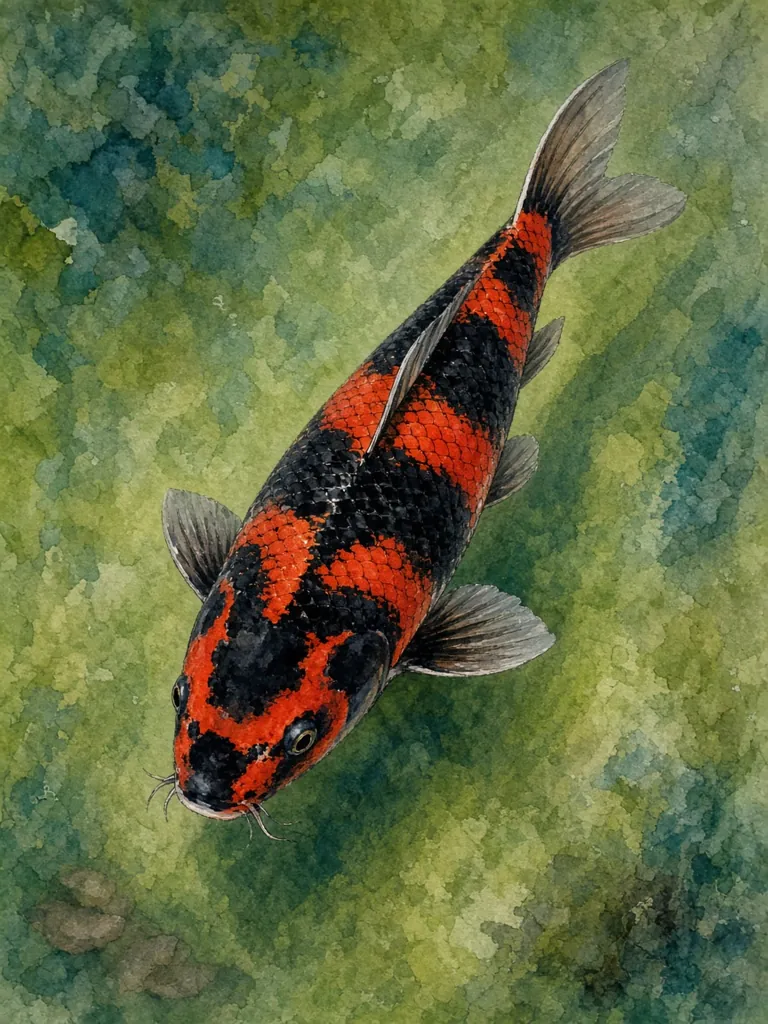
Sub-types
- Kage Showa — basic Showa Sanshoku pattern with a kage reticulated pattern over the white[2], described by JNPA as a black body with scarlet and white imprints carrying a mesh-like ink pattern[1].Kage Shiro Utsuri — basic black-and-white Shiro Utsuri pattern with a kage pattern over the white[2][1].Kage Hi Utsuri — red-and-black Hi Utsuri pattern complemented by a kage pattern over the red[2][1].Kage Ki Utsuri — black body with yellow imprints and a mesh-like ink pattern over the yellow, according to JNPA[1].
Metallic and ginrin forms
Metallic (hikari) versions of Kage patterns also exist. JNPA describes Kage-gin-shiroutsuri as having the appearance of Gin-shiroutsuri (a metallic Shiro Utsuri) with the added mesh-like ink pattern on its white imprints, and Kage-kin-kiutsuri as a Kin-kiutsuri with the same mesh pattern over its yellow imprints; both are grouped under the Hikari-utsuri family rather than plain Kawarimono[6]. ZNA’s Hikari-utsurimono listing confirms Gin Shiro (metallic Shiro Utsuri) and Kin Ki Utsuri (metallic Ki Utsuri/Hi Utsuri) as members of that metallic Utsuri family, into which kage-marked individuals can fall[8].Classification at shows
In the ZNA’s 2021 nishikigoi classification used for the ZNA America Koi Show, Kage Utsuri is listed explicitly as an example variety within class 10, Kawarimono, alongside Hajiro, Matsukawabake, Kumonryu and Kanoko[4]. ZNA’s own breakdown of Kawarimono sub-groups places a “Kage Utsuri family” — Shiro Kage Utsuri, Hi Kage Utsuri and Kage Showa — as one of several named groupings within that class[3]. The JNPA likewise lists Kage-showa, Kage-shiroutsuri, Kage-hiutsuri and Kage-kiutsuri under its Kawarigoi variety page, noting that Kawarigoi collectively covers nishikigoi that fall outside the 20 regulated named varieties such as Kohaku and Taisho Sanshoku[1]. As noted above, the JAS vocabulary standard does not assign Kage its own numbered variety entry, instead treating Kage-shiroutsuri as an example photo under the general kawarigoi definition[5].How it differs from similar varieties
Standard Shiro Utsuri, Hi Utsuri and Ki Utsuri carry Showa-type sumi over a white, red or yellow ground without the additional reticulated overlay, and ZNA notes that sumi in the Utsurimono family is said not to settle until a koi is four or five years old[9]. The kage pattern adds a further mesh-like black veil over the colored imprints of these base varieties, as described for each Kage type by JNPA[1]. Kage Showa differs from a standard Showa Sanshoku in the same way, carrying the mesh pattern over its white and scarlet areas in addition to the usual black, white and red Showa markings[1][2]. The related but visually distinct term kage zumi/shizumi zumi describes black that sinks indistinctly under the skin, which judges may note separately from the mesh-pattern kage varieties[7].Judging notes
General guidance for the Utsurimono group, to which Kage Utsuri varieties are closely related, states that the pigment and placement of sumi is very important and should ideally extend to the mouth and fins, with sumi ideally wrapping around the entire body, according to the US dealer Kodama Koi Farm[10]. The same source notes that an Ichimatsu (checkered) pattern on the tail or a Hariwake-style split-color face is considered highly valuable in Utsurimono[10]. ZNA’s terminology glossary distinguishes well-regarded, lustrous sumi (hon zumi, urushi zumi) from poorer, duller sumi (nabe zumi) and from shadowy, sunken sumi (kage zumi), a distinction relevant when assessing the clarity of the kage net pattern itself[7]. According to Kodama Koi Farm, Shiro Utsuri — the base variety for Kage Shiro Utsuri — historically has not grown as large as Gosanke varieties, which made it harder to win top show awards until breeders such as Omosako Koi Farm produced larger specimens[11].Images
Common questions
What does “kage” mean on a koi?
Kage (影) means “shadow” or “phantom” and describes a blurred, reticulated black net pattern laid over the white or colored markings of certain Utsuri- and Showa-type koi[2].
Is Kage Showa the same as regular Showa Sanshoku?
What show class does Kage Utsuri belong to?
Does the JAS standard recognize Kage as its own variety?
Not as a separately numbered variety; the JAS nishikigoi vocabulary standard uses Kage-shiroutsuri as an example photo under its general kawarigoi (変わり鯉) entry rather than defining Kage varieties individually[5].
Are there metallic versions of Kage patterns?
Yes, JNPA describes Kage-gin-shiroutsuri and Kage-kin-kiutsuri as metallic Utsuri varieties carrying the same mesh-like kage pattern, placed within the Hikari-utsuri family[6].
Related koi topics
References
- ^ Kawarigoi - Variety - All Japan Nishikigoi Promotion Association. All Japan Nishikigoi Promotion Association. jnpa.info/en/nishikigoi/varieties/type/kawarigoi/. Retrieved November 2026.
- ^ Glossary – American Koi Judges Association (AKJA). American Koi Judges Association. akjajudges.com/glossary/. Retrieved November 2026.
- ^ KAWARIMONO | Zen Nippon Airinkai. Zen Nippon Airinkai. zna.jp/en/keep-nishikigoi/varieties-of-nishikigoi/kawarimono/. Retrieved November 2026.
- ^ Koi classification (ZNA 2021), NMZNA 2026 show documents. nmzna.net. nmzna.net/2026%20Show%20Docs/NMZNA%202026%20Koi%20Classification%20…. Retrieved November 2026.
- ^ JAS 0020 Nishikigoi. Vocabulary (MAFF) — Ministry of Agriculture, Forestry and Fisheries (Japan). maff.go.jp/j/jas/jas_standard/attach/pdf/index-536.pdf. Retrieved November 2026.
- ^ Hikari-utsuri - Variety - All Japan Nishikigoi Promotion Association. All Japan Nishikigoi Promotion Association. jnpa.info/en/nishikigoi/varieties/type/hikari-utsuri/. Retrieved November 2026.
- ^ NISHIKIGOI TERMINOLOGY 3 SUMI | Zen Nippon Airinkai. Zen Nippon Airinkai. zna.jp/en/keep-nishikigoi/nishikigoi-terminology/nishikigoi-termino…. Retrieved November 2026.
- ^ HIKARI-UTSURIMONO | Zen Nippon Airinkai. Zen Nippon Airinkai. zna.jp/en/keep-nishikigoi/varieties-of-nishikigoi/hikari-utsurimono/. Retrieved November 2026.
- ^ UTSURI MONO | Zen Nippon Airinkai. Zen Nippon Airinkai. zna.jp/en/keep-nishikigoi/varieties-of-nishikigoi/utsuri-mono/. Retrieved November 2026.
- ^ Utsurimono - Koi For Sale - Kodama Koi Farm. Kodama Koi Farm (koi dealer). kodamakoifarm.com/variety/utsurimono/. Retrieved November 2026.
- ^ Shiro Utsuri - Koi For Sale - Kodama Koi Farm. Kodama Koi Farm (koi dealer). kodamakoifarm.com/variety/shiro-utsuri/. Retrieved November 2026.