
Hi Utsuri
Key facts: Hi Utsuri (緋写り) is a koi variety with a black ground color overlaid with red or orange markings in a continuous black pattern known as utsurizumi, placing it in the Utsurimono (写り物) family alongside Shiro Utsuri and Ki Utsuri.[1][2]
Colors:
Hi Utsuri is one of three major variations within the Utsurimono group recognized by the Zen Nippon Airinkai, distinguished from Shiro Utsuri and Ki Utsuri by its red or orange skin ground beneath the black Showa-type sumi pattern.[1] According to Wikipedia, Hi Utsuri (緋写り) is genetically the same as Showa Sanshoku, but lacking white pigment, so only black and red remain.[3] The Japan Agricultural Standard (JAS) issued by Japan's Ministry of Agriculture, Forestry and Fisheries groups Hiutsuri together with Kiutsuri under a single standard entry, defining them as koi with a black body (kuroji) bearing red scarlet or yellow imprints connected by a continuous black utsurizumi pattern.[6]The American Koi Judges Association glossary gives a concise working definition: Hi Utsuri is simply “a black Koi with red markings.”[4] The All Japan Nishikigoi Promotion Association (JNPA) notes that Hiutsuri is often described as having a compelling appeal, compared with the more unassuming atmosphere associated with Kiutsuri.[2]- sumi (black)
- hi (red)
Name and meaning
The word utsuri means “to print,” a reference to the black markings resembling ink stains across the body.[3] Hi Utsuri combines this with hi (緋), red.[4][9] According to Wikipedia, the oldest attested Utsurimono form was actually the yellow variant, recorded in the 19th century as “black and yellow markings” (黒黄斑, kuro ki madara) before being renamed Ki Utsuri by the early 20th-century breeder Elizaburo Hoshino; the red and white forms were subsequently named Hi Utsuri and Shiro Utsuri.[3]Judging points
Appearance and the standard definition
The JAS vocabulary standard (JAS 0020) defines Hiutsuri and Kiutsuri jointly under entry 2021 as koi with a black ground color bearing red scarlet (beni-hi) or yellow imprints, annotating that individuals with red imprints are called Hiutsuri and those with yellow imprints are called Kiutsuri, and both carry the continuous black pattern called utsurizumi.[6] The standard also notes that this variety resembles Bekko but can be distinguished because Bekko does not have a black ground color.[2][6]The JNPA states that Hiutsuri and Kiutsuri are considered good quality when the red or yellow color is evenly stained all the way to the tips of the pectoral fins and when the ink pattern is well-balanced and boldly curls from the head to the tail.[2] The koi dealer Kodama Koi Farm describes Hi Utsuri generally as having a black base with red patches.[7]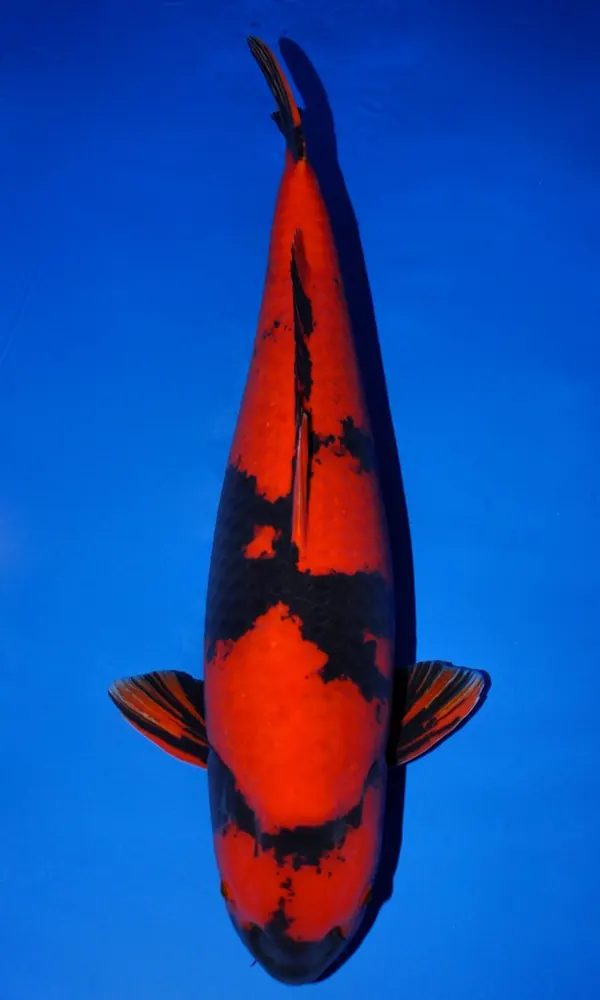
Classification at shows
At the ZNA International Koi Show, Hi Utsuri is classified within the Utsurimono group (class 3), alongside Shiro Utsuri, Ki Utsuri, and Doitsu Utsuri.[5] Ginrin-scaled Utsuri, including ginrin Hi Utsuri, are shown separately in the Kinginrin 1 class.[5] Metallic Hi Utsuri falls under the Hikari-Utsurimono classification; the ZNA lists Kin Ki Utsuri as covering metallic Ki Utsuri and metallic Hi Utsuri, and the AKJA glossary likewise defines Kin Hi Utsuri as a metallic Hi Utsuri placed in the Hikari-Utsurimono group.[10][4]Under JAS, the formal entry covering Hi Utsuri is shared with Ki Utsuri as item 2021, “Hiutsuri and Kiutsuri” (緋写り・黄写り).[6]Sub-types, including Kage Hi Utsuri
A notable variant is Kage Hi Utsuri, described by the JNPA as having a black body with red scarlet imprints overlaid by a mesh-like, shadow-type black (kage) pattern on top of the red, in addition to the standard utsurizumi pattern.[8] The AKJA glossary similarly defines Kage Hi Utsuri as a koi whose red-and-black Utsuri pattern is complemented by a kage pattern over the red, and places it in the Kawarimono class.[4] The ZNA groups the Kage Utsuri family, including Hi Kage Utsuri, within its broader Kawarimono category.[11]Scale forms: Doitsu and Ginrin
Doitsu-scaled Hi Utsuri exist, listed within the Utsurimono class at ZNA America shows as “Doitsu Utsuri.”[5] Ginrin versions also occur; Kodama Koi Farm has offered a “Ginrin Hi Utsuri” individual, confirming the variant is bred and sold commercially.[7] Within show classification, ginrin Utsuri koi (including ginrin Hi Utsuri) compete in the Kinginrin 1 class rather than within Utsurimono proper.[5]How it differs from similar varieties
Hi Utsuri is often compared to Bekko, since both can display red markings over black spots. The JAS standard distinguishes them by ground color: Bekko has a white, yellow, or red ground color with separated black spots, while Hi Utsuri (grouped with Ki Utsuri under JAS) has a black ground color with the red or yellow forming the markings, joined by a continuous utsurizumi pattern.[6][2] According to Wikipedia, Hi Utsuri is genetically the same as Showa Sanshoku but lacking white pigment, which is why Showa shows red, white, and black together while Hi Utsuri shows only red and black.[3] The Kodama Koi Farm guide to judging Utsurimono notes that, across the Utsurimono family generally, sumi pigment and placement are critical and should extend to reach the mouth and fins, ideally wrapping around the entire body.[12]Judging points
- Red (hi) color should be evenly stained all the way to the tips of the pectoral fins.[2]The black utsurizumi pattern should be well-balanced and boldly curl from the head to the tail.[2]Sumi should ideally wrap around the entire body, as is emphasized for Utsurimono generally.[12]An Ichimatsu (checkered) pattern on the tail or a Hariwake-style half-and-half face is considered highly valuable in Utsurimono.[12]Sharp kiwa (the back edge of a hi or sumi marking) is preferable, per ZNA terminology on Hi and Hi markings.[9]Even coloring in the hi plate is desired; uneven coloring, called hi mura, is considered poor quality.[9]
Images
Common questions
What is the difference between Hi Utsuri and Ki Utsuri?
Is Hi Utsuri the same as Showa?
Genetically they are considered the same according to Wikipedia, but Hi Utsuri lacks the white pigment that Showa Sanshoku displays, leaving only red and black.[3]
How does Hi Utsuri differ from Bekko?
What show class does Hi Utsuri compete in?
At the ZNA International Koi Show, Hi Utsuri competes within the Utsurimono class alongside Shiro Utsuri, Ki Utsuri, and Doitsu Utsuri.[5]
Related koi topics
References
- ^ UTSURI MONO | Zen Nippon Airinkai. Zen Nippon Airinkai. zna.jp/en/keep-nishikigoi/varieties-of-nishikigoi/utsuri-mono/. Retrieved November 2026.
- ^ Hiutsuri and Kiutsuri - Variety - All Japan Nishikigoi Promotion Association. All Japan Nishikigoi Promotion Association. jnpa.info/en/nishikigoi/varieties/type/hiutsuri-and-kiutsuri/. Retrieved November 2026.
- ^ Koi (Wikipedia). Wikipedia. en.wikipedia.org/wiki/Utsurimono. Retrieved November 2026.
- ^ Glossary – American Koi Judges Association (AKJA). American Koi Judges Association. akjajudges.com/glossary/. Retrieved November 2026.
- ^ Koi classification (ZNA 2021), NMZNA 2026 show documents. nmzna.net. nmzna.net/2026%20Show%20Docs/NMZNA%202026%20Koi%20Classification%20…. Retrieved November 2026.
- ^ JAS 0020 Nishikigoi. Vocabulary (MAFF) — Ministry of Agriculture, Forestry and Fisheries (Japan). maff.go.jp/j/jas/jas_standard/attach/pdf/index-536.pdf. Retrieved November 2026.
- ^ Hi Utsuri - Koi for Sale - Kodama Koi Farm. Kodama Koi Farm (koi dealer). kodamakoifarm.com/variety/hi-utsuri/. Retrieved November 2026.
- ^ Kawarigoi - Variety - All Japan Nishikigoi Promotion Association. All Japan Nishikigoi Promotion Association. jnpa.info/en/nishikigoi/varieties/type/kawarigoi/. Retrieved November 2026.
- ^ NISHIKIGOI TERMINOLOGY 2 HI and HI MARKINGS | Zen Nippon Airinkai. Zen Nippon Airinkai. zna.jp/en/keep-nishikigoi/nishikigoi-terminology/nishikigoi-termino…. Retrieved November 2026.
- ^ HIKARI-UTSURIMONO | Zen Nippon Airinkai. Zen Nippon Airinkai. zna.jp/en/keep-nishikigoi/varieties-of-nishikigoi/hikari-utsurimono/. Retrieved November 2026.
- ^ KAWARIMONO | Zen Nippon Airinkai. Zen Nippon Airinkai. zna.jp/en/keep-nishikigoi/varieties-of-nishikigoi/kawarimono/. Retrieved November 2026.
- ^ Utsurimono - Koi For Sale - Kodama Koi Farm. Kodama Koi Farm (koi dealer). kodamakoifarm.com/variety/utsurimono/. Retrieved November 2026.