
Ki Utsuri
Key facts: Ki Utsuri (黄写り) is a black-bodied koi with yellow markings arranged in the same continuous “utsuri-zumi” ink pattern seen in Shōwa Sanshoku, making it the yellow member of the Utsurimono (写り物) family alongside Shiro Utsuri and Hi Utsuri[1][2].
Colors:
Ki Utsuri is classified within the Utsurimono group of nishikigoi, defined by the Zen Nippon Airinkai as having Shōwa-type sumi on a yellow skin ground, as opposed to the white ground of Shiro Utsuri or red ground of Hi Utsuri[1]. The All Japan Nishikigoi Promotion Association (JNPA) groups Hiutsuri and Kiutsuri together as varieties sharing a continuous Utsurizumi pattern, distinguished only by the color of the imprint: red scarlet for Hiutsuri and yellow for Kiutsuri[2].According to a secondary source, Wikipedia, the yellow form is historically the oldest attested Utsurimono type, originally called Kuro ki madara (黒黄斑, "black and yellow markings") in the 19th century before being renamed Ki Utsuri (黄写り) by the early 20th-century breeder Elizaburo Hoshino[6]. The same source states that Ki Utsuri, Hi Utsuri and Shiro Utsuri are genetically equivalent to Shōwa Sanshoku but lack either red or white pigment respectively[6].- ki (yellow)
- sumi (black)
Name and meaning
The name Ki Utsuri (黄写り) combines ki (yellow) with utsuri, referring to the printed or stained appearance of the black sumi pattern across the body[1][6]. According to Wikipedia, the word utsuri means “to print,” since the black markings resemble ink stains on the skin[6].Judging points
- Sumi (black) should form a continuous, well-balanced pattern that curls boldly from head to tail[2]
- Yellow color should be evenly stained all the way to the tips of the pectoral fins[2]
- Sumi in the Utsurimono family is said not to fully settle until four or five years of age, so maturity should be considered[1]
- Pigment placement of sumi is important, reading through the mouth and fins, ideally wrapping around the whole body[7]
- An Ichimatsu (checkered) tail pattern or Hariwake (half-and-half) face pattern is considered highly valuable in Utsurimono generally[7]
History and origin
A secondary source states that colored koi present in Niigata around 1875 already included Ki Utsuri alongside Kōhaku and Asagi, making it one of the older recognized color forms from which later Nishikigoi varieties were developed[6]. The same source attributes the modern name Ki Utsuri to the breeder Elizaburo Hoshino, who renamed the earlier “Kuro ki madara” form in the early 20th century[6].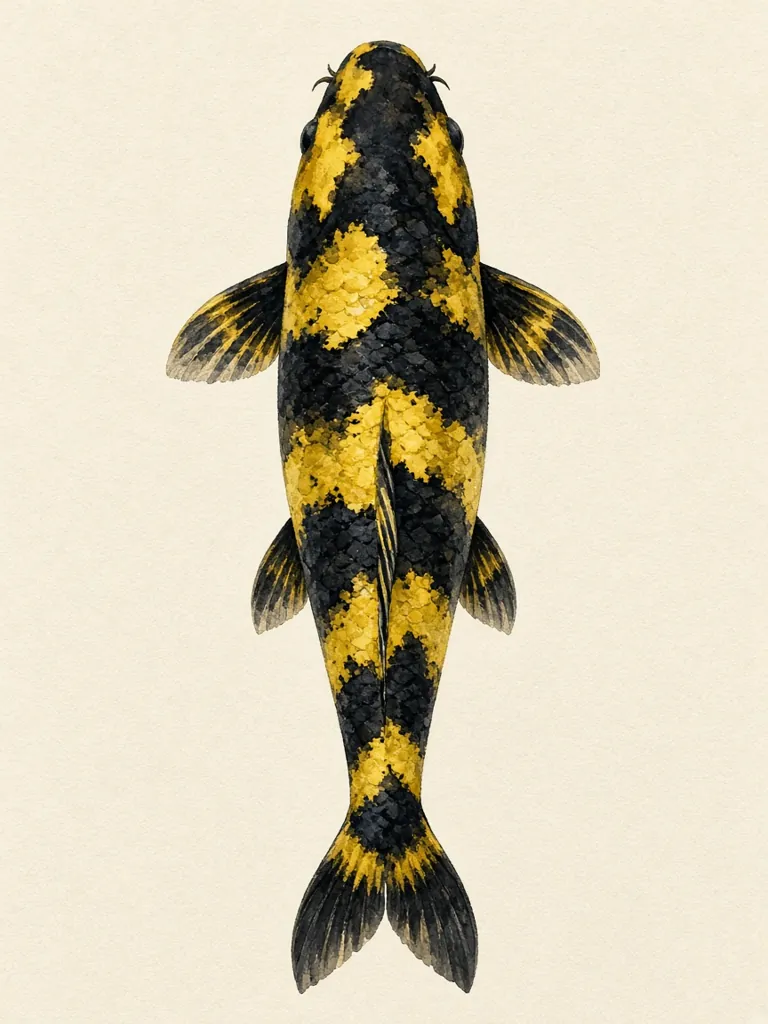
Appearance and standard definition
The Japanese Agricultural Standard (JAS) for Nishikigoi defines entry 2021, covering both Hiutsuri and Kiutsuri together, as a black-ground (kuro-ji) koi bearing either scarlet-red (benihi) or yellow imprints; the yellow-imprinted form is specifically termed Kiutsuri (黄写り), translated as “Ki Utsuri”[5]. The standard notes this variety possesses “utsuri-zumi,” a continuous black ground pattern, and that it can be distinguished from Bekkō by its black (rather than white, red, or yellow) ground color[5]. The JNPA similarly describes Kiutsuri as having a black body with yellow imprints forming an utsuri-zumi pattern across the body, noting it is “similar to Bekko” but distinguishable by its black background[2]. The JNPA further describes the Kiutsuri variety’s overall impression as having “an unassuming atmosphere,” in contrast to the more compelling appeal attributed to Hiutsuri[2].Sub-types
The JNPA lists Kage-kiutsuri as a variant having the appearance characteristics of Kin-kiutsuri with an added mesh-like ink pattern over the yellow imprints[8][9]. The American Koi Judges Association (AKJA) glossary separately defines Kage Hi Utsuri as a Koi whose red/black Utsuri pattern is complemented by a kage (shadow) pattern, indicating the kage trait applies across the Utsuri group[10].Scale forms: Doitsu and metallic (Kin) versions
The ZNA 2021 classification used for the NMZNA America Koi Show lists Doitsu Utsuri as a recognized scale form within the Utsurimono class, which includes Ki Utsuri[3]. A metallic (Kin) version also exists: the ZNA describes Kin Ki Utsuri as a metallic Ki Utsuri within its Hikari-Utsurimono family, alongside Kin Showa, Gin Showa, and Gin Shiro, plus doitsu forms of these[4]. The AKJA glossary likewise defines Kin Ki Utsuri simply as “a metallic Ki Utsuri”[10]. The JNPA describes Kin-kiutsuri as having a black body and scales, with gold imprints across the body and a whole-body shine, retaining the utsuri-zumi pattern[9]. According to the dealer Kodama Koi Farm, listed stock has included koi labeled “Kin Ki Utsuri” and plain “Ki Utsuri,” indicating both metallic and non-metallic forms are actively bred and traded[7].Classification at shows
- Under the ZNA 2021 Nishikigoi classification used for the NMZNA America Koi Show, Ki Utsuri is benched within class 3/4, UTSURIMONO, alongside Shiro Utsuri, Hi Utsuri, and Doitsu Utsuri[3].Metallic Kin Ki Utsuri falls under class 13, HIKARI UTSURIMONO[3][4].The JAS standard assigns Kiutsuri (along with Hiutsuri) to entry number 2021, distinct from Shiroutsuri (2004) and Bekkō (2020)[5].At the ZNA SoCal show, registration documents place all non-metallic Utsuri—shiro, hi, and ki—together in a single “Utsurimono” category[11].
How it differs from similar varieties
Ki Utsuri is most often confused with Ki Bekkō, since both show black markings on a yellow ground. The JAS standard notes that Bekkō and the Hiutsuri/Kiutsuri group can be distinguished because the latter have a black ground color (kuro-ji) rather than a white, red, or yellow ground with isolated black spots[5]. The JNPA makes the same point, stating Kiutsuri “is similar to Bekko, but it can be distinguished from the fact that…[it has] black backgrounds”[2]. Within the Utsurimono family itself, Ki Utsuri is separated from Shiro Utsuri and Hi Utsuri purely by ground color—yellow versus white versus red—while all three share the same Shōwa-type sumi pattern[1]. A secondary source adds that genetically Ki Utsuri is equivalent to Shōwa Sanshoku but lacking either white or red pigment[6]. Kodama Koi Farm, a koi dealer, notes that the pigment and placement of sumi is important across the Utsurimono family generally, and that patterns such as an Ichimatsu (checkered) tail or Hariwake face add value when present[7]; it also states Ki Utsuri belongs to a “Sumi pattern” category in which black markings contrast against a bright yellow base to create a balanced appearance[12].Judging points
The ZNA notes that sumi across the whole Utsurimono family is said not to settle down until a koi reaches four or five years of age, which is relevant to judging immature specimens[1]. The JNPA states that Kiutsuri is considered good when the yellow color is evenly stained all the way to the tips of the pectoral fins, and when the ink pattern is well balanced and boldly curls from the head to the tail[2].Images
Common questions
What is the difference between Ki Utsuri and Ki Bekkō?
Is Ki Utsuri the same as Hi Utsuri?
No. Both are classed together by the JNPA under Hiutsuri and Kiutsuri as sharing the same continuous Utsurizumi pattern, but Hi Utsuri has red/scarlet imprints while Ki Utsuri has yellow imprints[2].
What show class does Ki Utsuri belong to?
Is there a metallic version of Ki Utsuri?
How old is the Ki Utsuri variety?
According to a secondary source, Wikipedia, a yellow-and-black koi form existed in Niigata by around 1875 and was later renamed Ki Utsuri by the breeder Elizaburo Hoshino in the early 20th century, making it one of the older Utsurimono color forms[6].
Related koi topics
References
- ^ UTSURI MONO | Zen Nippon Airinkai. Zen Nippon Airinkai. zna.jp/en/keep-nishikigoi/varieties-of-nishikigoi/utsuri-mono/. Retrieved November 2026.
- ^ Hiutsuri and Kiutsuri - Variety - All Japan Nishikigoi Promotion Association. All Japan Nishikigoi Promotion Association. jnpa.info/en/nishikigoi/varieties/type/hiutsuri-and-kiutsuri/. Retrieved November 2026.
- ^ Koi classification (ZNA 2021), NMZNA 2026 show documents. nmzna.net. nmzna.net/2026%20Show%20Docs/NMZNA%202026%20Koi%20Classification%20…. Retrieved November 2026.
- ^ HIKARI-UTSURIMONO | Zen Nippon Airinkai. Zen Nippon Airinkai. zna.jp/en/keep-nishikigoi/varieties-of-nishikigoi/hikari-utsurimono/. Retrieved November 2026.
- ^ JAS 0020 Nishikigoi. Vocabulary (MAFF) — Ministry of Agriculture, Forestry and Fisheries (Japan). maff.go.jp/j/jas/jas_standard/attach/pdf/index-536.pdf. Retrieved November 2026.
- ^ Koi (Wikipedia). Wikipedia. en.wikipedia.org/wiki/Utsurimono. Retrieved November 2026.
- ^ Utsurimono - Koi For Sale - Kodama Koi Farm. Kodama Koi Farm (koi dealer). kodamakoifarm.com/variety/utsurimono/. Retrieved November 2026.
- ^ Kawarigoi - Variety - All Japan Nishikigoi Promotion Association. All Japan Nishikigoi Promotion Association. jnpa.info/en/nishikigoi/varieties/type/kawarigoi/. Retrieved November 2026.
- ^ Hikari-utsuri - Variety - All Japan Nishikigoi Promotion Association. All Japan Nishikigoi Promotion Association. jnpa.info/en/nishikigoi/varieties/type/hikari-utsuri/. Retrieved November 2026.
- ^ Glossary – American Koi Judges Association (AKJA). American Koi Judges Association. akjajudges.com/glossary/. Retrieved November 2026.
- ^ ZNA SoCal 50th Annual Koi Show exhibitor registration packet (2026). znasocal.org. znasocal.org/wp-content/uploads/2026/02/2026-entrant-registration-1…. Retrieved November 2026.
- ^ Koi Patterns and Markings: A Guide to Their Meaning, Types, and Selection. Kodama Koi Farm (koi dealer). kodamakoifarm.com/koi-patterns-and-markings/. Retrieved November 2026.