
Bekko
Key facts: Bekko (鼈甲) is a nishikigoi variety with clustered black sumi (墨) markings set against a single-colored ground of white, red or yellow, resembling the pattern of tortoiseshell[1][2].
Colors:
Bekko is a classic non-metallic variety defined by scattered black ink-like spots, called urushizumi, over an otherwise solid-colored body[1]. The Japan Agricultural Standard (JAS) describes Bekko as having a white, yellow or red body with black imprints shaped like spots, distinguishing it from Shiro Utsuri, Hi Utsuri and Ki Utsuri because those varieties have a black ground rather than a black-on-light pattern[1].According to the Zen Nippon Airinkai (ZNA), Bekko carries Sanke-style sumi spots on a white, yellow or red body and is usually produced during the breeding of Taisho Sanshoku[7]. The dealer Kodama Koi Farm similarly describes Bekko and Taisho Sanke as being bred together and effectively siblings, with Bekko having only black and white (or the base color) with no hi (red) pattern[10].- shiroji (white ground)
- hi (red)
- ki (yellow)
- sumi (black)
Name and meaning
The name Bekko comes from its resemblance to the shell of a sea turtle, called bekko in Japan[1]. Wikipedia likewise notes that the Japanese name means “tortoise shell” and is commonly written as 鼈甲[2].Judging points
- Shiroji (white ground) should be pure white with no blemishes on Shiro Bekko[10].
- Sumi markings should be evenly arranged with balance across the front, middle and rear of the body, avoiding both excess and deficiency[10].
- Color should extend evenly to the tips of the pectoral fins[1].
- Small scattered black dots (jari-zumi) are considered a fault[1].
- On Aka Bekko the fins and belly should be fully colored in red or orange[7].
Appearance and the JAS standard
JAS 0020 defines bekko (べっ甲, entry 2020) as having a ground color of white, yellow or red with clustered, dot-shaped black markings, noting variants named Shiro Bekko (white ground), Aka Bekko (red ground) and Ki Bekko (yellow ground)[4]. The standard also notes that Bekko can resemble Shiro Utsuri or Hi/Ki Utsuri but is distinguishable because Bekko is not built on a black ground[4][1].The All Japan Nishikigoi Promotion Association (JNPA) adds that good Bekko should be evenly colored to the tips of the pectoral fins, show a well-balanced arrangement of sumi, and be free of small scattered black dots known as jari-zumi[1]. Kodama Koi Farm states that the Shiroji (white ground) is of supreme importance for Shiro Bekko, requiring pure white skin free of blemishes with sumi that is neither excessive nor insufficient, and ideally balanced with sumi in the front, middle and rear sections of the body[10].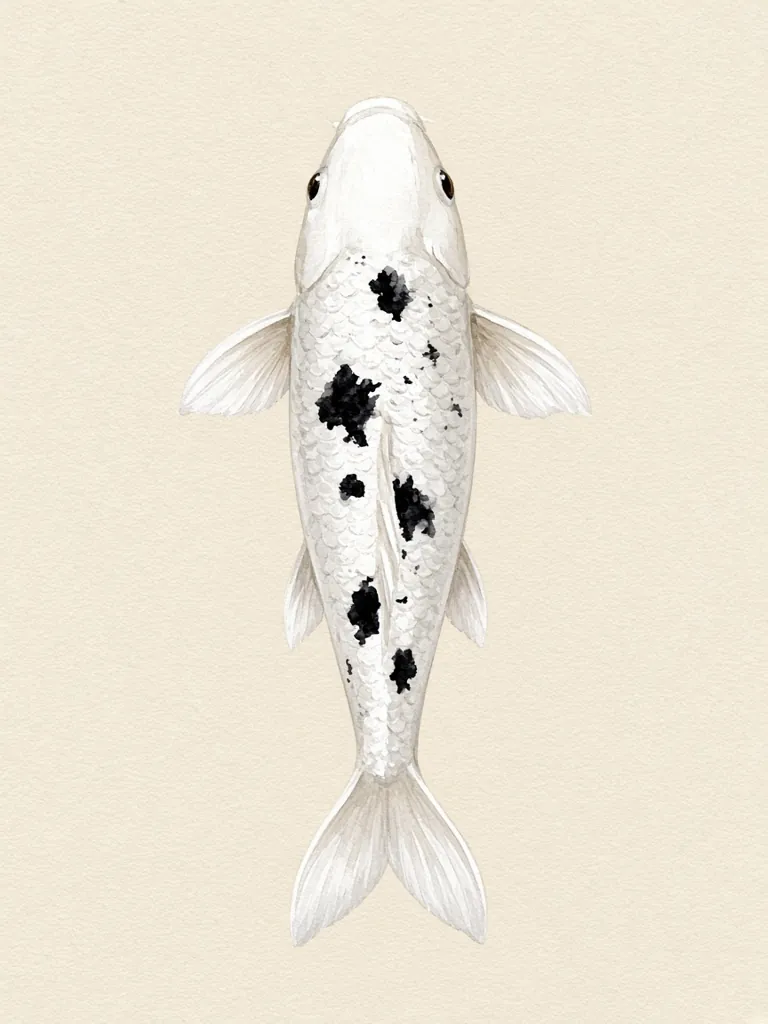
Sub-types
- Shiro Bekko (白鼈甲) has black spots on a white body; clear whiteness of the ground is considered important[7][1].Aka Bekko (赤鼈甲) has black spots on a red or orange body, with fins and belly expected to be fully colored in red or orange; it differs from Aka Sanke, which tends to show white on the fins, belly or body[7]. The AKJA glossary similarly defines Aka Bekko as a red koi with black markings[11].Ki Bekko (黄鼈甲) has black spots on a yellow body; ZNA notes it does not belong to the Taisho Sanshoku line and that a large, high-quality Ki Bekko is very rare[7].
Scale forms: doitsu and ginrin
Doitsu versions exist: JNPA describes Doitsu-shiro-bekko and Doitsu-aka-bekko as having almost no scales over the body, with the skin exposed, while retaining the appearance characteristics of Shiro Bekko or Aka Bekko respectively[5]. The ZNA classification list for the ZNA America Koi Show likewise includes Doitsu Bekko within the Bekko class[3].Ginrin forms also occur. JNPA describes Ginrin-shiro-bekko as having shining golden or silver scales combined with the appearance characteristics of Shiro Bekko[6]. The AKJA glossary defines Gin Bekko as basically a metallic Shiro Bekko, classified under Hikari Moyomono[11], and ZNA lists Gin Bekko (metallic Shiro Bekko) and Tora Ogon (metallic Ki Bekko) as members of the Hikari-moyomono group[9].Classification at shows
The ZNA 2021 nishikigoi classification used for the ZNA America Koi Show places Shiro Bekko, Aka Bekko, Ki Bekko and Doitsu Bekko together in a single Bekko class (class 6)[3]. The ZNA SoCal Koi Show entrant registration groups Bekko, including Shiro, Aka (hi) and Ki Bekko, within category group B alongside varieties such as Asagi/Shusui and Kawarimono[12]. Results from the Sydney Koi Show show Bekko benched as its own class across multiple size categories, separate from Utsurimono, Kohaku, Taisho Sanke and Showa Sanshoku[13].Metallic Bekko derivatives such as Gin Bekko and Tora Ogon are instead classified under Hikari Moyomono rather than the Bekko class[9].How it differs from similar varieties
Bekko is frequently compared to the Utsurimono group. JNPA explains that Shiro Utsuri and Shiro Bekko look similar, but the ink color differs; a useful way to remember the distinction is that Showa Sanshoku without red imprints is Shiro Utsuri, while Taisho Sanshoku without red imprints is Shiro Bekko[8]. The JAS standard formalizes this: Bekko is built on a white, yellow or red ground, whereas Shiro Utsuri, Hi Utsuri and Ki Utsuri are built on a black ground, which is the key distinguishing feature[4]. Kodama Koi Farm groups Bekko, together with Shiro Utsuri and Ki Utsuri, within a broader “Sumi pattern” category, since black markings contrasting against the base color define the look of all three[10].Bekko is also distinguished from Aka Sanke: ZNA notes that while Aka Bekko carries sumi on a fully red or orange body, Aka Sanke is a separate variety that tends to show white on the fins, belly or body[7].Images
Common questions
What does the name Bekko mean?
How is Bekko different from Shiro Utsuri?
What are the main types of Bekko?
Are there metallic or doitsu Bekko?
Related koi topics
References
- ^ Bekko - Variety - All Japan Nishikigoi Promotion Association. All Japan Nishikigoi Promotion Association. jnpa.info/en/nishikigoi/varieties/type/bekko/. Retrieved November 2026.
- ^ Koi (Wikipedia). Wikipedia. en.wikipedia.org/wiki/Utsurimono. Retrieved November 2026.
- ^ Koi classification (ZNA 2021), NMZNA 2026 show documents. nmzna.net. nmzna.net/2026%20Show%20Docs/NMZNA%202026%20Koi%20Classification%20…. Retrieved November 2026.
- ^ JAS 0020 Nishikigoi. Vocabulary (MAFF) — Ministry of Agriculture, Forestry and Fisheries (Japan). maff.go.jp/j/jas/jas_standard/attach/pdf/index-536.pdf. Retrieved November 2026.
- ^ Doitsugoi - Variety - All Japan Nishikigoi Promotion Association. All Japan Nishikigoi Promotion Association. jnpa.info/en/nishikigoi/varieties/type/doitsugoi/. Retrieved November 2026.
- ^ B-ginrin - Variety - All Japan Nishikigoi Promotion Association. All Japan Nishikigoi Promotion Association. jnpa.info/en/nishikigoi/varieties/type/b-ginrin/. Retrieved November 2026.
- ^ BEKKO | Zen Nippon Airinkai. Zen Nippon Airinkai. zna.jp/en/keep-nishikigoi/varieties-of-nishikigoi/bekko/. Retrieved November 2026.
- ^ Shiroutsuri - Variety - All Japan Nishikigoi Promotion Association. All Japan Nishikigoi Promotion Association. jnpa.info/en/nishikigoi/varieties/type/shiroutsuri/. Retrieved November 2026.
- ^ HIKARI-MOYOMONO | Zen Nippon Airinkai. Zen Nippon Airinkai. zna.jp/en/keep-nishikigoi/varieties-of-nishikigoi/hikari-moyomono/. Retrieved November 2026.
- ^ Bekko Archives - Kodama Koi Farm. Kodama Koi Farm (koi dealer). kodamakoifarm.com/variety/bekko/. Retrieved November 2026.
- ^ Glossary – American Koi Judges Association (AKJA). American Koi Judges Association. akjajudges.com/glossary/. Retrieved November 2026.
- ^ ZNA SoCal 50th Annual Koi Show exhibitor registration packet (2026). znasocal.org. znasocal.org/wp-content/uploads/2026/02/2026-entrant-registration-1…. Retrieved November 2026.
- ^ 49th Sydney Koi Show 2026 results (Sydney Koi Show). Sydney Koi Show. sydneykoishow.com/admin/photoresultsnew.toy?eid=206700. Retrieved November 2026.