
Kanoko
Key facts: Kanoko (鹿の子) describes koi — most often Kohaku, Sanke or Showa — whose red (hi) pattern appears as a dappled, dotted effect rather than solid color, caused by individual scales being only partly dyed red[1][2].
Colors:
Kanoko is not a single fixed variety but a descriptive term applied to several varieties whose hi pattern shows a dappled, dotted appearance, said to resemble a fawn's coat[1]. It most commonly appears combined with Kohaku, Sanke and Showa, producing Kanoko Kohaku, Kanoko Sanke and Kanoko Showa, and the All Japan Nishikigoi Promotion Association also lists a Kanoko Asagi and a metallic Kanoko Kin-Showa[2].Both the Zen Nippon Airinkai (ZNA) and the American Koi Judges Association (AKJA) classify Kanoko-pattern koi within the broader Kawarimono grouping[3][1].- hi (red)
- shiroji (white ground)
- sumi (black)
Name and meaning
The American Koi Judges Association glossary states that Kanoko literally means “fawn,” referring to the dappled red pattern found on some koi[1]. The term describes the visual effect rather than a single lineage, and is attached as a prefix or modifier to the base variety name, as in Kanoko Kohaku, Kanoko Sanke and Kanoko Showa[1].Judging points
Appearance and pattern
According to the All Japan Nishikigoi Promotion Association, Kanoko-kohaku has a white body with part of the scales dyed red, producing a dotted pattern across the body; some individuals have scarlet imprints and some do not[2]. Kanoko-sanshoku carries the appearance characteristics of Taisho Sanshoku with the same dotted, partly-dyed scale pattern, and Kanoko-showa carries the appearance characteristics of Showa Sanshoku with the equivalent dappled red pattern[2]. The AKJA glossary similarly defines Kanoko Kohaku, Kanoko Sanke and Kanoko Showa as those respective varieties with dappled red markings[1].The term kado-gin and other scale-edge terms describe related skin effects but are distinct from the Kanoko dappling itself, which concerns how red pigment sits on individual scales rather than iridescence[1].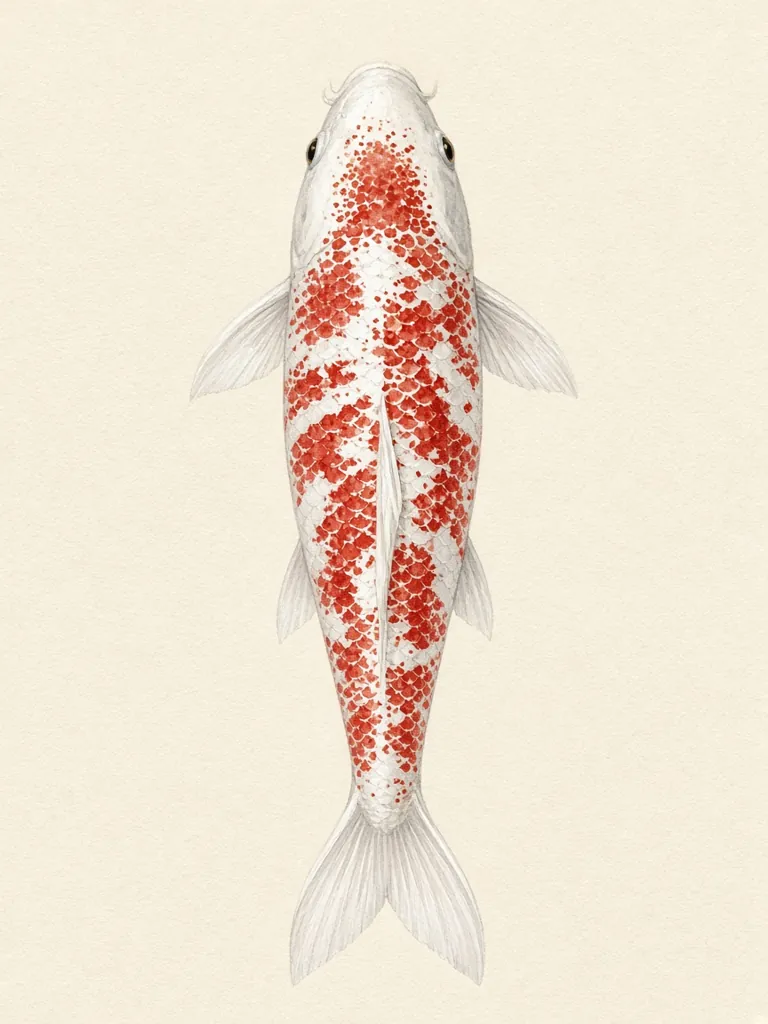
Sub-types
- Kanoko Kohaku — white ground with a dappled red (hi) pattern instead of solid hi[1][2].Kanoko Sanke — Taisho Sanshoku pattern expressed with dappled rather than solid hi[2][1].Kanoko Showa — Showa Sanshoku pattern expressed with dappled hi[2][1].Kanoko Asagi — described by the All Japan Nishikigoi Promotion Association as having the appearance characteristics of Asagi with the same dotted, dappled red pattern across the body[2].Kanoko Kin-Showa — a metallic version, having the characteristics of Kanoko-showa with the whole body shining[2].Ginrin-kanoko-karashi — a mustard-colored, ginrin-scaled koi with a reddish dotted pattern on some scales, noted by the source as sometimes called “golden-corn”[2].Sakura Ogon / metallic Kanoko Kohaku — the Zen Nippon Airinkai lists a metallic Kanoko Kohaku within its Hikari-moyomono category, and the AKJA glossary notes Sakura Ogon as a metallic Kanoko Kohaku[5][1].
Classification at shows
The Zen Nippon Airinkai places Kanoko (including Kanoko Kohaku, Kanoko Sanke and Kanoko Showa) within its Kawarimono class[3]. A ZNA America show classification document likewise lists Kanoko under category 10, Kawarimono, alongside varieties such as Hajiro and Kumonryu[4]. Entry rules from the 59th ZNA International Koi Show list “Shikanoko” as a specific variety noted within the Kawarimono category (category 10), and list “Beni Kanoko” as a specific variety noted within the Hikarimono category (category 12)[6].Metallic Kanoko forms are treated separately: the Zen Nippon Airinkai includes a metallic Kanoko Kohaku within its Hikari-moyomono class[5].JAS standard and related definitions
The Japanese Agricultural Standard JAS 0020 on Nishikigoi vocabulary defines the base varieties Kohaku, Taisho Sanshoku and Showa Sanshoku by ground color and imprint color, but its published entries do not include a dedicated numbered definition for Kanoko itself among the terms excerpted here[7]. The standard does note that variety assignment can be ambiguous when an individual koi shows the appearance characteristics of more than one variety, leaving the categorization to the standard's users[7].The All Japan Nishikigoi Promotion Association separately notes that Kawarigoi — the broader category to which Kanoko-pattern koi belong when not classified under the twenty regulated varieties — covers koi that either cannot be produced stably or have appeared through mutation, as well as koi that can be produced stably and carry conventional names[2].Differences from similar varieties
Kanoko differs from standard Kohaku, Sanke and Showa chiefly in how the red pigment is distributed: in the standard varieties, hi is typically expressed as solid, continuous patches (sashi and kiwa boundaries define their edges), whereas in Kanoko forms only part of each scale is dyed red, creating a dotted or stippled look rather than a continuous block of color[2][1]. This distinguishes Kanoko from related dappled-pattern terms such as sarasa (described in the AKJA glossary as red spots on the back) and from kage patterning, which involves a black reticulated overlay rather than dappled red[1].Images
Common questions
Is Kanoko a separate koi variety?
What does “Kanoko” mean?
According to the American Koi Judges Association glossary, Kanoko literally means “fawn,” referring to the dappled red pattern it describes[1].
How is Kanoko Showa different from regular Showa?
Kanoko Showa has the same black, white and red pattern structure as Showa Sanshoku, but the red is expressed as a dappled, dotted effect across the scales rather than solid hi, according to the All Japan Nishikigoi Promotion Association[2].
Are there metallic Kanoko koi?
Related koi topics
References
- ^ Glossary – American Koi Judges Association (AKJA). American Koi Judges Association. akjajudges.com/glossary/. Retrieved November 2026.
- ^ Kawarigoi - Variety - All Japan Nishikigoi Promotion Association. All Japan Nishikigoi Promotion Association. jnpa.info/en/nishikigoi/varieties/type/kawarigoi/. Retrieved November 2026.
- ^ KAWARIMONO | Zen Nippon Airinkai. Zen Nippon Airinkai. zna.jp/en/keep-nishikigoi/varieties-of-nishikigoi/kawarimono/. Retrieved November 2026.
- ^ Koi classification (ZNA 2021), NMZNA 2026 show documents. nmzna.net. nmzna.net/2026%20Show%20Docs/NMZNA%202026%20Koi%20Classification%20…. Retrieved November 2026.
- ^ HIKARI-MOYOMONO | Zen Nippon Airinkai. Zen Nippon Airinkai. zna.jp/en/keep-nishikigoi/varieties-of-nishikigoi/hikari-moyomono/. Retrieved November 2026.
- ^ 59th ZNA International Koi Show entry rules (ZNA). Zen Nippon Airinkai. zna.jp/wp-content/uploads/2023/07/59th-zna-koishow.pdf. Retrieved November 2026.
- ^ JAS 0020 Nishikigoi. Vocabulary (MAFF) — Ministry of Agriculture, Forestry and Fisheries (Japan). maff.go.jp/j/jas/jas_standard/attach/pdf/index-536.pdf. Retrieved November 2026.