
Matsukawabake
Key facts: Matsukawabake (松川化け) is a non-metallic black-and-white koi whose jet-black pattern can change noticeably with environmental conditions, particularly water temperature, and is classified within the Kawarimono group[1][2].
Colors:
Matsukawabake is a scaled koi variety covered in white and jet-black patterning across the whole body except the head, placing it among the Karasu-goi family of black-patterned kawarimono[1][4]. It is best known for the instability of its black markings, which are reported to change, sometimes rapidly, in response to changes in the environment in which the koi lives[1]. The American Koi Judges Association similarly describes it as a non-metallic black and white koi whose pattern changes with the time of year and water temperature[2].Because it does not fit within the regulated major varieties such as Kohaku, Taisho Sanshoku or Showa Sanshoku, Matsukawabake is grouped with other minority patterns under Kawarimono at most shows[1][4].- sumi (black)
- shiroji (white ground)
Name and classification
Matsukawabake belongs to a group of black-patterned non-metallic kawarimono that the Zen Nippon Airinkai (ZNA) places under the “Karasu-goi family,” alongside Karasu-goi, Hajiro, Hage Shiro, Yotsu Jiro, Kumonryu and Sumi Nagashi[4]. A related variant with scarlet markings in addition to the black-and-white pattern is called Beni-matsukawa-bake according to the All Japan Nishikigoi Promotion Association (JNPA)[1].Judging points
- The black pattern is expected to be jet-black and to cover the body in contrast with white skin[1]
- Keepers should expect the sumi pattern to change with environmental conditions rather than remain fixed[1][2]
- Scale coverage over the whole body except the head distinguishes it from the scaleless Kumonryu[1]
- Classed among the Karasu-goi family of black-patterned kawarimono at shows[4]
Appearance and the JAS/JNPA definition
The JNPA describes Matsukawabake as having white and jet-black patterns across the body, with the whole body except the head covered in scales, distinguishing it from its scaleless relative Kumonryu[1]. The defining trait emphasized by the JNPA is that, due to changes in the environment in which the fish lives, the jet-black pattern may change frequently over a short period of time[1]. The AKJA glossary gives a parallel definition, calling it a non-metallic black and white koi whose pattern changes with the time of year and water temperature, and classifies it under Kawarimono[2].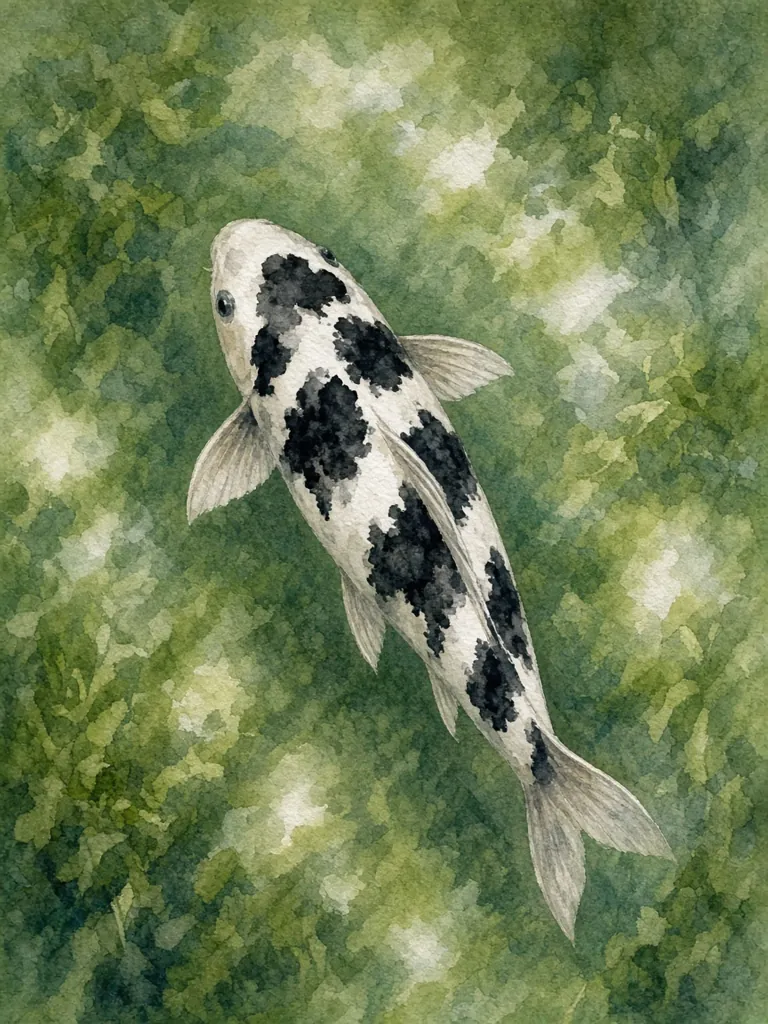
Pattern change and water temperature
The instability of the black pattern is the variety's most notable feature. The JNPA states explicitly that changes in environment can cause the jet-black pattern to shift frequently within a short period[1], and the AKJA links this specifically to the season and water temperature[2]. A closely related phenomenon is documented for the scaleless Kumonryu, where JNPA notes that the ink pattern sinks into the white body when water temperature is high and gushes out when the water temperature is low, meaning keepers can observe seasonal change in the pattern[5]. Because Matsukawabake and Kumonryu share this trait of a temperature-sensitive sumi pattern, they are often discussed together as koi whose appearance is unpredictable through the year, though Kumonryu is scaleless (doitsu) while Matsukawabake retains scales[1][5].Related forms
- Beni-matsukawa-bake: has scarlet (beni) patterns added to the body along with the Matsukawabake black-and-white appearance[1].Kumonryu: a scaleless (doitsu) relative described separately, with black cloud-like patterns that change over a black background as the white portion increases with growth[5].Beni Kumonryu and Ki Kokuryu are listed by the ZNA among other related black-patterned kawarimono in the same broad “others” grouping[4].
Classification at shows
Matsukawabake is grouped under the Kawarimono class in the ZNA's nishikigoi classification used for its International Koi Show, alongside Hajiro, Hage Shiro, Yotsu Jiro, Sumi Nagashi, Kumonryu, Beni Kumonryu, Kage Utsuri, Kanoko, Kikokuryu and Ochiba Shigure, among others[3]. The JNPA likewise places it among Kawarigoi, the broader category covering koi not belonging to the 20 regulated major varieties such as Kohaku and Taisho Sanshoku[1]. The JNPA notes that over 140 varieties are said to exist in total, with Kawarigoi collectively describing those outside the 20 regulated types, while the ZNA separately states there are no fewer than a hundred varieties when divided finely by pattern and color, most of which are grouped into the Kawarimono class at shows[1][4].Differences from similar varieties
Matsukawabake differs from Kumonryu primarily in scalation: Matsukawabake is a scaled variety covered in scales except on the head, whereas Kumonryu displays the characteristics of German carp (Doitsugoi), with almost no scales[1][5]. Both share the trait of an unstable, changeable black pattern linked to environmental conditions[1][5]. It also differs from the two-color utsurimono varieties, such as Shiro Utsuri, which the JNPA describes as having a continuous pattern of “utsuri-zumi” derived from a black background with no red imprints, a stable pattern type rather than one defined by seasonal change[6].Images
Common questions
Why does the black pattern on Matsukawabake change?
According to the All Japan Nishikigoi Promotion Association, the jet-black pattern on Matsukawabake may change frequently over a short period of time due to changes in the environment the koi lives in[1], and the American Koi Judges Association specifically links the change to the time of year and water temperature[2].
Is Matsukawabake the same as Kumonryu?
What show class is Matsukawabake judged in?
Is there a variety with red markings similar to Matsukawabake?
Yes, Beni-matsukawa-bake has scarlet patterns on the body in addition to the black-and-white appearance characteristic of Matsukawabake, according to the JNPA[1].
Related koi topics
References
- ^ Kawarigoi - Variety - All Japan Nishikigoi Promotion Association. All Japan Nishikigoi Promotion Association. jnpa.info/en/nishikigoi/varieties/type/kawarigoi/. Retrieved November 2026.
- ^ Glossary – American Koi Judges Association (AKJA). American Koi Judges Association. akjajudges.com/glossary/. Retrieved November 2026.
- ^ Koi classification (ZNA 2021), NMZNA 2026 show documents. nmzna.net. nmzna.net/2026%20Show%20Docs/NMZNA%202026%20Koi%20Classification%20…. Retrieved November 2026.
- ^ KAWARIMONO | Zen Nippon Airinkai. Zen Nippon Airinkai. zna.jp/en/keep-nishikigoi/varieties-of-nishikigoi/kawarimono/. Retrieved November 2026.
- ^ Kumonryu - Variety - All Japan Nishikigoi Promotion Association. All Japan Nishikigoi Promotion Association. jnpa.info/en/nishikigoi/varieties/type/kumonryu/. Retrieved November 2026.
- ^ Shiroutsuri - Variety - All Japan Nishikigoi Promotion Association. All Japan Nishikigoi Promotion Association. jnpa.info/en/nishikigoi/varieties/type/shiroutsuri/. Retrieved November 2026.