
Karasugoi family
Key facts: Karasugoi (烏鯉) is a solid jet-black Nishikigoi variety belonging to the Mujimono (無地) category, defined by the All Japan Nishikigoi Promotion Association as having no imprints with a whole body that is jet black, sometimes with white tips to the pectoral fins[1]. The Zen Nippon Airinkai groups Karasugoi together with related forms such as Hajiro, Hageshiro, Yotsujiro, Matsukawa-bake, Kumonryu and Sumi Nagashi under a "Karasu-goi family" within the Kawarimono class[2].
Colors:
Karasugoi (烏鯉), meaning crow koi in reference to its uniform black color, is a non-metallic, single-color variety. The All Japan Nishikigoi Promotion Association (JNPA) classifies it within Muji, the general category for single-color koi with no body pattern, describing Karasugoi as having no imprints with a whole body that is jet black, noting that in some individuals the tips of the pectoral fins are white[1].The Zen Nippon Airinkai (ZNA), by contrast, treats Karasugoi as the head of its own family of related black varieties sitting inside the broader Kawarimono class, listing Karasu-goi, Hajiro, Hage Shiro, Yotsu Jiro, Matsukawa-bake, Kumonryu and Sumi Nagashi together[2]. ZNA's dedicated Mujimono page also lists Karasugoi among solid-colored, non-metallic koi such as Chagoi, Soragoi, Benigoi, Kigoi, Karashigoi and the Matsuba varieties[4]. The two organizations therefore classify Karasugoi somewhat differently: as a Muji single-color variety under JNPA, and as the namesake of its own sub-family within Kawarimono under ZNA.- sumi (black)
- shiroji (white ground)
Name and meaning
The American Koi Judges Association (AKJA) glossary defines "karasu" as literally meaning "crow," used to describe overall black color, and defines Karasugoi as a black koi with white or orange bellies classified under Kawarimono[3]. This differs slightly from JNPA's description of a wholly jet-black body with occasional white pectoral fin tips[1], illustrating that definitions of the variety vary somewhat between sources.Judging points
- Karasugoi should show a wholly jet-black body with no imprints, per JNPA's Muji definition[1].
- Good sumi (black) is judged as deep, thick and lustrous (Hon Zumi), as opposed to dull, brownish Nabe Zumi[9].
- Overall skin luster, or Teri, indicates healthy condition and good finish[9].
- White markings, where present, should be limited to the pectoral fin tips to remain within the Karasugoi definition rather than crossing into Hajiro or Hageshiro[10][3].
Appearance and standard definition
According to JNPA, Karasugoi "has no imprints and the whole body is jet black. In some individuals, the tips of the pectoral fin is white"[1].The official Japanese Agricultural Standard for Nishikigoi vocabulary (JAS 0020) defines the broader category of muji (無地) simply as koi with no imprint (斑紋がないもの), without a separate named entry for Karasugoi specifically[6]. AKJA separately describes Karasugoi as having white or orange on the belly rather than the all-black body JNPA describes, indicating a divergence between sources on exactly how much non-black coloring is typical[3].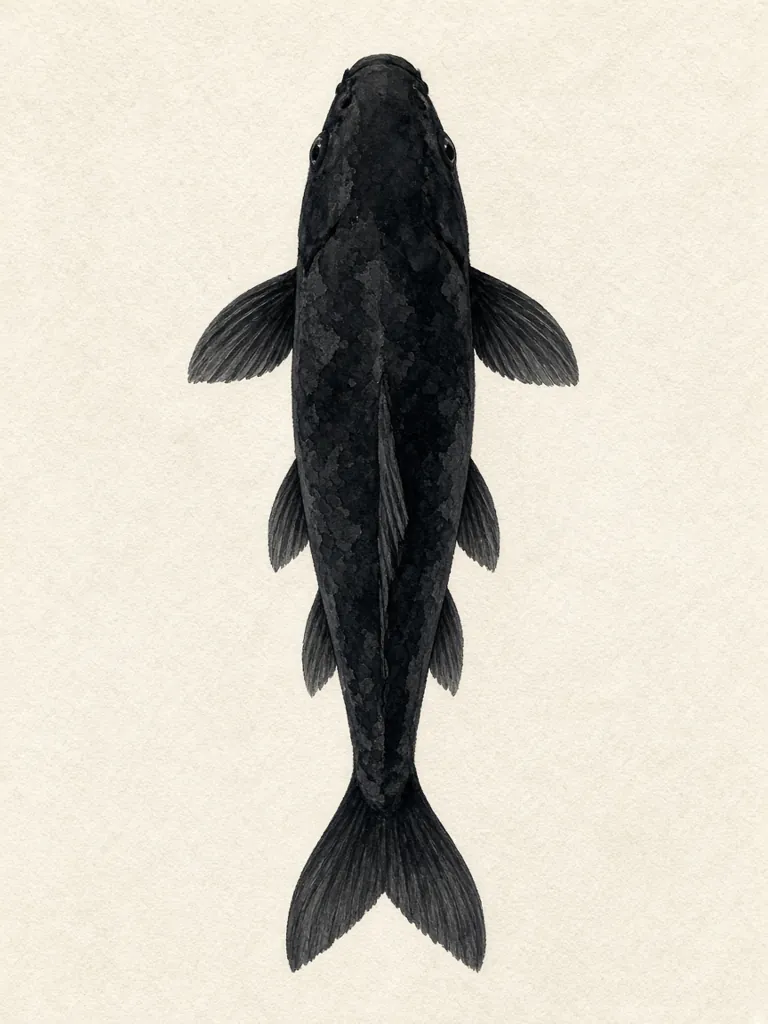
Sub-types within the Karasu-goi family
- Hajiro — has white pectoral fins, with the whole body jet black except for the pectoral fins; in some individuals part of the pectoral fin turns black[10]. AKJA similarly describes Hajiro as a black koi with white tips on its pectoral fins[3]. A koi dealer, Kodama Koi Farm, notes that Hajiro can occur in both regular-scaled and Doitsu (scaleless) forms[7].Hageshiro — AKJA describes Hageshiro as a black, non-metallic koi with white stripes on its pectoral fins and a white head and nose, classified under Kawarimono[3].Yotsujiro — listed by ZNA as part of the Karasu-goi family alongside Karasu-goi, Hajiro, Hage Shiro, Matsukawa-bake, Kumonryu and Sumi Nagashi[2], and also appears in ZNA's show-rule variety list under the Kawarimono class[11].Sumi Nagashi — AKJA defines Asagi Sumi-nagashi as a koi whose black scales are outlined in white, more commonly known simply as Sumi-nagashi, and classifies it under Kawarimono[3].Matsukawa-bake — JNPA describes Matsukawa-bake as having white and jet-black patterns across the body, with scales covering the whole body except the head, and notes that the black pattern may change frequently in a short period due to changes in environment[10].
Scale forms: Doitsu and related metallic descendants
Karasugoi can occur in scaleless or partially scaled Doitsu form; Kodama Koi Farm notes that Hajiro, a close relative within the Karasu-goi family, can be found in both regular-scaled and Doitsu versions[7].Karasugoi is also notable as an ancestral variety in the lineage that produced metallic black-and-white koi. According to Kodama Koi Farm, Kin Kikokuryu was developed through a long breeding process running from Magoi through Karasugoi, Hajiro, Doitsu Hajiro, Kumonryu, and finally Kikokuryu, with the dealer stating that "because it has the blood of Karasugoi, it has Sumi on the entire body including mouth, head and fins"[8]. Kodama Koi Farm further states that Kikokuryu is essentially a metallic Kumonryu and that, because Kumonryu originates in Karasugoi, the genetic strength of the Sumi carries through strongly despite dilution from the metallic Platinum parentage[12].Classification at shows
Classification of Karasugoi differs by organization. JNPA places Karasugoi within the Muji category[1]. ZNA's variety pages list Karasugoi both as the head of its own "Karasu-goi family" within the broader Kawarimono class[2] and, separately, among the solid-colored Mujimono varieties alongside Chagoi, Soragoi, Benigoi, Kigoi and Karashigoi[4]. A regional ZNA America show classification document lists Karasugoi explicitly under category 15, Mujimono, alongside Chagoi, Soragoi, Karashi, Matsuba, Ginrin Muji, Kigoi, Midori Goi and Aka Muji[5]. At the 59th ZNA International Koi Show, entry rules placed the related Hajiro and Yotsujiro under category 10, Kawarimono[11]. These differing placements reflect that Karasugoi sits at a boundary between the single-color Muji grouping and the broader Kawarimono "everything else" class depending on the organization.How it differs from similar varieties
Karasugoi is distinguished from its relatives within the same family primarily by the extent of white markings. Where JNPA's Karasugoi is wholly jet black apart from occasional white pectoral fin tips[1], Hajiro specifically has white pectoral fins against an otherwise jet-black body[10][3], and Hageshiro adds a white head and nose in addition to white pectoral fin stripes[3]. Matsukawa-bake differs further in showing extensive white alongside black patterning across the body rather than being predominantly black, and that patterning can shift over time with environmental change[10]. Kumonryu, also grouped in the same ZNA family, is a Doitsu variety whose black "cloud-like" markings likewise change with the seasons, but it is considered under JAS vocabulary as its own named variety (九紋竜, kumonryu) with the appearance characteristic of a Doitsu koi that develops white areas on an originally black ground over time[6].Sumi quality and judging notes
Because Karasugoi and its relatives are judged primarily on black coloration, general sumi (black marking) quality terminology used across koi judging is relevant. ZNA's terminology glossary defines Hon Zumi as good sumi with dark black color, thickness and luster, and contrasts it with Nabe Zumi, described as brownish sumi of lesser quality with no luster, like soot[9]. The same source notes that "Teri," the luster of the skin, indicates healthy and well-finishing condition[9], a quality relevant to judging the glossy jet-black skin expected of Karasugoi.Images
Common questions
Is Karasugoi a Muji variety or a Kawarimono variety?
Sources disagree: JNPA classifies Karasugoi under Muji, the single-color category[1], while ZNA lists it as the head of its own "Karasu-goi family" within the broader Kawarimono class, and elsewhere also within Mujimono[2][4]. A regional ZNA America show document places it specifically under Mujimono[5].
What is the difference between Karasugoi, Hajiro and Hageshiro?
Can Karasugoi be Doitsu (scaleless)?
What famous varieties descend from Karasugoi?
Related koi topics
References
- ^ Muji - Variety - All Japan Nishikigoi Promotion Association. All Japan Nishikigoi Promotion Association. jnpa.info/en/nishikigoi/varieties/type/muji/. Retrieved November 2026.
- ^ KAWARIMONO | Zen Nippon Airinkai. Zen Nippon Airinkai. zna.jp/en/keep-nishikigoi/varieties-of-nishikigoi/kawarimono/. Retrieved November 2026.
- ^ Glossary – American Koi Judges Association (AKJA). American Koi Judges Association. akjajudges.com/glossary/. Retrieved November 2026.
- ^ MUJIMONO | Zen Nippon Airinkai. Zen Nippon Airinkai. zna.jp/en/keep-nishikigoi/varieties-of-nishikigoi/mujimono/. Retrieved November 2026.
- ^ Koi classification (ZNA 2021), NMZNA 2026 show documents. nmzna.net. nmzna.net/2026%20Show%20Docs/NMZNA%202026%20Koi%20Classification%20…. Retrieved November 2026.
- ^ JAS 0020 Nishikigoi. Vocabulary (MAFF) — Ministry of Agriculture, Forestry and Fisheries (Japan). maff.go.jp/j/jas/jas_standard/attach/pdf/index-536.pdf. Retrieved November 2026.
- ^ Doitsu Variety - The beauty of Scaleless Koi, Unique Koi Varieties. Kodama Koi Farm (koi dealer). kodamakoifarm.com/doitsu-variety-beauty-no-scales/. Retrieved November 2026.
- ^ Kin Kikokuryu: The sensational new variety. Kodama Koi Farm (koi dealer). kodamakoifarm.com/sensational-variety-kin-kikokuryu/. Retrieved November 2026.
- ^ NISHIKIGOI TERMINOLOGY 3 SUMI | Zen Nippon Airinkai. Zen Nippon Airinkai. zna.jp/en/keep-nishikigoi/nishikigoi-terminology/nishikigoi-termino…. Retrieved November 2026.
- ^ Kawarigoi - Variety - All Japan Nishikigoi Promotion Association. All Japan Nishikigoi Promotion Association. jnpa.info/en/nishikigoi/varieties/type/kawarigoi/. Retrieved November 2026.
- ^ 59th ZNA International Koi Show entry rules (ZNA). Zen Nippon Airinkai. zna.jp/wp-content/uploads/2023/07/59th-zna-koishow.pdf. Retrieved November 2026.
- ^ Kikokuryu - Koi For Sale - Kodama Koi Farm. Kodama Koi Farm (koi dealer). kodamakoifarm.com/variety/kikokuryu/. Retrieved November 2026.