
Soragoi
Key facts: Soragoi is a solid gray-blue, non-metallic koi classified within the Mujimono group of single-colored Nishikigoi[1][2].
Colors:
Soragoi is a non-metallic, single-colored (muji) variety whose body is an even gray-blue, without patterning[2][1]. It is grouped by the Zen Nippon Airinkai (ZNA) among the mono-colored Nishikigoi alongside Ki-goi, Aka-muji, Karashi-goi and Cha-goi[4].In judging and classification terms, Soragoi sits at the intersection of two competing traditions: some show schedules place it with the broader Kawarimono grouping of mono-colored fish[4], while the ZNA's own Mujimono class page and the current ZNA 2021 classification table list Soragoi specifically under Mujimono[1][3].- sora (gray-blue)
Name and meaning
The American Koi Judges Association glosses Soragoi simply as "a gray-blue, non-metallic Koi" classified under Kawarimono in its glossary entry[2]. The ZNA instead places the variety in its Mujimono (無地もの) category, the designation for non-metallic, solid-colored koi[1].Judging points
Appearance and the standard definition
Soragoi is described as a gray-blue, non-metallic koi with no body pattern[2]. The Japanese Agricultural Standard (JAS) for Nishikigoi vocabulary, issued by the Ministry of Agriculture, Forestry and Fisheries, defines the broader category muji (無地) as koi with no imprint (斑紋) anywhere on the body, meaning the skin is a single, even ground color[5]. The All Japan Nishikigoi Promotion Association similarly states that Muji is "a general name for single-color Nishikigoi that have no patterns on their bodies," and names Soragoi's sibling varieties within that group as Karashigoi (yellow), Aka-muji (bright red), Chagoi (brown) and Shiro-muji (white)[6]. According to the JNPA's judging guidance for Muji varieties generally, koi that are evenly colored all the way to the tips of the pectoral fins and that have good body shape are highly valued[6].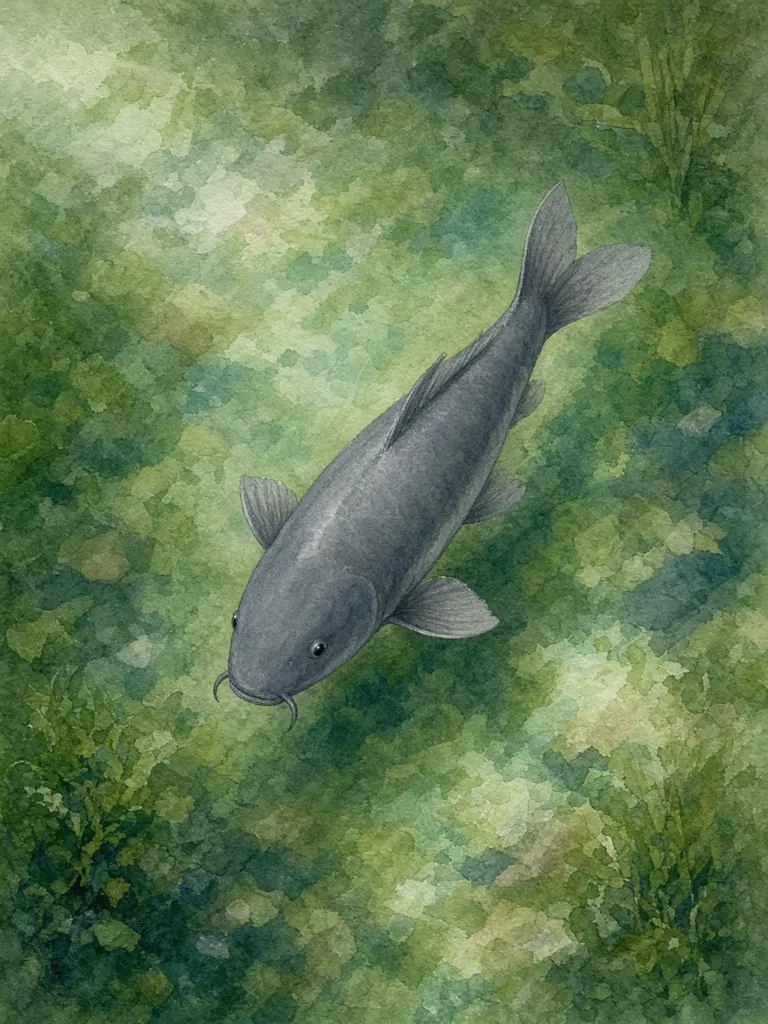
Sub-types and related varieties
Soragoi belongs to the same mono-colored grouping as Chagoi, Benigoi (Aka-muji), Kigoi, Karashigoi and Karasugoi[1][4]. The JNPA also notes that Matsuba-patterned fish, whose scales are colored black one by one, are grouped within Muji, producing related forms such as Aka-matsuba and Ki-matsuba[6]; these matsuba forms are separately treated at Matsuba and Kin Matsuba and Gin Matsuba.Scale forms: Doitsu and Ginrin Soragoi
The ZNA states that Doitsu Muji and Ginrin Muji varieties are shown within the Mujimono class[1]. The All Japan Nishikigoi Promotion Association describes Ginrin-soragoi specifically as having shiny golden or silver scales combined with the appearance characteristics of ordinary Soragoi[7]. Ginrin Soragoi are also offered commercially; the dealer Kodama Koi Farm has listed Ginrin Soragoi specimens bred in Japan, illustrating that the scale-enhanced form is actively kept and traded[8][9].Classification at shows
Classification of Soragoi varies by organization and show schedule. In the 2021 ZNA classification table used for the ZNA America Koi Show, Soragoi is listed explicitly under category 15, Mujimono, alongside Chagoi, Karashi, Matsuba, Karasugoi, Kigoi, Midori Goi and Aka Muji, including their Doitsu and Ginrin forms[3]. The ZNA's own Mujimono class description confirms Soragoi's placement there as a non-metallic, solid-colored koi[1]. By contrast, the ZNA's Kawarimono page lists Sora-goi among the "Mono-colored" subgroup of the Kawarimono class, used at shows where minority varieties are grouped together[4]. The American Koi Judges Association's glossary also files Soragoi under Kawarimono[2]. The Kodama Koi Farm Kawarimono archive describes Kawarimono broadly as nonmetallic koi that do not fit into any other class, each fish unique in color and marking, according to the dealer[10].How it differs from similar varieties
Soragoi is distinguished from Chagoi by ground color: Chagoi is described as an austere brown single-colored koi, whereas Soragoi is gray-blue[6][2]. It differs from Asagi, which the JAS standard and other sources describe as having a pale blue-gray back but with red (hi) markings on the abdomen and cheeks, whereas Soragoi carries no such hi pattern and is uniform in color[5][2]. It is likewise distinct from Kigoi (solid yellow) and Karasugoi, which the JNPA describes as jet black over the whole body, sometimes with white pectoral fin tips[6].Images
Common questions
Is Soragoi a Mujimono or a Kawarimono variety?
Sources differ by organization: the ZNA's current Mujimono class description and its 2021 classification table for the ZNA America Koi Show both place Soragoi under Mujimono[1][3], while the ZNA's Kawarimono page and the American Koi Judges Association glossary instead list it among mono-colored Kawarimono[4][2].
What color should a Soragoi be?
Are there Ginrin or Doitsu Soragoi?
How does Soragoi differ from Asagi?
What is judged in a Soragoi?
General Muji judging guidance from the All Japan Nishikigoi Promotion Association values even body color reaching to the tips of the pectoral fins along with good body shape[6].
Related koi topics
References
- ^ MUJIMONO | Zen Nippon Airinkai. Zen Nippon Airinkai. zna.jp/en/keep-nishikigoi/varieties-of-nishikigoi/mujimono/. Retrieved November 2026.
- ^ Glossary – American Koi Judges Association (AKJA). American Koi Judges Association. akjajudges.com/glossary/. Retrieved November 2026.
- ^ Koi classification (ZNA 2021), NMZNA 2026 show documents. nmzna.net. nmzna.net/2026%20Show%20Docs/NMZNA%202026%20Koi%20Classification%20…. Retrieved November 2026.
- ^ KAWARIMONO | Zen Nippon Airinkai. Zen Nippon Airinkai. zna.jp/en/keep-nishikigoi/varieties-of-nishikigoi/kawarimono/. Retrieved November 2026.
- ^ JAS 0020 Nishikigoi. Vocabulary (MAFF) — Ministry of Agriculture, Forestry and Fisheries (Japan). maff.go.jp/j/jas/jas_standard/attach/pdf/index-536.pdf. Retrieved November 2026.
- ^ Muji - Variety - All Japan Nishikigoi Promotion Association. All Japan Nishikigoi Promotion Association. jnpa.info/en/nishikigoi/varieties/type/muji/. Retrieved November 2026.
- ^ B-ginrin - Variety - All Japan Nishikigoi Promotion Association. All Japan Nishikigoi Promotion Association. jnpa.info/en/nishikigoi/varieties/type/b-ginrin/. Retrieved November 2026.
- ^ Bekko Archives - Kodama Koi Farm. Kodama Koi Farm (koi dealer). kodamakoifarm.com/variety/bekko/. Retrieved November 2026.
- ^ Ginrin - Koi for Sale and History - Kodama Koi Farm. Kodama Koi Farm (koi dealer). kodamakoifarm.com/variety/ginrin/. Retrieved November 2026.
- ^ Kawarimono Archives - Kodama Koi Farm. Kodama Koi Farm (koi dealer). kodamakoifarm.com/variety/kawarimono/. Retrieved November 2026.