
Matsuba
Key facts: Matsuba (松葉) is a Nishikigoi variety whose scales are colored black individually in a “pine-cone” pattern (matsuba-mon), seen over a red, yellow, or white body; it is classed within Muji as a single-colored variety[1][2].
Colors:
Matsuba (松葉) describes koi whose scales each carry a dark, pine-cone-like marking called matsuba-mon, formed by the black coloring concentrated at the center of individual scales rather than scattered as a pattern across the body[1][2]. According to the All Japan Nishikigoi Promotion Association (JNPA), Matsuba belongs to the Muji (無地) group, the general category for single-colored koi with no imprints, and the principal named forms are Aka-matsuba (red), Ki-matsuba (yellow), and Shiro-matsuba (white)[1][2].The Zen Nippon Airinkai (ZNA) similarly places Aka Matsuba, Ki Matsuba, Shiro Matsuba and Matsuba Doitsu together as a “Matsuba family” within the Kawarimono class for general show purposes, while its own Mujimono page lists Aka Matsuba and Ki Matsuba among single-colored varieties[4][3]. This reflects a broader pattern in koi classification where Matsuba can appear either as a stand-alone family or folded into a wider non-metallic single-color grouping depending on the organization and show[4][3][8].- ki (yellow)
- sumi (black)
- shiroji (white ground)
Name and meaning
The American Koi Judges Association (AKJA) glossary translates Matsuba as “Pinecone,” describing it as a koi with black markings in the center of the scales on the body, with this pattern also known as a pinecone pattern[2]. The JNPA describes the defining feature as scales “colored black one by one,” producing the matsuba-mon pattern across the back of the fish[1].Judging points
Origin
According to ZNA, Aka Matsuba and Ki Matsuba were produced from Gunjo Asagi bloodlines, placing the variety’s origin within the broader Asagi lineage, one of the old varieties of Nishikigoi whose early-19th-century ancestors are believed to underlie modern Nishikigoi[7].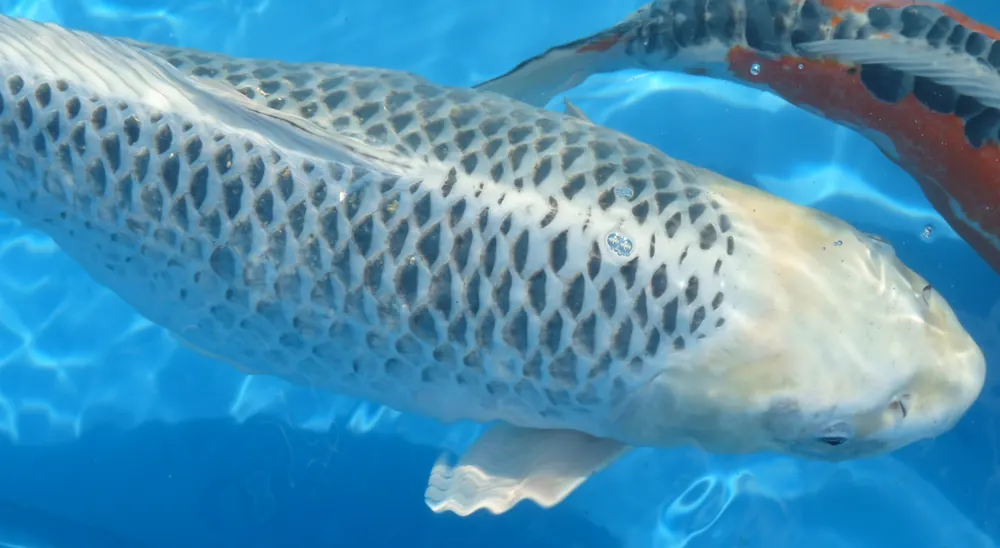

Appearance and the standard definition
The JNPA states that Matsuba is a Muji variety whose scales are individually colored black, and that this group includes Aka-matsuba and Ki-matsuba, with a further described sub-variety, Aka-matsuba, defined as having a red body and a pine-cone-like pattern (“matsuba-mon”) across the entire back due to the arrangement of scales with black parts[1]. The AKJA glossary gives parallel, separately worded definitions: Aka Matsuba as “a red koi with black ‘pinecone’ Matsuba pattern in the scales along the back,” Ki Matsuba as “a yellow koi with black ‘pinecone’ Matsuba markings in the center of the scales,” and Shiro Matsuba as “a white koi with a black ‘pinecone’ Matsuba pattern in the scales on the back”[2]. Within the Muji category generally, the JNPA notes that koi evenly colored all the way to the tips of the pectoral fins, with good body shape, are most highly valued[1].Sub-types
- Aka Matsuba — red ground color with the matsuba-mon pattern[1][2].Ki Matsuba — yellow ground color with the matsuba-mon pattern[2][1].Shiro Matsuba — white ground color with the matsuba-mon pattern[2].ZNA’s “Matsuba family” additionally lists Matsuba Doitsu, a scaleless (doitsu) form, alongside the three colored types[4].
Scale forms: Doitsu and Ginrin versions
A Doitsu (scaleless) form, Matsuba Doitsu, is listed by ZNA as part of the Matsuba family within Kawarimono[4]. Ginrin (sparkling-scale) versions are also recognized: the JNPA describes Ginrin-aka-matsuba and Ginrin-ki-matsuba as having shining golden or silver scales combined with the appearance characteristics of Aka-matsuba and Ki-matsuba respectively[5]. Metallic versions exist as well but are classified separately as Kin-matsuba and Gin-matsuba within Hikari-muji, described by the JNPA as varieties with matsuba-mon that also shine; related metallic forms include Doitsu-gin-matsuba and Aka-matsuba-ogon[6]. These metallic Matsuba-kei varieties are covered in detail on the page for Kin Matsuba and Gin Matsuba.Classification at shows
Classification of Matsuba varies by organization and event. ZNA’s own variety pages list Aka Matsuba and Ki Matsuba under Mujimono, the category for non-metallic, solid-colored koi[3], while ZNA’s Kawarimono page separately groups the “Matsuba family” (Aka Matsuba, Ki Matsuba, Shiro Matsuba, Matsuba Doitsu) there for general description[4]. At the ZNA International Koi Show, entry rules place Matsuba and Ginrin Muji within category 15, Mujimono[9]. A separate ZNA classification document for ZNA America similarly lists Matsuba under category 15, Mujimono, alongside Chagoi, Soragoi, Karashi and others[8]. Regional shows can differ further: the ZNA SoCal exhibitor packet places Matsuba within its “Mujimono” group described as single-color non-metallic koi including Ginrin and Matsuba[10].How Matsuba differs from similar varieties
Matsuba is distinguished from Asagi, from which it likely descends according to ZNA, by the absence of the reticulated scale pattern and red markings typical of Asagi; Asagi is instead described as a gray-blue koi with red along the sides, cheeks, and fins[7][2]. Matsuba is also distinct from Kawarigoi varieties such as Kanoko, which the JNPA describes as showing a dotted pattern from part of the scales being dyed, rather than the uniform per-scale pine-cone marking that defines Matsuba[11][1]. The metallic counterparts, Kin Matsuba and Gin Matsuba, are kept separate from non-metallic Matsuba and placed instead in Hikari-muji, since the JNPA and AKJA both note they combine the matsuba-mon pattern with an overall metallic shine[6][2].Images
Common questions
What does “Matsuba” mean as a koi pattern?
The AKJA glossary translates Matsuba as “Pinecone,” referring to black markings concentrated in the center of individual scales, giving a pine-cone-like pattern across the back[2].
What colors of Matsuba exist?
Is Matsuba classified as Kawarimono or Mujimono?
Are there metallic or Ginrin Matsuba?
How is Matsuba related to Asagi?
According to ZNA, Aka Matsuba and Ki Matsuba were produced from Gunjo Asagi bloodlines, linking Matsuba’s origin to the Asagi variety[7].
Related koi topics
References
- ^ Muji - Variety - All Japan Nishikigoi Promotion Association. All Japan Nishikigoi Promotion Association. jnpa.info/en/nishikigoi/varieties/type/muji/. Retrieved November 2026.
- ^ Glossary – American Koi Judges Association (AKJA). American Koi Judges Association. akjajudges.com/glossary/. Retrieved November 2026.
- ^ MUJIMONO | Zen Nippon Airinkai. Zen Nippon Airinkai. zna.jp/en/keep-nishikigoi/varieties-of-nishikigoi/mujimono/. Retrieved November 2026.
- ^ KAWARIMONO | Zen Nippon Airinkai. Zen Nippon Airinkai. zna.jp/en/keep-nishikigoi/varieties-of-nishikigoi/kawarimono/. Retrieved November 2026.
- ^ B-ginrin - Variety - All Japan Nishikigoi Promotion Association. All Japan Nishikigoi Promotion Association. jnpa.info/en/nishikigoi/varieties/type/b-ginrin/. Retrieved November 2026.
- ^ Hikari-muji - Variety - All Japan Nishikigoi Promotion Association. All Japan Nishikigoi Promotion Association. jnpa.info/en/nishikigoi/varieties/type/hikari-muji/. Retrieved November 2026.
- ^ ASAGI | Zen Nippon Airinkai. Zen Nippon Airinkai. zna.jp/en/keep-nishikigoi/varieties-of-nishikigoi/asagi/. Retrieved November 2026.
- ^ Koi classification (ZNA 2021), NMZNA 2026 show documents. nmzna.net. nmzna.net/2026%20Show%20Docs/NMZNA%202026%20Koi%20Classification%20…. Retrieved November 2026.
- ^ 59th ZNA International Koi Show entry rules (ZNA). Zen Nippon Airinkai. zna.jp/wp-content/uploads/2023/07/59th-zna-koishow.pdf. Retrieved November 2026.
- ^ ZNA SoCal 50th Annual Koi Show exhibitor registration packet (2026). znasocal.org. znasocal.org/wp-content/uploads/2026/02/2026-entrant-registration-1…. Retrieved November 2026.
- ^ Kawarigoi - Variety - All Japan Nishikigoi Promotion Association. All Japan Nishikigoi Promotion Association. jnpa.info/en/nishikigoi/varieties/type/kawarigoi/. Retrieved November 2026.