
Goshiki
Key facts: Goshiki (五色, “five colors”) is a koi variety produced by crossbreeding Asagi and Taisho Sanshoku, displaying a dark mesh-like reticulated pattern over red and white skin[1][2].
Colors:
Goshiki (五色) is classified as a mesh-patterned, non-metallic koi variety originating from crosses between Asagi and Taisho Sanshoku (Sanke)[1][2]. The name translates to “five colors,” traditionally referring to white, red, sumi black, and indigo/light blue, with the identity of a fifth color described as controversial by the Zen Nippon Airinkai (ZNA)[1].The All Japan Nishikigoi Promotion Association (JNPA) states the name derives from the blue and dark blue of Asagi combined with the white, red and black of Taisho Sanshoku, and notes that today koi with pale yellow patterns and red imprints on a white background are also called Goshiki regardless of the original five colors[2].- ai (indigo blue)
- hi (red)
- shiroji (white ground)
- sumi (black)
Name and meaning
According to the ZNA, Goshiki literally means five colors, with four generally agreed as white, red, sumi (black) and indigo blue, while the fifth remains a matter of debate among keepers[1].According to the koi dealer Kodama Koi Farm, Goshiki was created in 1918 by breeding Asagi with Kohaku, though the JNPA and ZNA both describe the cross as Asagi with Taisho Sanshoku, so this origin date should be treated as unverified[8][1][2].Judging points
Appearance and the JAS standard
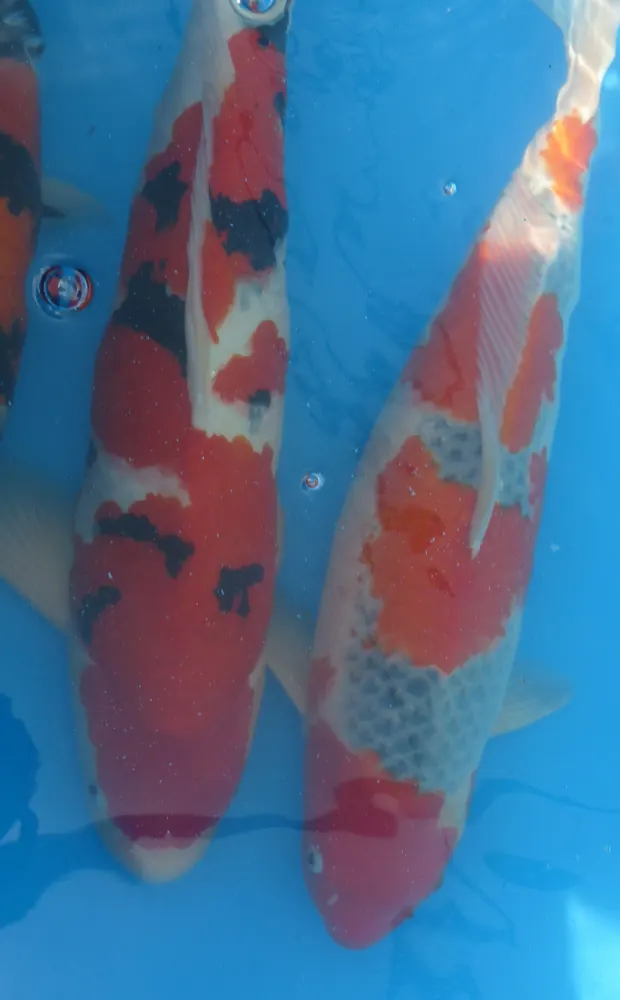
The Japanese Agricultural Standard (JAS) for nishikigoi vocabulary, issued by Japan's Ministry of Agriculture, Forestry and Fisheries, defines Goshiki (JAS No. 2005) as a koi that, except for the head, is indigo or light blue with a mesh-like reticulated pattern across the entire back created by the arrangement of scales, called “asagidi,” combined with scarlet imprints on the back[4][2]. Some individuals have indigo or light blue mixed into the scarlet imprints, and some do not; some also carry black imprints[4][2].Kodama Koi Farm, a US importer, describes the pattern as black, blue, and gray colors appearing in a netted reticulation across a white and red, Kohaku-like body, noting that unlike Kohaku, Goshiki typically display a very bright, bold hi (red) plate[8].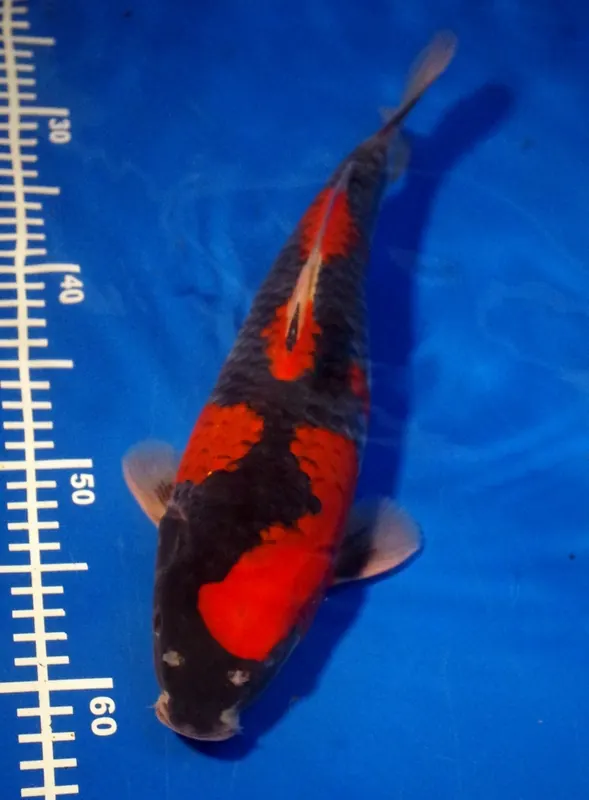

Sub-types
- The JNPA lists recognized variants including Mameshibori-goshiki, Black-goshiki, Goshiki-sanshoku, and Goshiki-showa, which combine the asagidi reticulation with the pattern characteristics of other varieties[2].Goshiki-sanshoku carries the appearance of Taisho Sanshoku combined with the asagidi pattern, and its scarlet imprints may or may not include indigo or light blue[2].The ZNA's classification for its international show lists Goshiki, Goshiki Sanke, Goshiki Showa, and Goshiki Shusui as the named varieties within the Goshiki class[3].The American Koi Judges Association (AKJA) glossary separately defines Goshiki Shusui as a doitsu, non-metallic blue Goshiki[5].Goshiki can also appear with a Tancho marking, called Tancho Goshiki, described by the JNPA as having a circular scarlet imprint on the head combined with the appearance characteristics of Goshiki[7].A related type called Goshiki-shigure is described by the JNPA as having an asagidi pattern with yellow imprints across the body and a gentle overall glow[9].
Scale forms: ginrin and doitsu
Ginrin forms of Goshiki exist; the JNPA describes Ginrin-goshiki as having shining golden or silver scales combined with the appearance characteristics of Goshiki, classed under B-ginrin for non-Gosanke varieties[6]. Kodama Koi Farm, a US koi dealer, also lists Ginrin Goshiki among koi it has offered for sale[8].Doitsu-scaled Goshiki also exist, as reflected in the AKJA glossary's definition of Goshiki Shusui as a doitsu, non-metallic blue Goshiki[5]. The related Doitsugoi (Doitsu koi) scale pattern is applied across many non-metallic varieties.Classification at shows
The ZNA's 2021 nishikigoi classification places Goshiki as class 11, listing Goshiki, Goshiki Sanke, Goshiki Showa, and Goshiki Shusui within it, separate from the Kawarimono class[3]. The ZNA's entry rules for its International Koi Show similarly list Goshiki as its own numbered variety class with its own size scope[10].Other organizations group Goshiki together with Koromo: the AKJA classification lists a combined “Koromo/Goshiki” category[11], and the ZNA SoCal chapter's show registration groups “Koromo/Goshiki” together, including Ai, Sumi, and Budo Goromo alongside Goshiki, Goshiki Showa and Goshiki Sanke[12]. Kodama Koi Farm's show-preparation guidance likewise lists “Koromo & Goshiki” as a combined competition category[13]. At the Sydney Koi Show, Goshiki is instead benched as its own class across multiple size groups[14].The JNPA assigns Goshiki its own JAS number (No. 2005) within the Japanese Agricultural Standard's list of regulated nishikigoi varieties[4][2], and lists it as one of the named varieties on its own variety index, alongside Kohaku, Taisho Sanshoku, and others[15][16].How it differs from similar varieties
The JNPA and the JAS standard both note that Goshiki can resemble Koromo, but the two are distinguished because Goshiki has the asagidi reticulated pattern over the whole back, which Koromo lacks[2][4]. The JAS definition of Koromo instead describes a half-moon-shaped indigo or black tint at the tip of scales within the hi pattern, without the asagidi background[4].Kodama Koi Farm notes that, unlike Kohaku, Goshiki typically carries a notably bright and bold hi plate in addition to its netted blue-gray coloring[8].Judging and keeping notes
According to Kodama Koi Farm, judging Goshiki requires beautiful Asagi-like color, with each scale showing clear ai (indigo) color and the hi being true red; because the thickness of the hi is considered important, keepers are advised to consider water conditions and feeding to enhance it[8]. The same source states that keeping water similar to breeders' mud ponds and feeding a well-balanced, nutritious diet with adequate carotene are the two main approaches used to support color development[8].Kodama Koi Farm also notes that standards for prize-winning Goshiki have changed over the past 15–20 years, with current preference for a clean pattern of blue-gray netting without large black spots, set against a bright hi pattern on bright white skin[8].Images

Common questions
What does Goshiki mean?
Goshiki (五色) means “five colors,” generally said to refer to white, red, sumi black and indigo blue, with the identity of a fifth color described by the ZNA as controversial[1].
How was Goshiki created?
How is Goshiki different from Koromo?
Is Goshiki judged together with Koromo at shows?
Related koi topics
References
- ^ GOSHIKI | Zen Nippon Airinkai. Zen Nippon Airinkai. zna.jp/en/keep-nishikigoi/varieties-of-nishikigoi/goshiki/. Retrieved November 2026.
- ^ Goshiki - Variety - All Japan Nishikigoi Promotion Association. All Japan Nishikigoi Promotion Association. jnpa.info/en/nishikigoi/varieties/type/goshiki/. Retrieved November 2026.
- ^ Koi classification (ZNA 2021), NMZNA 2026 show documents. nmzna.net. nmzna.net/2026%20Show%20Docs/NMZNA%202026%20Koi%20Classification%20…. Retrieved November 2026.
- ^ JAS 0020 Nishikigoi. Vocabulary (MAFF) — Ministry of Agriculture, Forestry and Fisheries (Japan). maff.go.jp/j/jas/jas_standard/attach/pdf/index-536.pdf. Retrieved November 2026.
- ^ Glossary – American Koi Judges Association (AKJA). American Koi Judges Association. akjajudges.com/glossary/. Retrieved November 2026.
- ^ B-ginrin - Variety - All Japan Nishikigoi Promotion Association. All Japan Nishikigoi Promotion Association. jnpa.info/en/nishikigoi/varieties/type/b-ginrin/. Retrieved November 2026.
- ^ Tancho - Variety - All Japan Nishikigoi Promotion Association. All Japan Nishikigoi Promotion Association. jnpa.info/en/nishikigoi/varieties/type/tancho/. Retrieved November 2026.
- ^ Goshiki - Koi for Sale - Kodama Koi Farm. Kodama Koi Farm (koi dealer). kodamakoifarm.com/variety/goshiki/. Retrieved November 2026.
- ^ Kawarigoi - Variety - All Japan Nishikigoi Promotion Association. All Japan Nishikigoi Promotion Association. jnpa.info/en/nishikigoi/varieties/type/kawarigoi/. Retrieved November 2026.
- ^ 59th ZNA International Koi Show entry rules (ZNA). Zen Nippon Airinkai. zna.jp/wp-content/uploads/2023/07/59th-zna-koishow.pdf. Retrieved November 2026.
- ^ AKJA Classifications – American Koi Judges Association (AKJA). American Koi Judges Association. akjajudges.com/akja_classifications/. Retrieved November 2026.
- ^ ZNA SoCal 50th Annual Koi Show exhibitor registration packet (2026). znasocal.org. znasocal.org/wp-content/uploads/2026/02/2026-entrant-registration-1…. Retrieved November 2026.
- ^ Preparing for Koi Competition and Tips for Winning Koi Shows. Kodama Koi Farm (koi dealer). kodamakoifarm.com/koi-show-competition-tips-preparation/. Retrieved November 2026.
- ^ 49th Sydney Koi Show 2026 results (Sydney Koi Show). Sydney Koi Show. sydneykoishow.com/admin/photoresultsnew.toy?eid=206700. Retrieved November 2026.
- ^ Variety - All Japan Nishikigoi Promotion Association. All Japan Nishikigoi Promotion Association. jnpa.info/en/nishikigoi/varieties/. Retrieved November 2026.
- ^ Variety - Shinkokai USA Official Website. Shinkokai USA (JNPA). shinkokaiusa.com/variety. Retrieved November 2026.