
Midorigoi
Key facts: Midorigoi (緑鯉) is a kawarimono variety with a yellow body and no imprints, distinguished by an olive-green back or green scales along the dorsal area[1].
Colors:
Midorigoi is one of the many non-standard koi varieties grouped under Kawarimono (変わり物), a broad category covering nishikigoi that do not belong to the major regulated varieties such as Kohaku, Taisho Sanshoku and Showa Sanshoku[1]. According to the All Japan Nishikigoi Promotion Association, Midori-goi has a yellow body with no imprints, and an olive-green back or green scales on the back[1].In show classification systems the variety is placed differently depending on the organization: the ZNA America classification lists Midori Goi under the Mujimono class alongside Chagoi, Soragoi, Karashi, Kigoi and Aka Muji[2], while the JNPA treats it as a Kawarigoi entry alongside fish such as Ochiba-shigure and Beni-kikokuryu[1].- ki (yellow)
- midori (green)
Name and classification
Midorigoi appears in the JNPA's list of Kawarigoi, a term the organization explains carries two meanings: koi that cannot be produced stably or that have appeared as mutations, and koi that can be produced stably and carry conventional names, the latter including fish like Ochiha-shigure and Beni-kikokuryu that are also shown competitively[1].Separately, show classification documents from the ZNA America chapter list Midori Goi within the Mujimono class, grouped with Chagoi, Soragoi, Karashi, Matsuba, Karasugoi, Kigoi and Aka Muji[2]. This differs from the JNPA's treatment of the fish as a type of Kawarigoi[1], illustrating that variety placement can vary between organizations.Judging points
- Ground color should be a clean yellow body with no imprint pattern, per the JNPA's description of Midori-goi[1]
- The back should show the characteristic olive-green coloring or green scales that define the variety[1]
- In doitsu specimens, judges assess exposed skin quality since the body has almost no scales[4]
- Classification context matters: under ZNA America rules the fish is judged within the Mujimono class alongside other single-color varieties[2]
Appearance and standard definition
The JNPA describes Midori-goi as having a yellow body with no imprints (斑紋), with an olive-green back or green scales along the back[1]. This places the variety among muji, or patternless, non-metallic koi, since it lacks a contrasting hi, sumi or shiro pattern of the kind defined for varieties such as Kohaku or Showa in the JAS Nishikigoi vocabulary standard[3].The JAS standard formally defines related concepts used to classify nishikigoi appearance, including 斑紋 (imprint), described as a pattern formed by a color locally different from the ground skin color, and notes that ground colors are based on JIS color names but allow for individual biological variation[3]. No Midorigoi-specific JAS entry number is given in the available JAS text, which instead defines related terms such as kawarigoi (JAS 2010), covering varieties such as Ochiba-shigure and Kage-shiroutsuri that do not fit the other listed categories[3].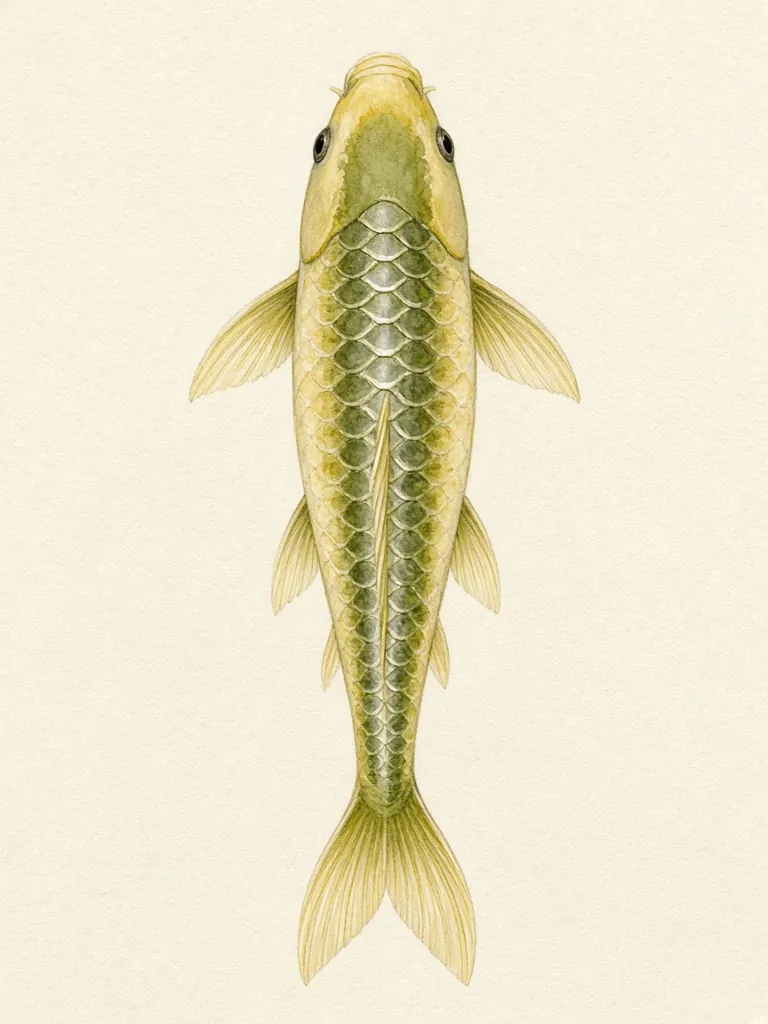
Doitsu scale form
A scaleless version, Doitsu-midorigoi, is documented by the JNPA: it has almost no scales over the body, with the skin exposed, and otherwise carries the appearance characteristics of Midorigoi[4]. This doitsu form parallels other scaleless variants such as Doitsugoi (Doitsu koi), which the JNPA lists alongside Doitsu-shiroutsuri, Doitsu-goshiki, and Doitsu-ochiba-shigure as doitsu-scaled versions of otherwise scaled varieties[4].Relationship to Shusui and Asagi lineage
Midorigoi's green coloring links it conceptually to the doitsu lineage that also produced Shusui, the first doitsu variety of koi, bred in the early 1900s by crossing a scaleless German carp (Doitsugoi) with the Asagi variety[5][6]. According to Zen Nippon Airinkai, Kichigoro Akiyama, a teacher at what is now the Tokyo Fisheries College, produced the cross, and strong Shusui specimens began appearing from around 1928[5]. Shusui itself has several named forms, including Hana Shusui, Hi Shusui, Ki Shusui and Pearl Shusui[5]. The American Koi Judges Association glossary similarly describes Shusui as a doitsu Asagi, with Ki Shusui noted as “a yellow Shusui with a greenish dorsal,” described as a very rare variety[7]. Midorigoi is distinguished from these forms by its overall yellow body combined with a green or olive back rather than the blue ground associated with Asagi and Shusui[1].How it differs from similar varieties
Midorigoi can be distinguished from other yellow or green-tinted kawarimono and mujimono koi by its specific combination of a muji (patternless) yellow body with a green back. This differs from Kigoi and Karashigoi, which are also grouped in the Mujimono class according to ZNA America's classification but are not described as having a green back[2]. It also differs from Ki Shusui, a yellow doitsu Shusui with a greenish dorsal described by the American Koi Judges Association, since Midorigoi is non-doitsu in its standard (scaled) form and is not an Asagi derivative according to the JNPA's description[7][1].Classification at shows
- The JNPA lists Midori-goi within its Kawarigoi variety group (JAS classification context), among dozens of named Kawarigoi types such as Kanoko-kohaku, Ochiba-shigure and Kikokuryu[1].The ZNA America 2021 koi classification document used for the ZNA America Koi Show places Midori Goi in class 15, Mujimono, alongside Chagoi, Soragoi, Karashi, Matsuba, Ginrin Muji, Karasugoi, Kigoi, Aka Muji and related doitsu and ginrin muji forms[2].The doitsu-scaled form, Doitsu-midorigoi, is documented separately by the JNPA as a doitsu variant carrying Midorigoi's appearance characteristics[4].
Images
Common questions
What class is Midorigoi judged in at shows?
What color pattern defines Midorigoi?
According to the JNPA, Midori-goi has a yellow body with no imprints, and an olive-green back or green scales along the back[1].
Is there a scaleless (doitsu) Midorigoi?
Yes, the JNPA documents Doitsu-midorigoi as a scaleless variant that carries Midorigoi's appearance characteristics with the skin exposed[4].
Related koi topics
References
- ^ Kawarigoi - Variety - All Japan Nishikigoi Promotion Association. All Japan Nishikigoi Promotion Association. jnpa.info/en/nishikigoi/varieties/type/kawarigoi/. Retrieved November 2026.
- ^ Koi classification (ZNA 2021), NMZNA 2026 show documents. nmzna.net. nmzna.net/2026%20Show%20Docs/NMZNA%202026%20Koi%20Classification%20…. Retrieved November 2026.
- ^ JAS 0020 Nishikigoi. Vocabulary (MAFF) — Ministry of Agriculture, Forestry and Fisheries (Japan). maff.go.jp/j/jas/jas_standard/attach/pdf/index-536.pdf. Retrieved November 2026.
- ^ Doitsugoi - Variety - All Japan Nishikigoi Promotion Association. All Japan Nishikigoi Promotion Association. jnpa.info/en/nishikigoi/varieties/type/doitsugoi/. Retrieved November 2026.
- ^ SHUSUI | Zen Nippon Airinkai. Zen Nippon Airinkai. zna.jp/en/keep-nishikigoi/varieties-of-nishikigoi/shusui/. Retrieved November 2026.
- ^ Shusui - Koi For Sale - Kodama Koi Farm. Kodama Koi Farm (koi dealer). kodamakoifarm.com/variety/shusui/. Retrieved November 2026.
- ^ Glossary – American Koi Judges Association (AKJA). American Koi Judges Association. akjajudges.com/glossary/. Retrieved November 2026.