
Kujaku
Key facts: Kujaku (孔雀) is a Hikari-moyomono (metallic patterned) koi variety produced from Asagi bloodlines, showing a net-like “asagi” scale pattern over a shining metallic body with scarlet (hi) markings along the back.[1][2]
Colors:
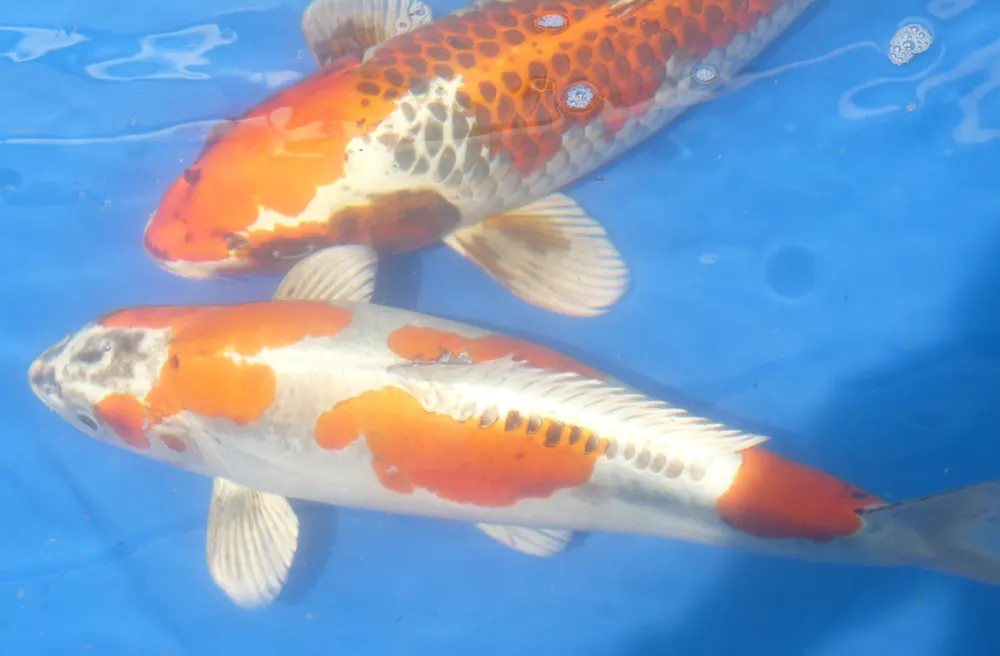
Kujaku (孔雀), meaning peacock, was developed from Asagi stock by crossbreeding in characteristics of Hikari-moyo (metallic pattern) and red imprints.[1] The name is said to come from the association with the beauty of a peacock opening its wings, and the variety is also called Kujaku-ogon.[1] According to a secondary source, a dealer account states the variety was first bred by a Mr. Nishi Hiranishi in 1960, though this claim is not corroborated elsewhere in the sources used here.[9]A good Kujaku is described as having metallic sheen over the whole body and a well-balanced pattern of red imprints set against a distinct mesh (net) pattern of scales.[1] The American Koi Judges Association glossary similarly describes Kujaku as a platinum koi with hi markings covering a large proportion of the body and Matsuba patterning in the scales.[6]- hi (red)
- ai (indigo blue)
- shiroji (white ground)
- gin (silver)
Name and meaning
Kujaku (孔雀) means peacock in Japanese; the All Japan Nishikigoi Promotion Association states the name reflects the beauty of a peacock opening its wings, and that the variety is also called Kujaku-ogon.[1] It is classified within the Hikari-moyomono group as Sho-chiku-bai Kujaku in the Zen Nippon Airinkai's variety listing, grouped alongside other metallic patterned varieties.[3]Judging points
Appearance and the JAS standard
The Japanese Agricultural Standard (JAS) for nishikigoi vocabulary defines Kujaku (number 2009) as an asagi-ground koi with scarlet imprints on the back, and whose whole body shines; it notes that some individuals also carry the appearance characteristics of Doitsugoi (German scale type, number 2012).[2] The All Japan Nishikigoi Promotion Association similarly states that Kujaku has an “asagi” pattern and scarlet imprints on the back, with the whole body shining.[1]A summary from Ojiya Nishikigoi no Sato describes Kujaku as having a Kohaku-like red-and-white pattern over asagi net-patterned scales with strong luster, with the name drawn from the beauty of a peacock spreading its feathers.[5] The American Koi Judges Association glossary describes Kujaku as a platinum koi with hi markings over a large proportion of the body and Matsuba (pinecone) patterning within the scales.[6]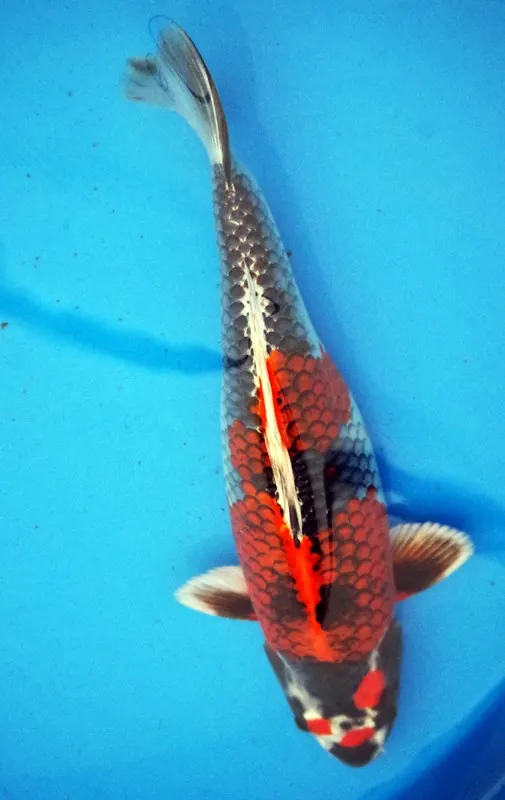

Sub-types
- Beni Kujaku: an orange-red Kujaku with red markings covering the entire body, classed in Hikari Moyomono.[6]Tancho Kujaku: has a circular scarlet imprint confined to the head, otherwise showing the appearance characteristics of Kujaku, as described by the All Japan Nishikigoi Promotion Association.[7]Ginrin Kujaku: classed under B-ginrin, showing shining gold or silver scales along with the appearance characteristics of Kujaku.[8]
Scale forms: Doitsu Kujaku
Doitsu-kujaku has almost no scales over the whole body, with the skin exposed, while retaining the appearance characteristics of Kujaku, according to the All Japan Nishikigoi Promotion Association.[1] The American Koi Judges Association glossary describes Doitsu Kujaku as a platinum koi with red markings over the body and black markings confined to the scales along the dorsal and lateral lines.[6] The JAS standard likewise notes that individuals combining the Kujaku and Doitsugoi appearance characteristics are classified as Kujaku.[2]Doitsu-tancho-kujaku, combining the scaleless Doitsu skin with a single head marking, is also listed by the All Japan Nishikigoi Promotion Association.[7]Classification at shows
At ZNA-affiliated shows, Kujaku is classified under the Hikari Moyomono group, alongside varieties such as Hariwake, Kikusui, Yamato Nishiki and Kinsui/Ginsui; the Zen Nippon Airinkai lists Sho-chiku-bai Kujaku within this category.[3] A 2021 ZNA America koi show classification document likewise places Kujaku, Kujaku Ogon and Kujaku Doitsu within class 12, Hikari Moyomono.[4]At the ZNA SoCal exhibitor show, Hikari Moyomono is listed as a group covering “metallics with patterns,” including Hariwake and Kikokuryu, within which Kujaku is benched.[10] The Shinkokai USA variety list, representing the JNPA system, lists Kujaku as a distinct named variety among its main categories.[11]How Kujaku differs from similar varieties
Kujaku is distinguished from plain Asagi by its metallic sheen and from Hariwake by its retained net-like scale pattern combined with hi markings, following the JAS description of an asagi ground with scarlet imprints and overall shine.[2] It differs from Goshiki in ground color, since Goshiki is not built on an asagi base, according to the description given at Ojiya Nishikigoi no Sato.[5] Kujaku also differs from Gin Matsuba and Kin Matsuba, which are classed as Hikari Utsurimono rather than Hikari Moyomono, and from plain Matsuba, a non-metallic Mujimono variety, according to the Zen Nippon Airinkai and ZNA America classification lists.[3][4]Images

Common questions
What does the name Kujaku mean?
Kujaku (孔雀) means peacock in Japanese; the name is associated with the beauty of a peacock opening its wings, and the variety is also called Kujaku-ogon.[1]
What is the JAS definition of Kujaku?
The Japanese Agricultural Standard defines Kujaku as an asagi-ground koi with scarlet imprints on the back and a whole body that shines, noting some individuals also show Doitsugoi (scaleless) characteristics.[2]
How is Kujaku classified at shows?
What is Doitsu Kujaku?
Related koi topics
References
- ^ Kujaku - Variety - All Japan Nishikigoi Promotion Association. All Japan Nishikigoi Promotion Association. jnpa.info/en/nishikigoi/varieties/type/kujaku/. Retrieved November 2026.
- ^ JAS 0020 Nishikigoi. Vocabulary (MAFF) — Ministry of Agriculture, Forestry and Fisheries (Japan). maff.go.jp/j/jas/jas_standard/attach/pdf/index-536.pdf. Retrieved November 2026.
- ^ HIKARI-MOYOMONO | Zen Nippon Airinkai. Zen Nippon Airinkai. zna.jp/en/keep-nishikigoi/varieties-of-nishikigoi/hikari-moyomono/. Retrieved November 2026.
- ^ Koi classification (ZNA 2021), NMZNA 2026 show documents. nmzna.net. nmzna.net/2026%20Show%20Docs/NMZNA%202026%20Koi%20Classification%20…. Retrieved November 2026.
- ^ 小千谷市 錦鯉の里-つちかわれた伝統と地場産業を明日へ伝える総合産業会館サンプラザ. Ojiya Nishikigoi no Sato. nishikigoinosato.jp/appreciation.html. Retrieved November 2026.
- ^ Glossary – American Koi Judges Association (AKJA). American Koi Judges Association. akjajudges.com/glossary/. Retrieved November 2026.
- ^ Tancho - Variety - All Japan Nishikigoi Promotion Association. All Japan Nishikigoi Promotion Association. jnpa.info/en/nishikigoi/varieties/type/tancho/. Retrieved November 2026.
- ^ B-ginrin - Variety - All Japan Nishikigoi Promotion Association. All Japan Nishikigoi Promotion Association. jnpa.info/en/nishikigoi/varieties/type/b-ginrin/. Retrieved November 2026.
- ^ Kujyaku - Koi For Sale - Kodama Koi Farm. Kodama Koi Farm (koi dealer). kodamakoifarm.com/variety/kujyaku/. Retrieved November 2026.
- ^ ZNA SoCal 50th Annual Koi Show exhibitor registration packet (2026). znasocal.org. znasocal.org/wp-content/uploads/2026/02/2026-entrant-registration-1…. Retrieved November 2026.
- ^ Variety - Shinkokai USA Official Website. Shinkokai USA (JNPA). shinkokaiusa.com/variety. Retrieved November 2026.