
Yamato Nishiki
Key facts: Yamato Nishiki (大和錦) is a metallic variety that carries the red, white and black pattern of Taisho Sanshoku (Sanke) on a shining, metallic body, placing it within the Hikari-moyomono class.[1][2]
Colors:
Yamato Nishiki is described by the All Japan Nishikigoi Promotion Association (JNPA) as having the appearance characteristics of Taisho-sanshoku while the whole body shines brightly, placing it among the Hikari-moyo (光り模様) group of metallic patterned koi.[5] The Zen Nippon Airinkai (ZNA) likewise lists Yamato Nishiki under its Hikari-moyomono class alongside varieties such as Metallic Kohaku and Metallic Taisho Sanshoku.[2]According to the US koi dealer Kodama Koi Farm, Yamato Nishiki is a metallic version of the scaled Sanke, and a scaleless Doitsu form exists that is sometimes called Heisei Nishiki.[1] The American Koi Judges Association (AKJA) glossary notes that the variety now known as Yamato-nishiki was historically called Koshi-nishiki, described as the result of a cross between an Ogon and a Sanke, and that the term "yamato" itself referred to the result of a cross between a Sanke and a Fuji Ogon.[3]- shiroji (white ground)
- hi (red)
- sumi (black)
- gin (silver)
Name and meaning
The AKJA glossary defines Yamatonishiki (Ya-matt-toe-nish-Key) as a Japanese brocade — a metallic white koi with red and black markings, describing it as a metallic Sanke.[3] The same source records an older name for the variety, Koshi-nishiki, said to result from crossing an Ogon with a Sanke, and notes that the term "yamato" alone referred to a cross of Sanke and Fuji Ogon, with the two historically distinct lines now grouped together as Yamato-nishiki.[3]Judging points
- placeholder
Appearance and the JAS standard
The Japanese Agricultural Standard JAS 0020 for Nishikigoi vocabulary, issued by Japan's Ministry of Agriculture, Forestry and Fisheries, defines the general category hikari-moyo (光り模様) as any variety that is not black-grounded, carries an imprint pattern, and shines brightly over the whole body.[6] The JNPA's description of Yamatonishiki applies this metallic shine to a koi that otherwise shows the appearance characteristics of Taisho-sanshoku — that is, the same red, white and black imprint arrangement as Sanke, but rendered on a metallic ground.[5]The JNPA adds that a good Hikari-moyo overall is one with a high degree of gloss across the whole body and a well-balanced arrangement of the colored patches.[5]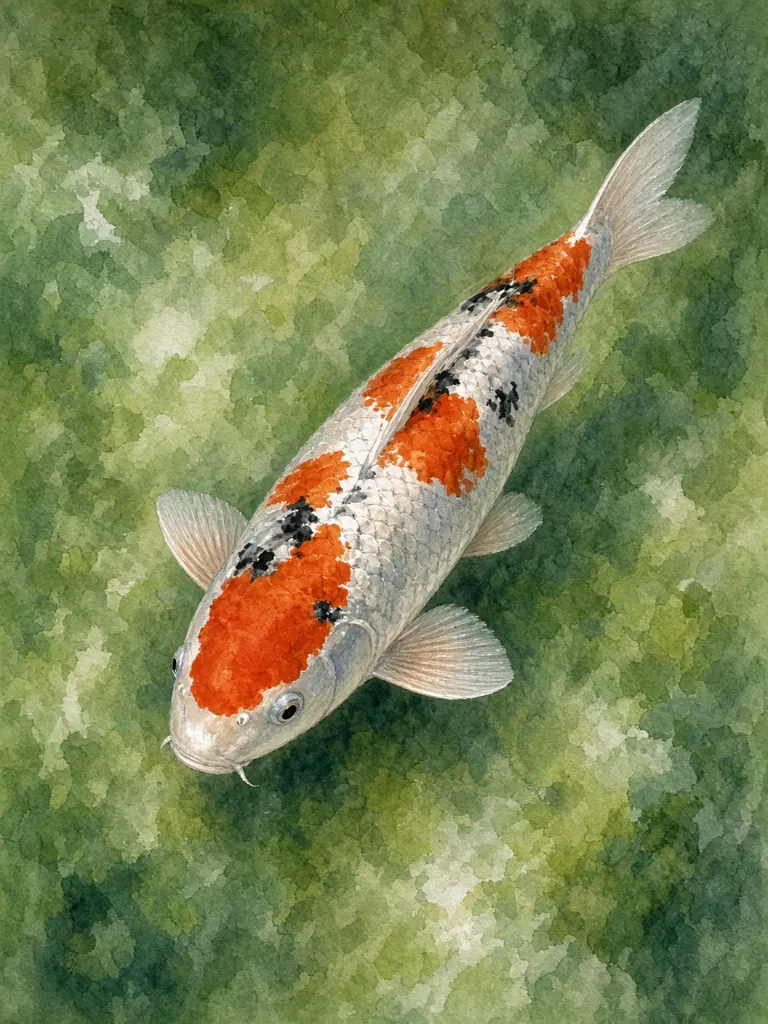
Sub-types and scale forms
A scaleless (Doitsu) form of Yamato Nishiki exists. The JNPA describes Doitsu-yamatonishiki as having almost no scales over the whole body, with the skin exposed, the whole body shining, and the appearance characteristics of Taisho-sanshoku; it notes this form is also called Heisei-nishiki in Japan.[5] Kodama Koi Farm likewise states that Heisei Nishiki is the Doitsu version of Yamato Nishiki, summarizing it as a "Doitsu Metallic Sanke," and recalls that the Doitsu form rose in popularity after it appeared, with the dealer's own commentary noting a preference for the look of the leather-skinned Doitsu body over the scaled form because, in the writer's opinion, the sumi (black) on scaled Yamato Nishiki tends to appear weaker against the metallic ground.[1]Classification at shows
At ZNA-affiliated shows, Yamato Nishiki is classed within category 12, Hikari Moyomono, alongside varieties such as Hariwake, Kikusui, Platinum Kohaku, Kinsui, Ginsui and Kujaku, according to the 2021 ZNA classification used for the NMZNA America Koi Show.[4] The ZNA's own variety listing similarly places Yamato Nishiki under Hikari-moyomono, distinguishing it from the Utsuri family and from plain-bodied metallics.[2] The JNPA's Hikari-moyo variety group covers the same metallic-and-patterned koi, including Yamatonishiki and its Doitsu form.[5]How it differs from similar varieties
Yamato Nishiki is distinguished from non-metallic Taisho Sanshoku (Sanke) by its overall metallic shine; the JNPA states it "has the appearance characteristics of Taisho-sanshoku, and the whole body shines brightly," implying the pattern logic is shared with Sanke but the ground is metallic rather than matte.[5] It is also distinct from other Hikari-moyomono varieties such as Sakura Ogon (a metallic Kohaku-patterned koi, also called Platinum Kohaku) and Hariwake-ogon (gold-and-silver patterned on a white body), both of which lack the black sumi markings that define Sanke-derived varieties like Yamato Nishiki.[5][3]Keeping notes
Kodama Koi Farm notes that the Doitsu form of this lineage, like other Doitsu koi, has fewer scales and can be more susceptible to injury and infection, and recommends regular inspection for signs of disease or parasites, clean filtered water, a stable temperature range, and monitored pH as general Doitsu-keeping practice.[1]Images
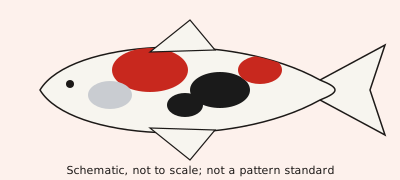
Common questions
What is Yamato Nishiki?
What is the difference between Yamato Nishiki and Heisei Nishiki?
How is Yamato Nishiki classified at shows?
Under the 2021 ZNA classification it sits in the Hikari Moyomono category alongside Hariwake, Kikusui and Kujaku.[4]
What was Yamato Nishiki previously called?
According to the AKJA glossary, the variety was previously known as Koshi-nishiki, said to result from a cross between an Ogon and a Sanke.[3]
Related koi topics
References
- ^ Doitsu Variety - The beauty of Scaleless Koi, Unique Koi Varieties. Kodama Koi Farm (koi dealer). kodamakoifarm.com/doitsu-variety-beauty-no-scales/. Retrieved November 2026.
- ^ HIKARI-MOYOMONO | Zen Nippon Airinkai. Zen Nippon Airinkai. zna.jp/en/keep-nishikigoi/varieties-of-nishikigoi/hikari-moyomono/. Retrieved November 2026.
- ^ Glossary – American Koi Judges Association (AKJA). American Koi Judges Association. akjajudges.com/glossary/. Retrieved November 2026.
- ^ Koi classification (ZNA 2021), NMZNA 2026 show documents. nmzna.net. nmzna.net/2026%20Show%20Docs/NMZNA%202026%20Koi%20Classification%20…. Retrieved November 2026.
- ^ Hikari-moyo - Variety - All Japan Nishikigoi Promotion Association. All Japan Nishikigoi Promotion Association. jnpa.info/en/nishikigoi/varieties/type/hikari-moyo/. Retrieved November 2026.
- ^ JAS 0020 Nishikigoi. Vocabulary (MAFF) — Ministry of Agriculture, Forestry and Fisheries (Japan). maff.go.jp/j/jas/jas_standard/attach/pdf/index-536.pdf. Retrieved November 2026.