
Kikusui
Key facts: Kikusui (菊水) is a metallic, doitsu-scaled koi with almost no scales on its body and a red pattern resembling a Kohaku (紅白), placing it within the Hikari-moyomono (光り模様) classification[1][2].
Colors:
Kikusui is described by the All Japan Nishikigoi Promotion Association (JNPA) as having almost no scales across the whole body, with the skin exposed, a brightly shining whole body, and the appearance characteristics of Kohaku[1]. The American Koi Judges Association (AKJA) similarly defines it as “basically a doitsu platinum Kohaku,” placing it in the Hikari Moyomono group[5].Zen Nippon Airinkai (ZNA) lists Kikusui among the varieties within its Hikari-moyomono class, a group defined as metallic-bodied koi with two or more colors, excluding the Utsuri family[2].- hi (red)
- shiroji (white ground)
- gin (silver)
Name and classification
Kikusui appears as a named variety within the Hikari-moyo (光り模様) group in JNPA's variety listing, alongside Sakura-ogon, Hariwake-ogon, Yamatonishiki and their doitsu forms[1]. ZNA's classification places Kikusui within its Hikari Moyomono class together with Hariwake, Platinum Kohaku, Yamato Nishiki, Kinsui, Ginsui and Kujaku varieties[2][4]. For a broader view of the parent group, see Hikari-moyomono.Judging points
Appearance and the JAS standard
The Japanese Agricultural Standard JAS 0020 for Nishikigoi vocabulary, issued by the Ministry of Agriculture, Forestry and Fisheries, lists Kikusui's photo as a reference example under the category “hikari-moyo” (光り模様), defined generally as koi that are not on a black ground, have an imprinted pattern, and whose whole body shines[3]. JNPA's description aligns with this: Kikusui has almost no scales across the body, the skin is exposed, the whole body shines brightly, and it has the appearance characteristics of Kohaku[1]. AKJA likewise summarizes Kikusui (which it also spells “Kikisui”) as “basically a doitsu platinum Kohaku” within Hikari Moyomono[5].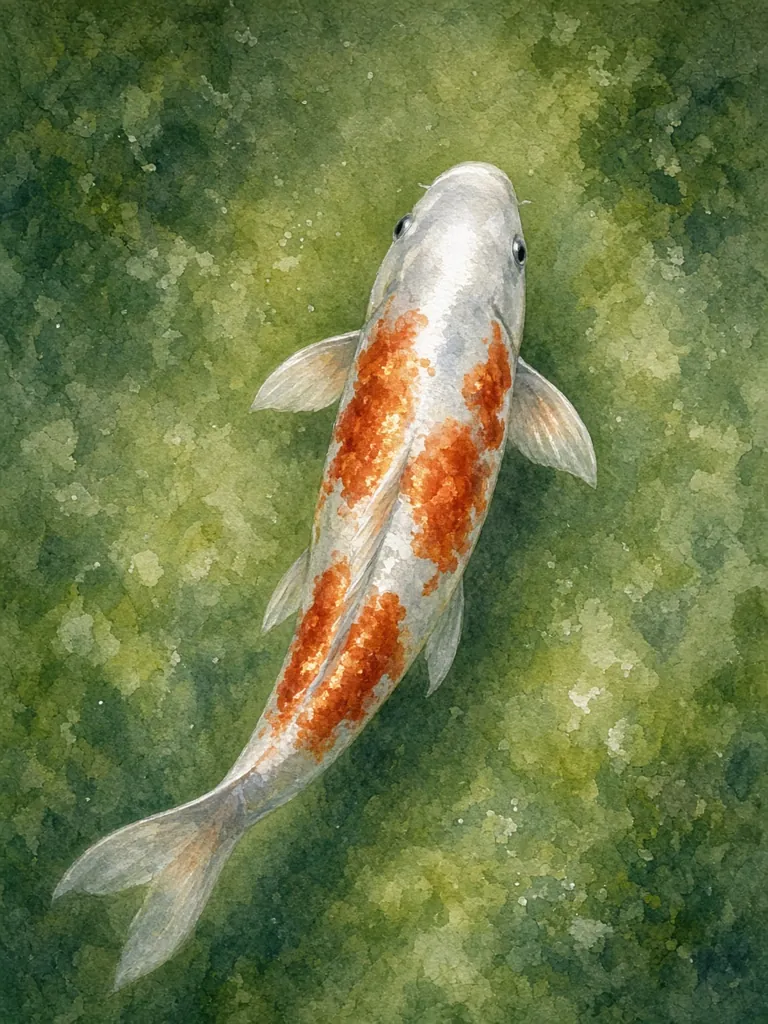
Scale type: doitsu and exposed skin
Kikusui is consistently described as a doitsu-type koi, meaning it carries almost no scales over the body with the skin exposed, according to JNPA[1]. The JAS standard's general entry for doitsugoi (ドイツ鯉) defines the type as koi with almost no scales across the body and exposed skin, noting the doitsu trait originated from German food carp imported to Japan and later crossed with various nishikigoi varieties, strongly transmitting the scaleless appearance to offspring[3]. See Doitsugoi (Doitsu koi) for more on this scale form.Related varieties within Hikari-moyomono
JNPA lists several related Hikari-moyo varieties alongside Kikusui, including Sakura-ogon (also called Platinum-kohaku), Hariwake-ogon, Doitsu-hariwake-ogon, Yamatonishiki and Doitsu-yamatonishiki (also called Heisei-nishiki)[1]. ZNA's list of Hikari-moyomono members additionally includes Kinsui, Ginsui, metallic Shusui, Sho-chiku-bai Kujaku, metallic Ai Goromo, metallic Kanoko Kohaku, Gin Bekko, Tora Ogon and various Hariwake forms[2]. Related pages include Hariwake, Yamato Nishiki, Kohaku, and Platinum Ogon.Distinguishing Kikusui from similar varieties
Kikusui is distinguished from a standard Platinum Kohaku primarily by its doitsu scale pattern: AKJA defines Platinum Kohaku as “a metallic white Koi with an overlaying hi pattern,” also known as Kin-fuji, without specifying doitsu scaling, whereas Kikusui (“Kikisui”) is explicitly called “basically a doitsu platinum Kohaku”[5]. It is also distinct from the related Kikokuryu and Beni Kikokuryu variety, which AKJA notes was developed by crossing a Kumonryu with a Kikisui, producing a metallic koi retaining many Kumonryu characteristics and placed in the Kawarimono class, though this classification may change[5]. For comparison with other metallic doitsu-patterned koi, see Hariwake and Kujaku.Classification at shows
At the ZNA International Koi Show, Kikusui is placed in Class 12, Hikari Moyomono, alongside Hariwake, Doitsu Hariwake, Platinum Kohaku, Yamato Nishiki, Kinsui, Ginsui, Kujaku and related varieties[4]. This classification can be adjusted by individual districts or chapters for local shows[4]. See how koi varieties are classified and how koi are judged for further context.Images
Common questions
What is a Kikusui koi?
Is Kikusui the same as Platinum Kohaku?
Not exactly: AKJA defines Platinum Kohaku as a metallic white koi with an overlaying hi pattern, while Kikusui is described as “basically a doitsu platinum Kohaku,” distinguished by its doitsu (largely scaleless) body[5].
What show class is Kikusui judged in?
How is Kikusui related to Kikokuryu?
According to AKJA, the Kikokuryu was developed by crossing a Kumonryu with a Kikisui (Kikusui), producing a metallic koi that retains many Kumonryu traits[5].
Related koi topics
References
- ^ Hikari-moyo - Variety - All Japan Nishikigoi Promotion Association. All Japan Nishikigoi Promotion Association. jnpa.info/en/nishikigoi/varieties/type/hikari-moyo/. Retrieved November 2026.
- ^ HIKARI-MOYOMONO | Zen Nippon Airinkai. Zen Nippon Airinkai. zna.jp/en/keep-nishikigoi/varieties-of-nishikigoi/hikari-moyomono/. Retrieved November 2026.
- ^ JAS 0020 Nishikigoi. Vocabulary (MAFF) — Ministry of Agriculture, Forestry and Fisheries (Japan). maff.go.jp/j/jas/jas_standard/attach/pdf/index-536.pdf. Retrieved November 2026.
- ^ Koi classification (ZNA 2021), NMZNA 2026 show documents. nmzna.net. nmzna.net/2026%20Show%20Docs/NMZNA%202026%20Koi%20Classification%20…. Retrieved November 2026.
- ^ Glossary – American Koi Judges Association (AKJA). American Koi Judges Association. akjajudges.com/glossary/. Retrieved November 2026.